




CBTA – Competency Based Training and Assessment has transformed the way training is delivered within aviation. Instead of pilots being marked on individual flight tasks, instructors mark pilots on how well they handle complex situations using set behavioral competencies. A proper recording system is needed in the aviation learning system to link the completion of theoretical courses to the recording of marks on tablets during the offline simulator.
What is Competency Based Training and Assessment?
CBTA Competency Based Training and Assessment has changed how training is delivered within aviation. Traditionally training would be task based to assess whether pilots can complete certain tasks such as steep turns and engine failures at V1. Pilots would be given a pass/fail grade depending on how well they completed these tasks. This does not show if the pilot is making good decisions and being a good leader under pressure.
The CBTA methodology looks at the underlying behaviours of the pilot according to the framework provided in ICAO Doc 9868. From this the examiner will be able to assess the pilots’ communication, workload and situational awareness during the engine failure. This will produce a safer and more resilient flight crew.
To ensure an effective tracking system is in place a good software package is required. Tracking these complex competencies cannot be done using basic paper kneeboards or excel sheets. The training department will need to have a system in place that will allow them to link the ground school theory to the competency grading matrices.
9 ICAO competencies Explainer:
Training departments have to identify how they assess the nine competencies identified by ICAO. All scenarios in the simulator and line checks have to assess the competency of pilots.
- Knowledge Application – understanding how to apply procedures and aircraft systems.
- Procedures Application – Applying procedures correctly and using checklists.
- Communication – Communicate clearly and accurately.
- Autopilot – Managing the autopilot systems.
- Manual flight – Managing the aircraft manually.
- Leadership – Creating a team orientated and communicative environment.
- Decision Making – Be able to identify risks and make the most safe decision.
- Situational Awareness – Know the situation the aircraft is in and know what will happen next.
- Task prioritisation – Know to prioritise your tasks.
These are assessed by the instructors looking for certain Observable Behaviours (OB). For instance, if an instructor is marking Communication, an OB could be ‘Pilot responds to clearances from ATC clearly and quickly’.
Why legacy spreadsheets can’t help with CBTA
If your flight department is using a manual spreadsheet system, it is impossible to move to a CBTA format. Corporate LMS systems are not capable of tracking complex observable behaviors or creating a full picture of competency. Only linear videos and multiple-choice quizzes can be tracked.
Trying to manage CBTA using paper forms causes massive issues. Training Coordinators will waste hours entering scores manually into Excel. This causes huge errors in your compliance data. Paper forms also cannot create any data analytics.
Without a central database, you will struggle to show FAA/EASA inspectors that your training is improving pilot performance. You will need an aviation tracking management system that can track digital grading by instructors and automatically update expiry dates.
Four steps to Competency Tracking
You don’t have to stop flying to implement CBTA. The following steps will help you tie your online ground school training to competency.
1. Link your LMS theory to your TMS competencies
Every competency starts with a pilot’s theoretical knowledge. Make sure your e-learning modules connect to your class booking software. Ensuring your pilot gets automatic access to book a simulator session once they complete an online aircraft system module.
2. Create digital O.B. Matrices
Replace your paper based checkride forms with digital matrices. Create a list of observable behaviors for each ICAO core competency. When examining a simulator scenario, your examiner should be using digital rubrics to mark their candidates.
3. Offline iPad marking
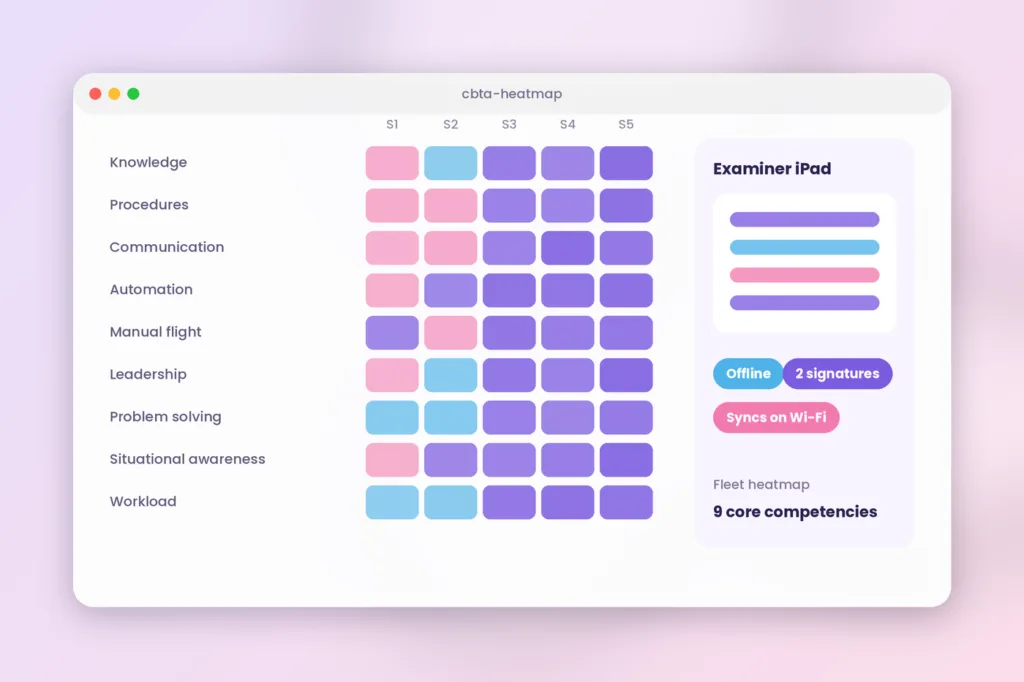
With little reliable Wi-Fi access in concrete simulators, it is vital that your training software contains a feature to allow instructors to download marking sheets on their iPad prior to the session. This also allows instructors to mark observed behaviours and digitally sign. Once the tablet is back online the signed sheets will automatically upload.
4. Data Analysis – Fleet Wide Competency Heatmap
The end goal of tracking CBTA’s is data analysis. Instructors can submit their digital marking sheets which are then collated into Fleet Wide Heatmaps. This allows the Chief Flight Instructors to identify any systemic issues and make proactive changes to recurrent training scenarios.
How EASA Area 100 KSA and Dangerous Goods require you to use CBTA
Global regulatory bodies are pushing operators to move to CBTA. Not only is it now recommended for elite flight decks, but regulators require you to track competencies within your flight schools, cabin crew and ground handling teams.
EASA regulations require Approved Training Organisations ATO to follow the Area 100 KSA framework. This has forced flight schools to track cadets’ collaborative and communication skills. You must track the KSA throughout their ab-initio training.
EASA and ICAO also require Dangerous Goods (DGR) training to be delivered using CBTA. Training organisations must use an aviation LMS system to ensure that DGR theory is linked to practical assessments. You must be able to show regulators that your ground staff are truly competent with hazardous materials
Improves Instructor Standardization
When marking pilots on paper marking sheets, there will be subjective bias. Using digital CBTA tracking means that the marking can only be done based on specific observable behaviors, removing any bias and providing a fair training environment. All of your departments will be working to the exact same standard.
FAQs
1. What is CBTA?
CBTA stands for Competency Based Training and Assessment. It is a modern training methodology used within aviation that is endorsed by both ICAO and EASA. The training methodology focuses on training pilots to develop specific competencies.
2. What are the 9 ICAO competencies?
Application of Knowledge, Application of Procedures, Communication, Aeroplane Flight Path Management (Automation), Aeroplane Flight Path Management (Manual), Leadership and Teamwork, Problem Solving and Decision Making, Situational Awareness and Workload Management. These are the 9 competencies that have been identified by ICAO for pilots. They are the basis of tracking within the CBTA training methodology.
3. Why is CBTA not easily tracked using a standard corporate LMS?
A generic Learning Management System will only provide tracking for linear courses and multiple choice quiz scores. To track CBTA it requires a training management system that can track complex observable behaviours across multiple simulator sessions, marking by instructors using offline tablets and heatmaps showing pilot competency.
4. What is Evidence Based Training (EBT)?
Evidence-Based Training is a data driven training programme that uses CBTA to show how pilots are assessed on their core competencies. EBT uses flight data to show what scenarios pilots should be trained on during their recurrent simulator sessions.
5. Does EASA require a Competency Based Training and Assessment approach?
Yes! EASA and ICAO require flight crew, cabin crew and ground handling personnel to receive dangerous goods training using a Competency-Based Training and Assessment approach. Training providers are required to use an aviation LMS to ensure the dangerous goods theory is directly linked to practical assessments and expiry dates.
6. Can instructors mark CBTA’s using the simulator?
Yes! Using a premium Aviation Training Management System, instructors can download the CBTA marking matrix onto their iPad or Electronic Flight Bag. Examiners can mark the practical behaviour and digitally signoff using the simulator bay without any internet connection. Once back on Wi-Fi the data will automatically upload.
Unify your Ground School & Competency grading
Review your current grading system for simulator sessions and line checks. If you are still using paper forms for your examiners to complete competency checks, then you are losing out on crucial competency data. See how much time your coordinators are spending manually entering paper grades into an Excel spreadsheet to track expiry dates.
If you’re ready to implement a real CBTA program, SimpliTrain can help! Unify your online ground school with offline iPad grading matrices. Use our Aviation Training Management System page to see how airlines and ATOs are using a fully auditable CBTA tracking system or book a SimpliTrain Demo.