




An aviation Learning Management System offers online ground school courses, records simulator sign offs and qualification expiries, in a single database. However, corporate portals are unable to host generic training, whereas aviation software will be built around the requirements of FAA, EASA and ICAO regulations, in relation to flight, cabin and technical operations. In 2026, airlines, MROs and training organisations require an e-learning system able to bring ground school courses, simulators and 90-60-30 day expiry alerts together, in one system.
What is an aviation LMS and why do generic corporate portals fail?
A learning management system in the aviation sector is used for managing the full lifecycle of an individual’s aviation theory, competency grading, and regulation recertification, and much more. A portal solution used for online ground school can integrate directly with flight checks, maintenance task authorizations, and audit-ready crew records.
Generic corporate LMS software such as Cornerstone, Litmos or TalentLMS is unsuitable for aviation because these products were designed to onboard office HR staff. According to the September 2026 study by FirstHR, enterprise LMS portals do not have the logic for FAA ground training, certificate expiry algorithms or even simulator scheduling engines. Such portals will let you know if the pilot watched the video about winter operations, but will not recognize if they fulfilled 90-day landing recency requirements or base-month grace periods for expired ratings.
By implementing enterprise level LMS or WMS software, training coordinators will be required to create shadow-spreadsheets tracking certifications and simulator sessions in line with operational needs. This administrative burden is functionally impossible to achieve through the use of generic corporate LMS platforms. The ability to produce accurate records about expired medicals or landing-recency requirements may lead to operational certificate suspension in the event of an unannounced regulatory audit.
Aviation LMS vs. aviation TMS: why you need both in one platform
An aviation LMS is where digital learning content lives, whereas an aviation Training Management System (TMS) handles the operational logistics of the classroom, simulator, instructors, and expiry dates. Usually, the approach of a majority of operators is wrong in purchasing an e-learning portal first and then trying to integrate a separate scheduling tool. Having your training management and learning system exist independently of one another will require your team to spend additional time performing manual operations of transferring completion records from one system to another.
Instead, think of a TMS and LMS working together within a single platform. As your pilot takes the online aircraft systems module in the LMS, their passage unlocks the ability to reserve a full-flight simulator session within the TMS. When their instructor reviews the tablet on the simulator, it renews the six-month expiry in their training records. View the comparison table below how a unified aviation LMS and TMS solution differs from the standalone corporate portals and CBT libraries.
| Capability | Generic Corporate LMS | Standalone Aviation CBT Library | Unified Aviation LMS + TMS (SimpliTrain) |
|---|---|---|---|
| Online Ground School (SCORM / Video) | Supported | Pre-built aircraft slide decks | Full custom SCORM, video, & exam delivery |
| Simulator & Instructor Scheduling | Not supported | Not supported | Built-in conflict-free resource scheduler |
| FAA Base-Month & EASA Grace Logic | Simple completion date-math only | Basic course expiry dates | Full base-month & 90-day carry-forward engine |
| MRO OJT Task Card Sign offs | Not supported | Theoretical modules only | Digital task sign offs & dual signatures |
| Typical Pricing Structure | Per active learner / employee | Per pilot / per course module | Flat per-admin pricing ($60/mo/admin) |
What airlines, MROs, and training organisations each need in 2026?
Airlines, maintenance repair stations, and flight academies are subject to different regulatory bodies, while frequently using the same software. Your aviation LMS must be able to tailor its processes to the specific compliance requirements of each department.
Airlines (FAA Part 121/135 and EASA Part-ORO)
Carriers are defined by their intense recurrent training mandates, across the flight deck, cabin, and dispatch. Under the 2026 EASA Part-ORO (ORO.FC.230) regulations, commercial pilots must complete Operator Proficiency Checks every six months and Licence Proficiency Checks per year. Cabin attendants meanwhile must complete annual Safety and Emergency Procedures (SEP) modules and 24 month renewals on dangerous goods under the 2026 IATA Dangerous Goods Regulations (DGR). To keep thousands of crew members legal while avoiding costly grounding, airlines will require 3 key LMS capabilities in 2026:
- Offline EFB and iPad course delivery: Crew need to be able to download recurrent ground school modules prior to a trip and complete the course offline in the hotel, syncing results on return to online
- CBTA and EBT grading matrices: Examiners require a digital form that records behavioural competency scores during simulator and line checks rather than a binary pass/fail system
- Automated base-month expiry tracking: The platform needs to connect online ground school and simulator checks to a live aviation training tracking software engine, which calculates grace windows
MROs and repair stations (FAA Part 145 and EASA Part-145/147)
In aviation, MRO defines the facilities of Maintenance, Repair, and Overhaul, who are responsible for inspections and service and airworthiness certifications. Generic LMS roundups rarely consider MROs – but maintenance organisations face some of the strictest documentary audits in the industry. Under 2026 rules in 14 CFR § 145.163 (eCFR), certificated repair stations must retain records of initial, recurrent, human factors, and on-the-job training for two years.
Suppose your operation also has an EASA Part-147 approved maintenance training school. In that case, the software requirements grow exponentially more stringent. Under 2026 EASA continuing airworthiness rules, an LMS used by an MRO or Part-147 organisation would have to provide:
- Digital OJT task card sign offs: Senior engineers require tablet based check lists to be used on the hangar floor, to verify and sign off practical maintenance tasks performed by junior technicians.
- Strict seat-time and exam proctoring: EASA Part-147 distance learning requires the tracking of exact minimum hours of study and a mandatory 75% pass mark on exams, with no penalty marking.
- Component and aircraft authorisation linking: The completion of a B1 or B2 type course or continuation module training must immediately update a technician’s internal certifying staff authorisation matrix.
Training organisations and ATOs (FAA Part 141/142 and EASA Part-ORA)
An ATO (approved training organisation/certificated flight school) offers ab-initio cadet pilot courses, commercial type-rating programs and external airline cohorts for training, as opposed to an internal airline training department. As well as managing complex curriculum progression sequences, commercial ATOs also have to invoice B2B clients, so a training LMS must be able to simultaneously handle both student progression and commercial aspects of running a flight school:
- Sequential syllabus prerequisite locks: if a cadet has yet to complete their high-altitude aerodynamics exam in the LMS, they should be prevented from booking the corresponding flight lesson/simulator session.
- Tamper-proof student progression files: all ground exam results and stage checks must be automatically fed to auditable student records which are capable of retaining records for FAA one-year and EASA three-year requirements.
- Multi-tenant B2B client portals: if an airline sponsors a cohort of 30 cadets at your flight school, they would need a portal to view the cohort’s progress, attendance and invoicing details.
How to set up a compliant aviation learning workflow in 5 steps
You do not need to halt your monthly line operations to consolidate your aviation training processes from disparate spreadsheet and YouTube-style portals into a single pane of glass learning ecosystem. Here is our suggested 5-step workflow to help you tie up your online courses, checkride progress and compliance records into a single coherent system:
- Map the role specific learning pathways to the authority rules: Slice your learner population along their line of work (Captain, First Officer, Cabin Crew, Part-66 B1/B2 Engineer, Ramp Agent) and populate auto-enrolled curricula according to their initial and recurrent training programs.
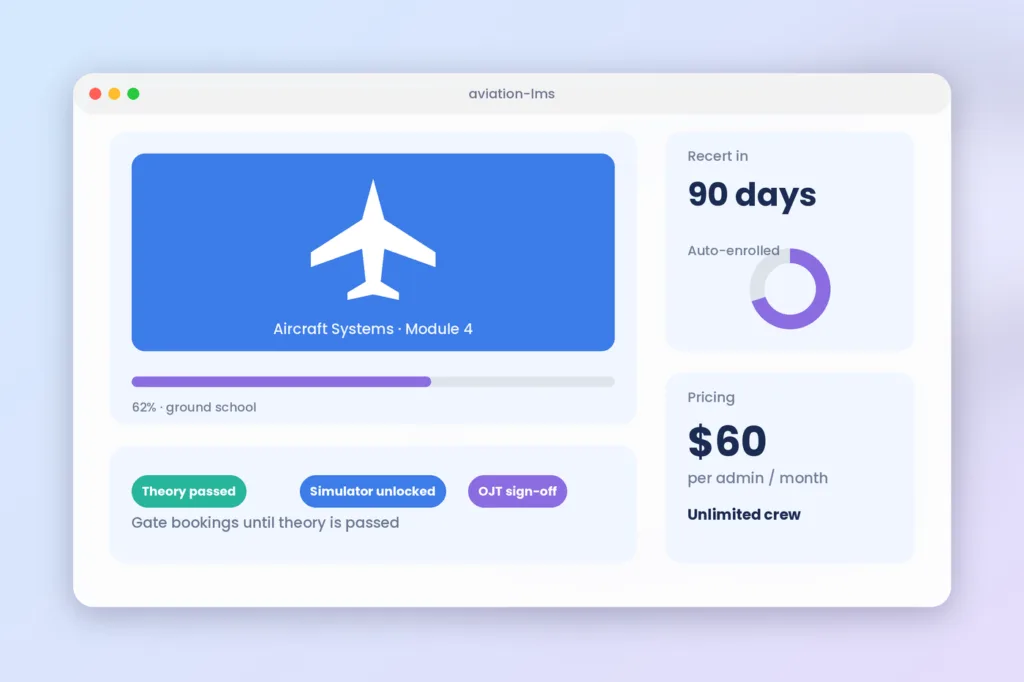
- Gate simulator and OJT bookings blocked until theory passed: Tie your online SCORM modules to your training scheduling software to prohibit trainees from booking a simulator bay or instructor time until they pass the pre-course ground exams.
- iPad grading with dual electronic signatures: Eliminate the paper kneeboards and hangar clipboards by replacing them with tablet based mobile grading systems having 2026 FAA Advisory Circular 120-78B compliant, non-tamper electronic signatures plus timestamps.
- 90-60-30 day recertification automation: Configure your expiry engine to automatically enroll crews in their recurrent online CBT course 90 days prior to their expiry date while retaining the original base month of their qualification.
- 60 second regulatory audit exports: Configure standard report templates to allow CFOIs and Quality Managers to export a chronological training/certificate history for any employee with a single mouse-click.
How to avoid the per-learner pricing trap when choosing an aviation LMS?
Most traditional corporate LMS and aviation training platforms charge a monthly subscription based on the number of active learners or staff members accounted for in the database. For seasonal airlines, ground handlers and commercial aviation training organizations, this can be a tremendous burden.
Consider this: a regional airline or charter company may only employ 300 seasonal cabin crew and ramp staff at the busiest time of the year. At the same time, an MRO or contract ATO might train 1,500 technicians from different airlines that only use the LMS for a two-week training program once a year.
This means that organizations that use a per-learner billing model will pay thousands of dollars for the vast amounts of idle aviation training records. There is no need to overbill thousands of inactive seasonal aviation training staff. By switching to a per-administrator billing plan, organizations can ensure they only pay for the actual back-office support personnel.
With SimpliTrain, you can start with a flat $60 monthly subscription per-administrator and only pay for the training coordinators and managers on staff. No matter if you have 200 internal pilots or 3,000 external technicians from MROs on training, your accounting department will see a predictable software expense. To learn more about different aviation training software licensing models, download our Buyers’ Guide for Training Management Software 2026.
FAQs
1. What is an aviation LMS and how does it work?
An aviation LMS is a learning management system which delivers online ground school and tracks simulator and maintenance tests, while also reminding users when a qualification is due for renewal. Aviation LMS’s are different to regular corporate portals as they enforce FAA, EASA, and ICAO regulation for flight crew, cabin crew, and MRO technicians within one centralised auditable database.
2. What is the difference between an aviation LMS and an aviation TMS?
An aviation LMS provides digital e-learning modules and SCORM ground school courses, as well as online testing and competency based training. An aviation Training Management System (TMS) manages physical training and instructor led simulator sessions and logs. By unifying these two training channels within one software, it breaks down the barriers of different departments using excel spreadsheets.
3. What do MRO and ATO mean in aviation training?
Within the aviation industry, MRO defines the Maintenance, Repair, Overhaul facilities, and ATO defines Approved Training Organisation. An MRO requires an LMS to log Part 145 and Part-147 FAA and EASA technical training and log required tasks performed. An ATO needs an LMS to manage sequential syllabus locking, student tracking and manage simulator training resource scheduling.
4. What do EASA Part-147 approved training organisations require in an LMS?
An EASA Part-147 approved training organisation is a maintenance training school which have been authorised to provide theoretical and practical aircraft engineering course and examinations. Part-147 approved schools are required to impose seat time restrictions to training courses, grade examinations with no less than 75% pass marks and retain records for three years.
5. Can flight and cabin crew complete aviation LMS courses offline?
Modern aviation LMS platforms enable flight crew, cabin crew and maintenance engineers to download SCORM lessons, and grading forms directly on iPads or Electronic Flight Bags. Flight crews can complete recurrent training modules in the hangar or away from the aircraft with the LMS software recording timestamps and electronic signatures when back online.
6. How much does an aviation LMS cost in 2026?
Depending on the supplier aviation LMS platforms can charge between $49 to $60 per month for entry level systems or per active personnel for legacy enterprise systems. SimpliTrain’s innovative per-admin pricing model charges $60 per admin, per month enabling airlines, MRO and ATO training departments to train thousands of crew members without incurring extreme per-user software costs.
Unify your aviation LMS and training operations in one place
Take stock of your current training workflow and identify where your online ground school, simulator schedules, and MRO task sign offs currently exist in disconnected silos. Calculate the man-hours your coordinators spend manually entering quiz results into Excel expiry trackers. Then determine what your current LMS is charging you for inactive/seasonal crew profiles.
If you’re looking to consolidate online learning, simulator resource scheduling and 90-60-30 day compliance tracking into one platform, we built SimpliTrain for your operation. Explore our Aviation Training Management System page to see how real airlines and MROs run audit-ready training programs or book a SimpliTrain Demo today.