




Corporate clients who pay thousands of dollars for B2B training programs expect a standard of performance than a simple handout spreadsheet with attendance lists. Corporate clients want to see the business value of the training measured by skills retained the time needed to become productive and actual changes, in the workplace. To keep operations staff from drowning in report formatting commercial training organizations should invest in automated dashboards.
Why don’t basic attendance sheets work for B2B training buyers?
The Modern B2B buyer demands real-time and personalized data. Spending six figures on enterprise training courses isn’t justified on providing a corporate client with a CSV spreadsheet of attendance logs. When it comes to getting a contract for training services people in charge of learning and development, in companies look for success measures. These metrics help them see if the training helped skill gaps and boosted employee productivity.
According to the 2026 State of the Connected Customer study, by Salesforce 66% of B2B buyers anticipate that purchasing processes will feature the data personalization and transparency that they see in consumer products. A simple email with a PDF file attached informing the client of successful completions is not an option anymore. Modern corporations want to access a portal, track the progress of their cohorts, and be able to export the data themselves.
Furthermore, simple attendance-keeping does not reflect the primary inquiry of corporate purchasers: Did the training have an impact? According to a 2025 workplace learning ROI study conducted by the Association for Talent Development (ATD) organizations that measure job impact and on-the-job application renew the training budget two times faster than those that track merely attendance. To sustain enterprise accounts, training organizations must provide the indicators that purchasing executives use to justify the training spend.
What are the four key reporting metrics that corporate buyers are looking for?
To transform a transactional vendor into a strategic partner, your reports must tie into the buyer’s internal objectives. Instead of generic summaries, zero in on the four key performance indicators that enterprise buyers will use to assess your product.
Tracking how many people finish the training and where learners stop participating
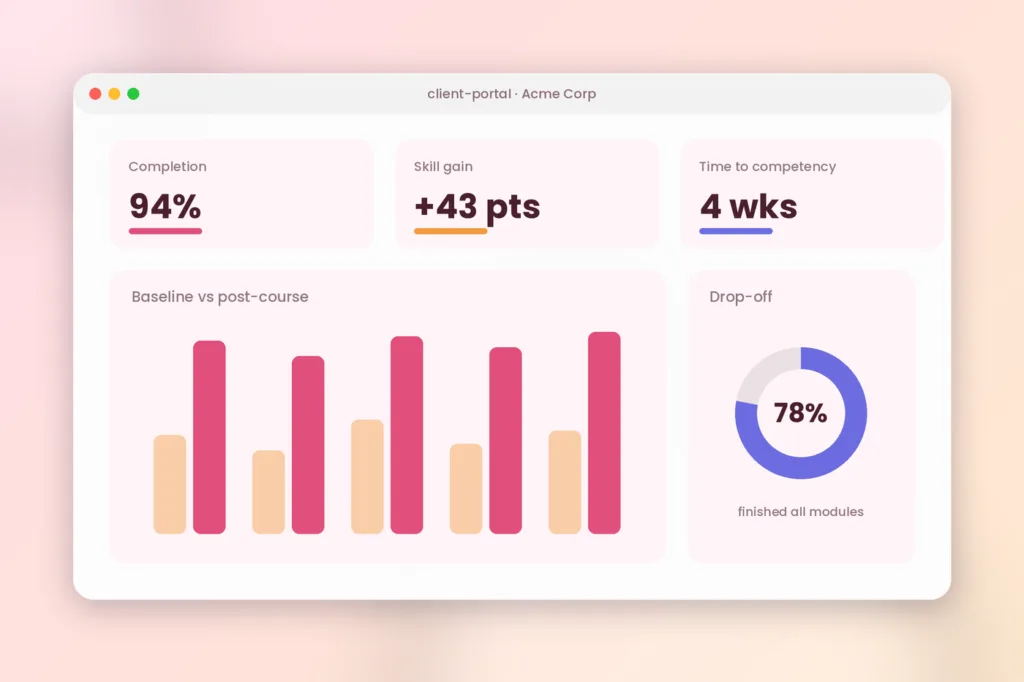
The first two reports that enterprise-level buyers want to see are the completion reports for employees who have taken the assigned modules and passed the final compliance checks. It is the most basic of the reports but is crucial for enterprise clients as they operate in heavily regulated industries (finance, healthcare, manufacturing, etc.).
The other metric that a corporate-level buyer will want to see is the percentage of learners who dropped out at any given point in the program. If the enterprise bought 100 seats for a blended program, but 30% of the employees dropped out after half of the course, the corporate trainer will likely want a report showing this information. This way, they can contact these employees and require them to finish the program as there is no point in having unused seats.
Measuring baseline skills against post-course performance
A test score is not a story. To demonstrate that your curriculum is working you need to compare posttraining performance with the baseline that you measured before training. Getting a diagnostic test before the instructorled sessions begin give you a starting point, for each learner.
When you turn over the training report you are able to clearly demonstrate to the client that their group progressed from a 45% baseline competency up to an 88% postcourse mastery level. That is the result that the corporate buyer paid for. Without getting a baseline you would be asking the client to believe that the training succeeded because they gave nice feedback.
Calculating program ROI and business impact
Corporate training ROI measures the money you earn from making employees better compared to how your training program costs. Even if training providers cannot always see a client’s money data you can give them the tools and numbers they need to work it out.
A 2026 workforce development analysis by the Society for Human Resource Management (SHRM) says that good training should cut an employee’s time to competency a lot.
If your onboarding program brings a client’s hires to full production in four weeks instead of eight your report should shout out that faster timeline. Then the client can add their payroll and productivity numbers to that saved time showing the clear money return, on your invoice.
Monitoring on the job behavioral application
The ultimate B2B training buyer expectation is behavioral change in the workplace. Learners quickly forget what they learned in the classroom, unless reinforced. A 2025 impact study by the Training Industry found that impactful reinforcement regimes maintain 70 to 80% retention of the taught material 90 days post-training, as opposed to the industry average of 20% for unreinforced programs.
To track this metric, include 30 day and 60 day post training surveys in your reporting arsenal. Email the attendees’ managers asking whether they have seen any of the new behaviors at work. Aggregating the results of such manager talks will serve as proof of training efficacy to the client, highlighting the training’s ability to cause lasting changes in the workplace.
How does manual reporting drain operational margins?
The manual process of reporting eats away at your profit margin, as it requires hours of unproductive administrative work. Teams that use disparate software to track operations data have to export large amounts of data from their delivery system and perform various transformations on this data to produce reports for each corporate client.
If your training coordinators spend their Friday afternoons scrubbing spreadsheets to make sure that Client A does not see Client B’s employee data, it is a sign that you have wasted resources on low-value tasks. Your coordination team could have been working on more important activities, such as finding new venues or instructors, negotiating favorable pricing for training programs, or planning the training delivery strategy.
Manual data manipulation also creates compliance issues. One wrong move of the mouse in Excel and the privacy of a company may be compromised if the corporate buyer gets another organization’s certification data. By automating the process of creating reports, the business will save not only the expense of unbillable hours but also eliminate the danger of human error.
Comparing reporting delivery methods: static exports vs. live client portals
Modernizing your delivery method is just as vital as evolving the metrics that you track. Delivered data via live portals eclipses time-tested static attachments on any operational front.
| Evaluation Metric | Manual PDF / CSV Exports | Automated Client Dashboards |
|---|---|---|
| Data Recency | Outdated the moment it is exported | Real-time, instant updates |
| Administrative Cost | High unbillable hours per client | Zero marginal cost per report |
| Data Security | High risk of email misdirection | Secure, credentialed login access |
| Client Experience | High friction; requires waiting on vendor | Low friction; 24/7 self serve access |
How do you set up secure, multi-tenant client reporting dashboards?
To create real time dashboards without compromising data privacy, a commercial training provider needs an online training management system based on multi-tenancy. The architecture will let you host several corporate clients in one application and keep their data strictly separated.
An enterprise trainer logging in to your custom client area will see only the records of their learners. They will be able to track the progress of their employees, download certificates, and check the bills without contacting your support team.
It is necessary to analyze your current back-office applications. If you are now considering upgrading your infrastructure to the multi-tenant solution, our Training Management Software Buyer’s Guide 2026 will tell you which requirements to include in your RFP.
FAQs
1. What do B2B training buyers need in a client report?
A good report must show tangible business value and results rather than just hours trained. Always include completion rates, baseline skill improvements, and productivity increases. If you successfully prove the ROI to the client who invested in the service, your corporate training budget will renew.
2. How do training providers measure corporate training ROI?
Calculate ROI by subtracting the cost of a training program from the value of productivity it brings and dividing it by the costs. Providers will measure the improvement by comparing decreased error rates, faster processing speeds, and higher sales results before and after the courses.
3. Why enterprise training clients need real-time reporting?
Enterprise clients need real-time reporting because they’re often large organizations that need to know what’s going on right now instead of having to wait for a week-long manual process of getting a spreadsheet after each course completion. Letting them access the dashboards themselves helps you provide a convenient view of the progress, certifications, and attendance reports for your corporate clients.
4. How do you track completion reporting for B2B courses?
By connecting the registration tools for classes with the main learning database, corporations can automatically report completion data for each participant who finishes a course. This will also help track who is attending the sessions, completing assessments, and determine if there is any employee who hasn’t finished the course.
5. How does client reporting influence training contract renewals?
Proper client reporting has a direct impact on contract renewals because it enables department heads to justify their training budgets. By delivering adequate reporting, the training provider proves they improved employee skills, making their ongoing services a required and appreciated asset rather than an expense.
6. How can I share my training data with multiple corporate clients securely?
Use a training management system that uses multiple tenancy (partitioned data) and permissions to give access to only relevant data. This way, corporate administrators cannot see the data of other companies’ employees, and you won’t have to email CSV files of scores as that would be a security risk.
Next steps for your training client reporting modernization
Audit your current post-training reporting workflow and calculate how many unbillable hours per month your team spends on formatting the information properly. No more sending over PDFs; start adding baseline assessments to your training programs to track the metrics that matter most to your enterprise clients and help them renew their budgets.
If your team currently uses an old system that doesn’t allow for multi-tenant dashboards, it’s time to start looking into new training management software. Check out our Ultimate Guide to Training Management Software for Small Business to get started. Want to see the self serve portals in action? See all of SimpliTrain’s reporting options on the Product Page or set up a SimpliTrain Demo to get started today.