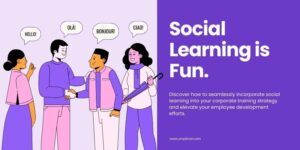
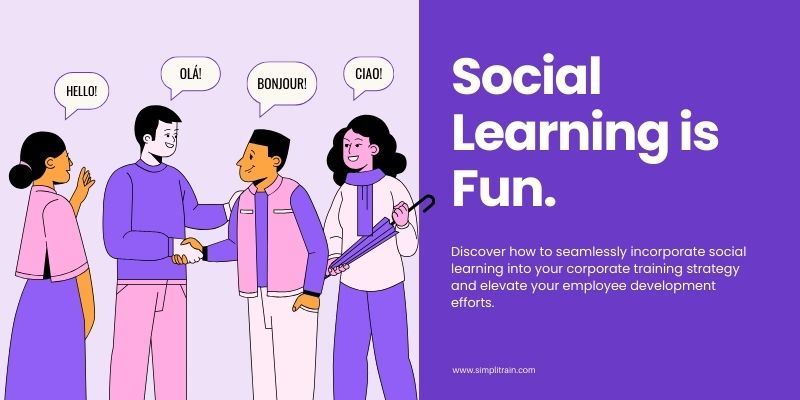





Most corporate training budgets still go toward formal instruction, courses, workshops, certifications, yet a substantial share of how people actually learn to do their jobs happens informally, through the people around them. The 70-20-10 model from the Center for Creative Leadership suggests that roughly 70% of learning comes from on-the-job experience, 20% from developmental relationships and social interaction, and only 10% from formal coursework. Worth noting: the model’s precise ratios are based on retrospective executive interviews from the 1980s rather than controlled research, and some L&D researchers have questioned how rigorously it’s been validated since. Even with that caveat, the underlying insight, that a meaningful share of workplace learning happens socially rather than in a classroom, holds up well, and it’s the reason social learning belongs in a corporate training strategy rather than as an afterthought.
What Is Social Learning in a Corporate Context?
Social learning is the process of learning through observing, discussing with, and getting feedback from others, rather than solely through structured, one-directional instruction. In a corporate setting, this happens through discussion forums, peer reviews, mentoring relationships, collaborative projects, and informal knowledge-sharing between colleagues who’ve solved a similar problem before. It’s not a replacement for formal training, it’s the layer that helps formal training actually stick once someone’s back at their desk applying it.
The Benefits of Integrating Social Learning
Higher engagement and participation. When learners can discuss ideas and ask questions of peers rather than passively consuming content, they’re more actively involved in the material, which tends to improve both retention and how meaningful the learning experience feels.
A more collaborative culture. Encouraging employees to share expertise and support each other’s learning does more than improve individual outcomes, it reinforces team cohesion in a way that isolated, individual course completion never does.
Access to collective knowledge. Every employee brings a different set of experiences. Peer-to-peer learning surfaces insights and shortcuts that no single training module could anticipate, since they come directly from people who’ve encountered the exact problem in your specific organizational context.
Faster feedback loops. Waiting for a scheduled review or a formal Q&A session slows learning down. Social learning tools let employees ask questions and get responses from peers or mentors in real time, which keeps momentum going instead of leaving someone stuck.
A stronger habit of continuous learning. Regular peer interaction around work problems keeps learning active between formal training events, rather than treating training as something that only happens during a scheduled course.
A Real Example: Social Learning at Scale
One SimpliTrain customer case study illustrates what this looks like in practice. A multinational conglomerate with a well-established formal training program still struggled with engagement, uneven knowledge-sharing across locations, and no real-time way for employees to collaborate across geographies. The solution combined discussion forums and groups where employees could ask questions and share insights, real-time collaboration tools including chat, video conferencing, and shared documents, and gamification elements, badges, leaderboards, and peer recognition, to sustain participation over time. The result wasn’t just higher engagement, it was measurable through built-in analytics, giving the organization a way to see which parts of their social learning strategy were actually working and refine the rest.
Social Learning in Regulated and Distributed Industries
Social learning isn’t limited to informal skill-sharing, it has a direct application in regulated and geographically distributed industries too. In banking and financial services, internal forums for peer-to-peer best-practice sharing help institutions keep pace with regulatory changes without waiting for every update to be formalized into a new course. The same principle applies to any organization running training across multiple locations or time zones: a peer conversation in a forum can close a knowledge gap faster than waiting for the next scheduled training cycle.
Social Learning Formats and What They’re Best For
| Format | Best Used For |
|---|---|
| Discussion forums and groups | Sharing knowledge across locations and time zones without waiting for a scheduled session |
| Peer review | Getting feedback on work in progress before it’s finalized or graded formally |
| Gamification (badges, leaderboards) | Sustaining participation over time rather than a one-time engagement spike |
| Real-time chat and video | Fast, informal collaboration for distributed or remote teams |
How to Implement Social Learning in Your Training Strategy
Start with clear objectives. Decide upfront whether the goal is improving engagement, closing specific knowledge gaps, or reducing time spent re-explaining the same issue across teams. The objective shapes which features and formats matter most.
Choose a platform that supports it natively. Look for an LMS or TMS with built-in discussion forums, peer review workflows, gamification, and real-time collaboration, rather than bolting on a separate social tool that lives outside your training records and generates no reportable data.
Build participation into the culture, not just the platform. Recognize and highlight active contributors early on. Adoption tends to stall when a tool is switched on but never actively modeled or encouraged by managers and team leads.
Support the rollout properly. A short walkthrough or onboarding session for the social features removes the awkwardness of a first-time user not knowing where to post a question or how visible their contribution will be.
Monitor, measure, and adjust. Track participation levels and pair them with the metrics that actually matter, not just forum post counts, but whether social learning activity correlates with faster onboarding or better performance outcomes. Use that data to refine what’s working and retire what isn’t.
Peer-generated contributions, forum answers, shared templates, informal tips, are also a form of user-generated content in a learning context, and treating them that way, curating the best ones into more permanent resources, extends their value well beyond the original conversation.
SimpliTrain includes built-in discussion forums, peer review, real-time collaboration, and gamification as native features, so social learning data lives alongside your formal training records instead of in a separate, disconnected tool. Book a demo to see it in action.