




An aviation training programme consists of all approved courses, standards, instructors, training aids, and records that qualify an individual to be regarded as a suitable candidate for hiring in aviation.
To create an aviation training programme that will satisfy the regulators and the operators, start with the certificate requirements. Next, prepare a syllabus for each job and for each aircraft. This manual includes six easy steps.
What is an aviation training program, and what does it include?
The aviation training program is the officially documented process by which an organization qualifies and requalifies its personnel. There are two definitions of this term. The students use the term when referring to school programs such as aviation or maintenance degrees. Training managers use it for the program an operator builds, gets approved and runs. This guide covers the second meaning. If you wish to join, seek a school accredited by your aviation body.
All regulators around the world have called for the same basic concept. As per Annex 6 of ICAO, an Operator should establish a ground and flight training program, approved by the State of the Operator, that ensures all the flight crew is suitably trained. This program should include suitable training facilities along with a suitable instructor to conduct such training on a recurrent basis. (ICAO quick reference guidance on Annex 6).
US regulations have more specifics. 121 Subpart N refers to training program requirements for crewmembers, aircraft dispatchers, and other operations personnel. The certificate holder shall maintain a current curriculum for each model of aircraft, including the authorized training devices. (14 CFR Part 121, Subpart N). Approval is done in stages. First, the certificate holder puts forward the program for approval and then, the FAA examines its effectiveness and notifies of any problems in it.
All sets of regulations make the same demands: a defined program, competent instructors, and evidence that it works. Only the language differs.
What must a program contain?
A program needs eight elements. Each one answers a regulator’s question and an operations question, so write both down.
| Element | What it is | Operations question |
|---|---|---|
| Scope | Roles and aircraft types covered | Who must be trained, and by when? |
| Syllabi | Courses with objectives, content and standards | How long is each course? |
| Training types | Initial, conversion, upgrade, differences, recurrent | Which type does each person need next? |
| Checks | Proficiency checks, line checks, safety equipment checks | Who can sign them off? |
| Devices and facilities | Simulators, classrooms, training aids | When are they free? |
| Instructors and checkers | Qualified, authorized staff | Do we have enough of them? |
| Records | Attendance, results, expiry dates | Who is current today? |
| Review | Effectiveness checks and approved changes | What do we change, and who approves it? |
The rules back this structure. FAA Part 135 requires ground and flight training curricula for initial, transition and upgrade training, among others. Under EU-derived air operations rules, CRM training is integrated into the operator conversion course, and the amount of training depends on the standards of qualification and experience set in the operations manual. Recurrent training adds more. Each flight crew member completes recurrent training and checking for their type, including an operator proficiency check, a line check, emergency and safety equipment training and checking, and CRM training. You can read that text in the UK CAA’s published copy of ORO.FC.230.
The review element is the one teams skip. A stagnant program must be either perfect or unwatched, and the authority will consider it to be the latter.
How do you build one, step by step?
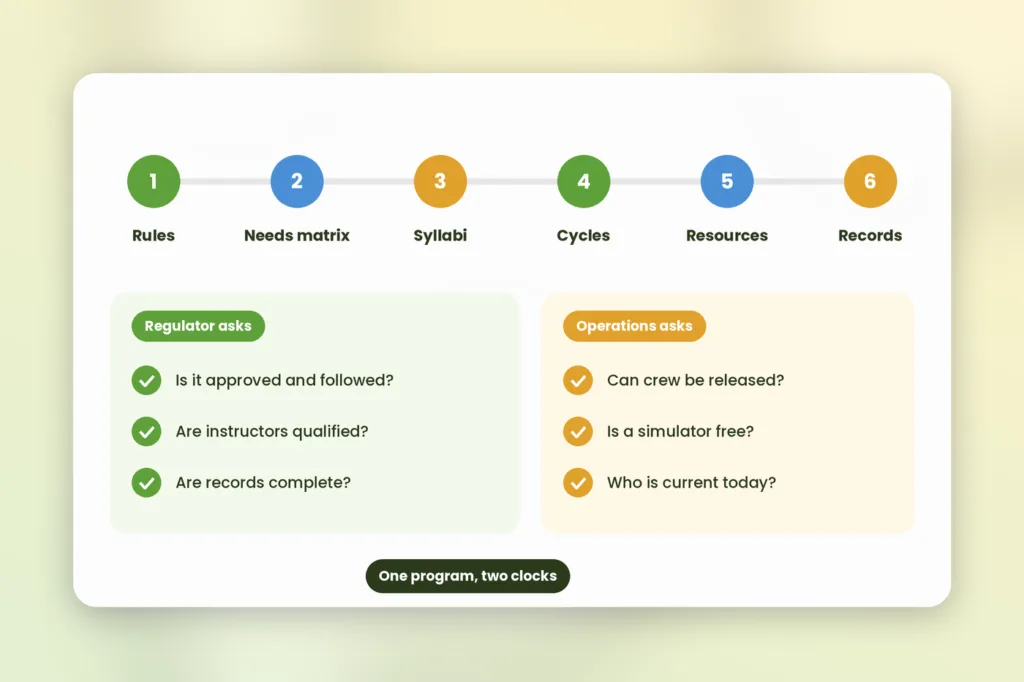
Complete six steps in sequence. Each step will produce a document that you can show to an inspector.
- Map the rules. List your certificate, your authority and every rule set that applies. Note any alternative route. For instance, no individual can be trained through the FAA Advanced Qualification Program until such a program is approved by the FAA. In the EU, operators can use evidence-based training since the regulations were amended according to ICAO Doc 9995. (Regulation (EU) 2020/2036).
- Build a needs matrix. Make a grid of role, aircraft type and training type. A captain on one type, a first officer on two types and a cabin crew member each get their own row.
- Write each syllabus. Stick to the order that the rules specify. The order for conversion is ground training and checks, training on emergency and safety equipment before any flight training in the aircraft, flight training and checks in the aircraft or simulator, followed by line flying and line checks.
- Set recurrent cycles. Give each recurring task a clock of its own: proficiency check, line check, annual emergency procedures, CRM review and DG training. Our own product, SimpliTrain, considers these to be cycles for monitoring and sends automated reminders 90, 60 and 30 days prior to expiration.
- Plan the resources. Match instructors, simulator slots and classrooms to crew release windows. Remember that in EU air operations, training an operator assigns counts as duty, including e-learning, and travel to a simulator at the operator’s request counts as a duty period. The EASA guidance is in its air operations FAQ.
- Record, review, and improve. Maintain records for the length of time specified by your authority. As per the EASA requirements, records of crew training, checking, and qualification shall be maintained for a minimum period of three years, as stated in the ORO.MLR.115.
Attention should be drawn towards instructors. The Halldale report covering Heads of Training meetings in 2024 states that instructor standardization and a training culture was crucial in APATS, with workshops and video evaluations of sessions with assessment of data recommended. Plan time for that purpose.
It is step five when things get tricky in actual practice. Perfect syllabus will not do any good if there is no instructor, no simulator, and no crew available on the same day.
How do regulators and operations see the same program?
Regulators ask whether the program is approved, followed and effective. Operations asks whether the program can run without breaking the schedule. Both questions are fair, and one program must answer both.
| Regulator asks | Operations asks |
|---|---|
| Is the syllabus approved and followed? | Can we release crew without cutting flights? |
| Are instructors and checkers qualified? | Do we have enough of them, and are they free? |
| Are records complete and retained? | Who is current today, and who expires soon? |
| Does the program work? | Can we absorb a hiring wave or a new fleet? |
We suggest a “two-clock rule.” Assign to each task a compliance clock, indicating when it must be completed, and an operations clock, indicating when crew members can be freed up. Then schedule inside the overlap. This is our recommendation, not a regulatory term.
SimpliTrain’s aviation page describes scheduling across bases and fleets, simulator slot allocation, instructor management and classroom capacity planning, with audit reports filterable by crew member, role, aircraft type, base or date. See our training scheduling page, instructor management page and certification management page. Our charter airline case study shows one operator’s view.
Which mistakes should you avoid?
The five errors that lead to most issues include:
- Writing the code only once. Regularly review it based on a fixed schedule and record all changes.
- Using one expiry date for everything. Give conversion, recurrent and each check its own clock.
- Ignoring instructor capacity. Count instructors and checkers per type before you promise dates.
- Forgetting duty time. Record assigned training, including e-learning, in crew duty records.
- Scattering records. Keep attendance, results and certificates in one place that an inspector can search.
For the wider picture, read our guide on what training management is. SimpliTrain is a learning and training management system, and therefore it addresses the training aspect. It does not replace your quality or safety management systems.
Most audit findings on training are record problems, not course problems. Fix the records first.
Your next step
Choose any role along with the aircraft. Add information to one row in the needs matrix: types of training, checks, cycles, instructors, and records. Then check whether you can show that person’s status in under a minute. If you cannot, see how SimpliTrain handles aviation training on our aviation training management page, or book a demo and bring your own matrix.
FAQs
1. What is an aviation training program?
It is the approved set of courses, standards, instructors, training devices and records that qualify aviation personnel and keep them qualified. Operators build one for crew, dispatchers and technicians. The students also refer to it in their classes, like flight training or maintenance degree programs, which are approved by an aviation authority independently.
2. Who approves an aviation training program?
Your aviation authority does. ICAO says the State of the Operator approves an operator’s ground and flight training program. In the United States, the FAA issues preliminary and final approvals of the Part 121 program. In Europe, the competent authority assesses the program and all its revisions. Never implement an amended syllabus prior to approval where applicable.
3. What training types should an operator’s program include?
Most programs include initial or indoctrination training, conversion or transition training, upgrade training, differences training and recurrent training. For instance, FAA Part 135 mandates ground and flight courses for initial, transition and upgrading training, amongst other forms. This can be complemented by proficiency and line checks amongst others.
4. How long must training records be kept?
Under EU air operations rules, According to EASA, documentation on the training, checking, and qualification of crew should be maintained for a period of three years, in line with ORO.MLR.115. The periods are variable by authority; however, operators will choose one that applies to all forms of documents in their program.
5. Does training count as duty time?
Under EASA’s FAQ for EU air operations, training an operator assigns counts as duty, including e-learning, and must be recorded. Travel to a simulator at the operator’s request counts as a duty period too. Make training windows using the schedule to ensure training does not take crew over their limits of duty hours.
6. Do I need any software for conducting aviation training program?
Software is not mentioned in any regulations, but it is expected of you to demonstrate an effective software proving crew members are trained. Spreadsheets strain across bases and fleets. In our view, a training management system helps. Ask any vendor to show your own cycles and an inspector-style report.