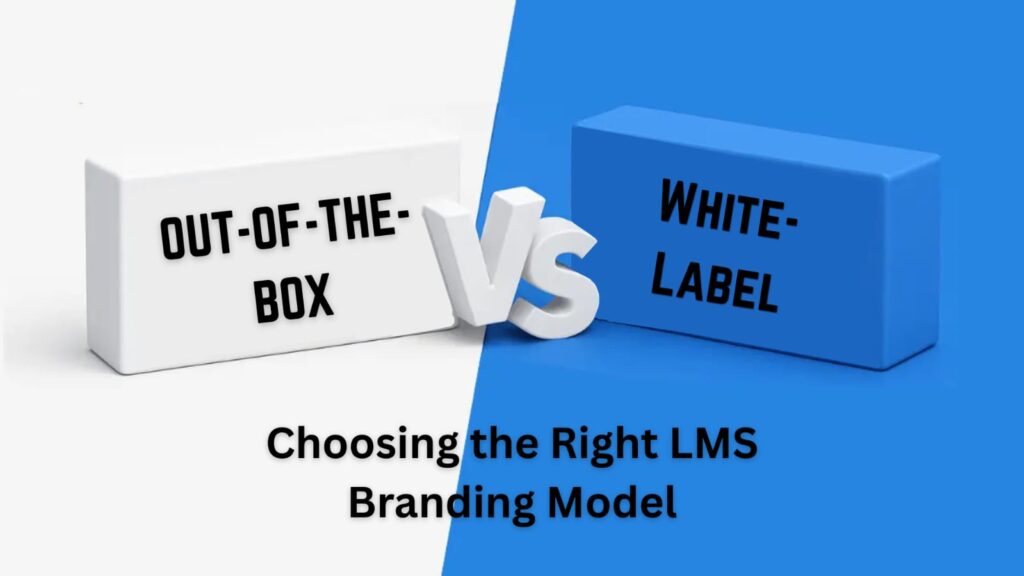






White label Learning Management System (LMS) branding is not a monolith, it is a range with two real ends. On one side there is out-of-the-box branding where the changes go only skin deep – your logo, your colors, a branded subdomain built on top of the pre-existing design from the vendor’s side. White-labeling on the other hand, takes the branding to a deeper level – a branded domain name and a customized learner interface with no traces of the underlying system.
This white paper provides an overview of each level, an unbiased methodology for distinguishing the two on any given platform and the implications based on industry data for a learning business.
Why “White-Label LMS” Isn’t One Thing
There is every incentive for vendors to make “white-label” a single checkbox feature on a features page. There is every incentive for buyers to interpret the presence of the checkbox as “brand from head to toe.” These incentives are not aligned, and the discrepancy between them is the source of dissatisfaction. In terms of numbers, the global market of learning management systems is estimated to be worth about $28.6 billion in 2025 and will amount to $34.1 billion in 2026 and will hit the ceiling of $123.8 billion in 2033 growing at the CAGR of 20.2%, and some of that growth will be driven by artificial intelligence-based personalization.
With that rate of growth, each year brings in additional suppliers, and “white-label” becomes a marketing buzzword way before its definition as a feature. And the entire white-label software market as a whole has taken an analogous path, according to one of the most cited estimates, reaching $38.22 billion in 2023 and maintaining an annual CAGR of 15.6% until 2030 (Grand View Research). And that growth means more “white-label” solutions for you to choose from and fewer standards as to what those solutions provide.
And the outcome is that you can find two solutions which both are marketed as “white-label,” where one will merely replace your logo on the login screen, and the other will completely rework your learner experience in your domain name. And none of them are necessarily deceiving; they’re simply operating within the range of the same concept without naming the range.
In reality, there are two distinct tiers of LMS branding depending on how extensive the rebranding effort is:
- Tier 1 – Out-of-the-box branding: cosmetic rebranding that occurs on top of the existing experience of the vendor.
- Tier 2 – White-label: an experience that’s fully rebuilt to resemble your product.
Neither option is inherently better than the other – they both have a unique set of advantages and drawbacks and are targeted at different clients with different needs. The trouble is, all vendors sell their solution as one and the same “white-label” product without making it clear what tier they are actually offering.
As the growth of the LMS market increases, the significance of “white-label” decreases. Consider the word to be just a beginning to asking questions.
Tier 1: Out-of-the-Box Branding – What It Actually Covers
Out-of-the-box branding means quick and cheap branding without any changes to the platform design. It usually includes:
- Custom URL/Domain having a unique web address rather than a subdomain provided by the vendor
- Placement of logo having your logo on the header, login screens, and certificates
- Support contact information replacing the vendor’s contact info with your email and support phone number
- Static page branding customizing About, Terms, and Help pages with your content
- Basic brand colors adding a single primary color to buttons and headers only, without changing anything else
And what it doesn’t include is any kind of redesigned experience for your learners. The navigation, interface design, course player and everything else would be vendor’s default product design, with your logo put on top of it. And for many buyers this solution is perfect. If you are a small training provider selling your courses directly to the learners and not having any comparison to other platforms at all, out-of-the-box branding gives you a professional solution quickly and cheaply.
Pre-packaged branding solutions are useful where getting something quick takes priority over ownership; internal training teams and local providers don’t lose deals because of a subdomain.
Tier 2: Full White-Label – What It Actually Covers
Full white labeling goes beyond identity – it transforms the experience. Full white label will generally include:
- Full visual overhaul – not just accents but new color palettes, typography, and layout
- Customized navigation and UX – menus, dashboard layouts, and player experience designed for your brand
- Branded learner journey – enrollment process, communications, and certifications that have been written specifically for you
- Total lack of vendor footprint – no “Powered by” mentions, vendor domains leaking into emails and links, or other giveaways of the actual underlying technology
Full white label is essential when your end-users are choosing your product based on their evaluation, or when enterprise buyers are evaluating vendors against each other; when channel partners are reselling a solution under a franchise agreement, or when your brand identity is a requirement of the certificate body. For example, if your training platform is being sold directly to organizations who are going to make six- and seven-figure investments, the templated appearance of your LMS is an instant strike against your credibility.
White-labeling is no longer an option but a requirement; in the world of franchises and resellers, a white-labeled platform will protect the contract while a branded one will sabotage it.
A Decision Framework: Which Tier Do You Need?
Stop asking yourself if this particular vendor provides white-labeling capabilities and think about these three:
- Who is your end client and is he/she/they going to compare you to other providers? Individual students signing up for one online class are unlikely to be picky about UI design. L&D director considering three vendors prior to the renewal is buying not just the service, but the UX quality as well.
- Are you reselling, franchising or working according to a partner model? Both reseller and franchising usually imply certain requirements to branding imposed by the master licensor. In case you have several training centers or partner brands, the answer will be multiplied – here’s our blog post about managing branding in franchise and multi-center training organizations.
- Are you an LMS-based only provider or you also provide ILT/vILT programs? In case you provide both instructor-led or virtual instructor-led training and online courses, LMS branding will only be half of the solution. Another crucial component – the scheduling, instructors’ management and operations platform or TMS – requires its own decisions on branding issues. Read more on that topic in our white label TMS blog post.
However, if your answers were “enterprise/comparative buyer”, “yes, reseller or franchisee”, or “yes, we do ILT/vILT”, then white label is definitely an option you should consider investing in. Otherwise, out-of-the-box branding would probably suffice for you at a lower price and faster setup process.
Questions to Ask Any LMS Vendor Before You Buy
Whatever platform it is you’re looking at, here are the questions you should be asking to determine which level you are truly buying:
- Domain: Are you getting your own root domain or a sub-domain of the vendor’s?
- Design System: Can you customize color and layout or just put in a logo?
- Learner Experience: Is the navigation and interaction pattern branded to your experience or some themed spin on the default design?
- Full touchpoint review: Open up the confirmation emails, certificates, and even the admin dashboard. Do you see the vendor’s branding at all?
- Timeline and cost: Out-of-the-box is a configuration exercise that is usually measured in days; full white label is a design and development exercise usually measured in weeks.
- Who it is for: Single location learning teams delivering internal content can get by with out-of-the-box. For franchises, resellers, and certification partners whose clients will be picking apart the vendor’s polish, full white-labeling is essential.
The framework works on any platform’s landing page, and it is intended to uncover the truth about what kind of white label the vendor is really selling.
Question 4, the every touchpoint check, detects more vendor overstatement than any sales discussion. Request that it be demonstrated for you, not explained.
What the Data Says About Brand Consistency and Buyer Trust
However, the business justification for out-of-the-box branding goes beyond aesthetics. According to Lucidpress (Marq), State of Brand Consistency Report, more than 400 professionals working on brand management have stated that consistently used branding should help to grow their businesses by 10% to 20%. In another wave of surveys, 68% of companies have noted that brand consistency helped to boost their revenues. For a training company, having vendor’s name appear in emails or certificates means being inconsistent according to the findings of the mentioned research.
There is also an analogous case from the point of view of the buyer in the training market. At the moment, corporate budgets allocated for education and development are subject to real scrutiny: according to the ATD 2026 State of the Industry report, average direct learning spending per person decreased to $846 in 2025 compared with $1,254 in 2024, despite the fact that the amount of formal learning hours spent on one person increased from 13.7 to 16.7. In light of such scrutiny of L&D budgets, a corporate purchaser who evaluates a training vendor needs indications of stability and professional approach, and the fact that the platform still carries the brand of the third-party vendor gives this indication in the wrong direction.
Increased pressure on training budgets increases the threshold of professionalism and not reduces it, having a vendor-branded solution does not make for easier selling in a highly scrutinized buying environment.
How SimpliTrain Approaches This Differently
SimpliTrain does offer both options clearly and does not combine the two under one general “white label” term.
The Out-of-the-box option includes customization of your URL, logo, contact information, and page content, a quick and professional solution for those providers who do not require a completely customized user interface.
The Full White Label customization goes beyond color scheme and UI design and includes full customization of the learner experience, for those providers who require an exact replica of the in-house platform, either for enterprise buyers, franchises, or certification authorities requiring specific branding.
Since SimpliTrain is not a Learning Management System, but rather a Training Operating System, these options apply not only to the learner interface but also to the operation layer including scheduling, instructor management, and registration processes.
Interested to know more about Full White Label and its implications?
Take a look at our case study to see how one of our partners built the whole learning experience under their own brand.
FAQ
1. How does out-of-the-box and full white label LMS branding differ from one another?
Out-of-the-box branding involves replacing the vendor’s branding by inserting your logo, contact information, and a subdomain. White label, on the other hand, entails creating a root domain, choosing your own color palette, and designing the UX according to your brand.
2. Is out-of-the-box branding “fake” white-labeling?
No, it is an honest, faster, and cheaper way that suits well for teams who want to create training courses but do not need any detailed UX customization. The problem is not with out-of-the-box branding itself but rather the unwillingness of the vendors to be transparent about the tier that they offer.
3. How long does white-label implementation take?
This is different for each vendor and depends on the degree of customization you need. But in general, full white-label implementation takes several weeks since it requires custom front-end design and development, while the configuration-only approach takes just several days.
4. Does white-label branding cover the entire platform or only the course catalog?
This depends on the vendor and on the level you have chosen. Most LMS vendors provide white-labeling only for the catalog and player part of the platform (this is what learners see). Providers of instructor-led and virtual instructor-led courses must make sure that the branding covers not only the LMS but also the TMS (training management system).
5. Why is brand consistency important for a training platform?
Because the training platform is a repeated exposure for the learners and, usually, corporate customers when renewing the contract. There is independent research that shows that brand consistency brings revenues for the companies and any instance of exposure of the vendor’s branding through emails footers, certificates, admin interface is a breach of the consistent branding policy (Lucidpress/Marq, State of Brand Consistency Report).
6. Does a franchise or reseller need the white-label or is it sufficient to provide out-of-the-box solution?
Usually, franchises, certification authorities, and resellers need a fully white-labeled version of the platform because their corporate customers evaluate professionalism of the platform among other things when choosing it.
7. Is there any way for me to know what tier a vendor provides prior to entering a contract?
Requesting the vendor’s confirmation e-mails, certificates, and admin panel during the demo instead of only the marketing website will help. You may ask the vendor whether you’ll get your own root domain or a subdomain, whether you will be able to modify the color palette and layout or not. The six-point checklist outlined in this guide can be used with any vendor’s platform.
8. Can I have a starting branding solution with the possibility to move to full white label later on?
Most likely yes, but keep in mind that such a change might require some design and development efforts. It will be useful to contact the vendor first to see whether such an option is available and how much it will cost.