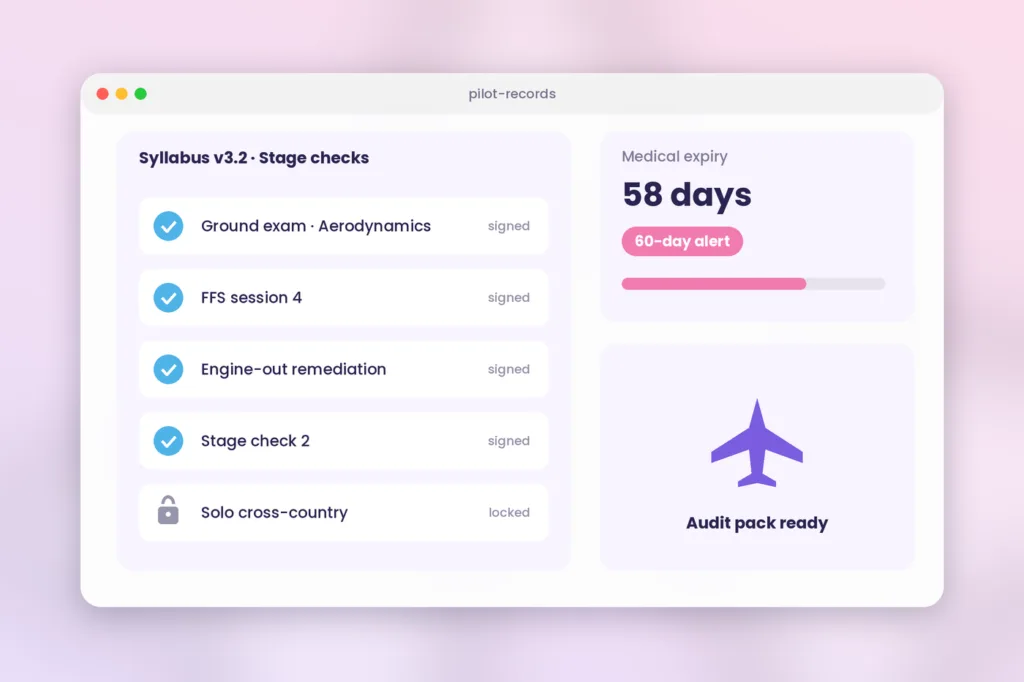





The pilot training records must have the ground school exams info, simulators hours, instructor signoffs and medical expirations available centrally in a tamper-proof and convenient source for audits. While the personal logbook can track the hours obtained, the official records will have all the syllabus components and tested passed. The organization can digitize the dull (training management) task and keep the record in one-place record source – first, they will make sure that no flight will go un-certified, second, they will be inspection-ready within minutes.
Incomplete pilot training records – your biggest audit risk?
In commercial aviation, a training event – even in the corporate space – that does not have a timestamp and signature, regulators will state, never happened. Flight schools, type rating organizations and operators are under enormous pressure to explain to authorities how they monitor progress on students and crews. One missing signature on a stage check or a blank seat time log can ground an entire fleet on a regulatory audit.
Aviation department around the globe is increasingly conducting unannounced record inspections under a new safety drive. Some in the aviation world have begun to check unannounced pilots’ training records, a recent article by Deccan Herald reported citing the Aircraft Accident Investigation Bureau in October 2026. Aviation authorities are becoming more aggressive in monitoring unannounced training record inspections.
When it comes to a pilot’s personal logbook and training records, companies usually combine the two into one. But in reality they are two very different things, especially since the 2026 FAA regulations at 14 CFR § 141.101 (eCFR) require a student to have a personal logbook when applying to a flight school. The regulations continue by adding that records of the training organization must include proof that the syllabus items have been completed in order.
What do aviation inspectors look for in pilot training records?
Aviation Inspectors review pilot training records to verify that every pilot was trained in accordance with the training manual. In any audit a pilot’s entire training history is examined, from initial enrollment with the training organization, through ground lessons, simulator sessions and finally remedial flights.
Sequential syllabus progression and prerequisite locks
Every Approved Training Organisation (ATO) and certified flight school operates on a sequential syllabus, where every lesson depends upon the student having successfully completed the previous lesson. So a training record would need to show that a student took and passed the high altitude aerodynamics test before they were allowed to fly using the full flight simulator. Similarly, an aviation inspector might crosscheck on time stamps in the pilot’s ground school training record with time stamps in their flight logs and might have a concern if a student’s logs showed a solo cross country flight lesson before they had received that lesson’s ground school test from their instructor.
Failed stage checks and documented remediation trails
The agency knows that some troublesome techniques are possible to be encountered when training, that a rider may have difficulty with. A failed lesson is not an audit issue provided the operator records the remedial training that occurred.
When an instructor provides an unsatisfactory engine-out approach standard and the student’s file is audited, it must include an action plan. It must identify what session the student was required to repeat, the instructor comments, and a passing grade before the student moves on. There must be no re-test following an unsatisfactory grade or this is an audit finding.
Verified instructor endorsements and qualification currency
The training record is valid if the instructor’s endorsement was current and qualified on the day of the lesson. During an audit, the auditor will compare the trainee’s lesson records with the instructor’s qualification file.
For example, a simulator check was completed on a Tuesday by an instructor whose flight instructor rating or medical certificate had expired on the previous Monday. The training session would be invalid for training purposes because the instructor was no longer current and qualified. The full record set of the trainee will be reconciled to current instructor information.
Competency-based grading and EBT metrics
Therefore the conventional method used has been to track the hours of training the pilot undertakes, and to record whether the pilot has completed the training successfully or not. Airlines and type rating organizations are moving toward Competency-Based Training and Assessment (CBTA) and Evidence-Based Training (EBT), where the focus is not on hours, but on the behavior exhibited by the pilot during training.
While auditing EBT there should be a focus on the method employed by the instructor(s) to grade the trainees’ ability to deal with situations, workload, manual flying skills, and the aircraft control during multiple sessions. Using those matrices in records, a chief flight instructor will be able to spot weak points, and coach the trainee for the check.
The failure of generic learning systems and spreadsheets to successfully complete aviation audits
A generic corporate learning management system plus spreadsheet tracking will not do the audit, as it cannot apply physical flight pre-requisites or versioning. A standard corporate LMS tracking system simply determines whether an office worker viewed a video and passed a multiple choice test about it. A flight training LMS tracks hours in a simulator, tail numbers flown, weather minimums, and physical instructor authorization–on top of video viewing and testing.
Kneeboard to spreadsheet delay
Within the confines of an aircraft cockpit, briefing room, or simulator bay, a flight instructor has to work with the resources at hand. In the absence of desktop computers, the instructor may jot down a few notes concerning the performance of a particular student on a kneeboard and tuck away the grading sheet until the following Friday.
That three-day turn time in an airline’s back office can lead to the lost grading sheet in a cup of coffee, at the bottom of a pilot’s bag or as a partial grading sheet folded up to have a student sign and return. But someone else may have booked that student for his next flight on Thursday, not realizing that he missed his stage check the day before.
Broken syllabus version control
Aviation training manuals and syllabi are constantly evolving to keep up with updated aircraft procedures and regulations. Suppose a Head of Training updates their syllabus from 3.1 to 3.2. Existing students in the training program can still be expected to audit against 3.1. Spreadsheets do not have a way of tracking versions. Updating the titles of lessons or grading rubrics in your master lesson plan excel file will replace student data or leave you with dozens of orphaned versions.
Missing audit trails and overwrite risks
Authorities and regulatory organizations demand that electronically kept pilot training records must be tamper-evident and tamper-proof. The auditor trail for electronically generated training records must be available for all electronically kept training records for which the 2026 standards apply to under FAA Advisory Circular 120-78B. Spreadsheets cannot be used since anyone who has access to a document can make modifications to them. For example, if an auditor is shown that they can modify dates, grades etc., they can discard the entire set of records stating that the digital files do not possess a valid audit trail.
Comparing worldwide pilot training record retention requirements
This comparison table helps you determine how long to keep your pilot training records based on regulatory jurisdiction, certificate, and security vetting information held in the file.
| Regulatory Authority | Applicable Rule | Minimum Retention Period | Core Compliance Requirement |
|---|---|---|---|
| FAA (Part 141 Flight Schools) | 14 CFR § 141.101 | 1 year after graduation or termination | Certified by the Chief Instructor; kept separate from personal pilot logbooks |
| FAA (Air Carriers & Operators) | 14 CFR Part 111 (PRD) | Reported within 30 days; retained career-long | Electronic reporting of training, proficiency checks, and disciplinary actions |
| EASA (Approved Training Orgs) | Part-ORA (ORA.ATO.120) | 3 years after training completion | Detailed ground, flight, and FSTD logs plus instructor progress reports |
| DGCA (Scheduled Airlines) | ATRP / CAR Guidelines | 3 years after training completion | Complete type rating, simulator proficiency, and recurrent check records |
| TSA (US Flight Training) | 49 CFR Part 1552 | 5 years after training completion | Foreign student security vetting, passport copies, and awareness training logs |
The new rules effective 2026 (14 CFR Part 111 – eCFR), require air carriers to upload their pilot records to the FAA Pilot Records Database within 30 days of the record being changed so that they can remain in compliance. Concurrently, the 2026 EASA Easy Access Rules for Organisation Requirements (Part-ORA) set a hard three-year retention window for all ATOs. Keeping on top of these can no longer be done by paper filing cabinets.
Everyday training record compliance for pilots.
Audit ready pilot training records through database integration Transform the time-consuming process of maintaining your pilot training records before an audit into automated reminders to update your operational database by simply connecting your curriculum, instructors’ grading tools and resource scheduler to one database.
Here’s how to put them into action.
- Centralise qualification and currency profiles: We’ll develop an easy to use, electronic profile for all students, commercial pilots and instructors, including their licence numbers, medical classes, language skills and type ratings.
- Enforce hard blocks on prerequisites: Integrate your training records system with your scheduling system and we’ll prevent a student from making a flight or simulator reservation unless they have a valid prerequisite sign-off or instructor’s medical.
- Tablet grading with dual digital signatures: We’ll provide your instructors with tablets in the cockpit or simulator bay to grade CBTA skills in real time, record remedial comments, and obtain dual signatures (instructor + student) before leaving the briefing room.
- Automate 30-60-90 day expiry and PRD notifications: We can set up periodic operations manager and pilot alerts 90/60/30 days prior to any recurrng check/medical expiry and new record add for 30-day FAA PRD filing readiness.
Connecting commercial billing to flight training progress
For commercial flight training organizations and contract type-rating providers, there are also financial considerations for flight school records. The training records of pilots funded by airlines or organizations, or those subject to recurrent simulator evaluations, must be reconciled with contracts for certified stage checks.
Having your training records monitor your billed hours provide your finance team with a complete overview of each pilot’s run of training and the hours of the simulator that have been booked for them. All of your airline’s training director can see the percentage of any of their cadets who made it through their stage check, the number of remedial flight hours they undertook, and download their training certificates for audits of compliance. Training to serve B2B aviation clients?
See our guide to training client reporting to understand how to track the training records of your contracted airline clients. And if you’re using a training management system, learn how to bring these workflows together in our Training Management Software Buyer’s Guide 2026.
FAQs
1. What are the advantages of aviation training software versus other generic learning platforms?
Aviation training software adds Regulatory documents and control features that the regular LMS does not have. The regular LMS system would record only the online courses completed by the trainees while aviation training software will display every ground exam taken, sims used, instructor endorsements, medical expirations, syllabus requirements, and any other documentation required.
2. What are the advantages of automated training records?
Automation of training records enables every student’s syllabus, grading sheet, and instructor endorsement to maintain an audit trail. If an FAA, EASA, or DGCA auditor seeks a file on a pilot, the instructor can submit the complete, fully compliant training history in seconds.
3. What do aviation inspectors look for in pilot training records?
Aviation inspectors will also review the training records to verify that pilots completed training in the approved order. They will look for logged ground and flight training, stage checks, and course completion. They will also check to make sure training records have correct medical expiration dates and dual digital signatures.
4. Which organizations keep these pilot training records?
Training records for pilots should be retained for a minimum of one year following graduation, depending on the regulator and type of operation, according to FAA Part 141. EASA Approved Training Organisations and the DGCA of India, for instance, mandate that training records must be stored and maintained for three years.
5. What is the difference between a pilot logbook and an official training record?
A pilot’s personal record of his or her flight hours that is used as evidence of his or her total aeronautical experience for certification. Official Training Record: A report of compliance with a person’s training that is kept by the flight school or air carrier as evidence that syllabus items, stage checks, and evaluations were accomplished according to the regulations.
6. How do aviation training management systems prevent uncertified flights?
Aviation training management systems stop these illegal flights by comparing the qualification files of the pilots with the schedule of the planes and simulators. It prevents an individual who doesn’t possess a particular stage check from being slated to fly the aircraft or simulator for that stage.
Get your aviation training operations audit ready today
Audit your flight and ground training files today to see where risks and liabilities are, with paper-based grading sheets or a level of spreadsheet tracking that makes you cringe. Define your syllabus prerequisites. Then, verify that each instructor’s currency is consistent with your dispatch schedule. Build one pane of training truth before the auditor visits your front door.
Are you currently spending man hours to manually amalgamate your paper based kneeboard data into an Excel based tracking system? Or is there a better way?
Use Simpli Train aviation training management software to consolidate and unify your flight operations. See the Simpli Train Aviation Solution on the Simpli Train Product Page or request a Simpli Train Demo to see how Simpli Train consolidates and unites your flight operations.