




Training no shows fall when you do three things. First, make the booking feel like a commitment. Next, remind people in layers. Then make cancelling so easy that people tell you early, so you can refill the seat.
So this guide walks through five levers, a 30-day reminder countdown and the numbers to track. We also compare real cancellation policies from training programs.
What do training no shows really cost?
However, not every empty seat is equal. The timing of the loss decides whether you can fix it.
| Type of loss | When you find out | Can you resell the seat? | Fix |
|---|---|---|---|
| Early cancellation | Weeks before | Yes | Waitlist and quick release |
| Late cancellation | Days or hours before | Rarely | Policy, substitutions and reschedule options |
| No-show | After the session starts | Never | Reminders and commitment |
A no-show is the worst case. As an illustration, the BMJ Open review on appointment reminders says that it is a free space that cannot be occupied by anyone else. This review focuses on the field of healthcare, but the same principle applies to any seat with a deadline.
Let us consider a hypothetical month. Suppose you book 200 seats at $250 each. There are 16 no-shows (8%) and 12 cancellations (6%). This means that there are 28 seats that remain vacant, putting you at risk of losing $7,000 worth of income.
The ripple costs are real too. One university training team explains the problem plainly in its cancellation policy. Trainers there are paid a fixed fee and prepare for the numbers booked. So last-minute losses waste that investment. The team also calls them disrespectful to the trainers.
A cancellation you hear about three weeks early is almost a non-event. So the goal is not zero cancellations. The goal is to move losses earlier.
Why do people skip a session they booked?
Most people do not skip on purpose. In fact, the BMJ Open authors note that most missed healthcare appointments come down to simple reasons, such as forgetfulness. Training also adds its own causes. Training no shows usually trace back to five causes. In our view, they are:
- Forgetting. The booking was made weeks ago and nothing reminded them.
- Work collisions. A client emergency or manager request lands on the day.
- Low Stakes: The seat is open or the company pays, so no one worries about the cost.
- Unsure Logistics: They do not know where to go, when to sign in or what to bring.
- Hard to cancel: It requires an email and an uncomfortable chat, so they just stay quiet.
It is that last point you have the most control over because if it is difficult to cancel, people will avoid doing so. Avoidance equals no show.
Whenever anyone cancels, ask why using a simple drop-down: schedule conflict, managerial call, sick, not right course, other. After two months, you will learn what the above points are costing you the most. You can then target your efforts there.
Which levers cut training no shows?
These five levers complement each other. You don’t have to apply all of them at once but they cover all different holes.
Lever One: Make Booking a Commitment
With an established policy there is motivation to make an informed decision. Real programs show a range, so the table below summarizes three published policies. They come from vendor and university programs. So adapt them to your own clients and local consumer rules.
| Program | Free cancellation | Late penalty | Other rules |
|---|---|---|---|
| Ciena Learning | 10 business days before | 50% at 6 to 9 days, 100% within 5 days | Substitutions allowed until the start. Courses with fewer than 6 students may be rescheduled. |
| Lightbend | Up to 24 hours before | Within 24 hours counts as a no-show, charged at 100% for public online events | Provider may cancel classes if minimum numbers are not met, up to 10 days before (classroom) or 3 days before (online). |
| Warwick Institute of Engagement | 7 calendar days before | A strike for the academic year | Two strikes bar a person from further training. |
Observe three different methods. Ciena has a sliding scale, and thus the penalty increases with the approaching date. Lightbend maintains a short window but safeguards itself with a minimum-numbers policy. Warwick relies on reputation rather than finances. Choose the one which suits your clients, and then announce it during booking.
Lever 2: Remind in layers
Reminders have the strongest evidence. The BMJ Open review pooled 21 randomized studies. Patients who received text notifications were 25% less likely to no-show. Their rate was 15%, against 21% with no reminder. However, the studies ran from 2005 to 2015 in healthcare, so treat the size of the effect as a guide.
Layering also matters. Attendance increased by 25% owing to multiple reminders, compared with only 6% from a single reminder. But multiple reminders did not help lower absenteeism without any other interventions. Voice messages performed a bit better than text messages for attendance.
A rapid review of predictive-model interventions adds a useful hint. The University of Manchester review found that phone-call reminders probably reduced no-shows among people flagged as high risk. So a short personal call may suit clients with a history of skipping.
Lever 3: Make cancelling easy
Place first an option to cancel or reschedule in every message. The BMJ Open example message even asks people to reply if they cannot come. The review found no significant rise in cancellations, though only three studies measured it. Either way, easy cancellations reduce no shows in training because an early cancellation is better than a no-show.
Also allow substitutions. If the client is unable to attend personally, the client can have an associate come in their place.
Lever 4: Refill fast
Keep a waitlist for every session. Then, when a seat opens, offer it within hours. Offer it to the same client’s team first, then to the waitlist, then to past learners.
However, be careful with overbooking. The Manchester review rated the effect of overbooking as uncertain. Moreover, for a full house on that day, there should be enough chairs, workbooks, and trainer attention.
Lever 5: Deal with repeat no-shows
Now look at the individualized and client pattern. First comes the nice opening line. Next follows the pre-payment for the next stay or you could just use the policy. The Warwick striked-based policy proves that the presence of such a policy can work without payment at all.
The handles follow a sequence. Policy provides expectations, reminders preserve memory, cancellations make losses visible sooner while waitlist makes those losses profitable. But if you have just two to work with then choose reminders and cancellation.
What does a 30-day reminder countdown look like?
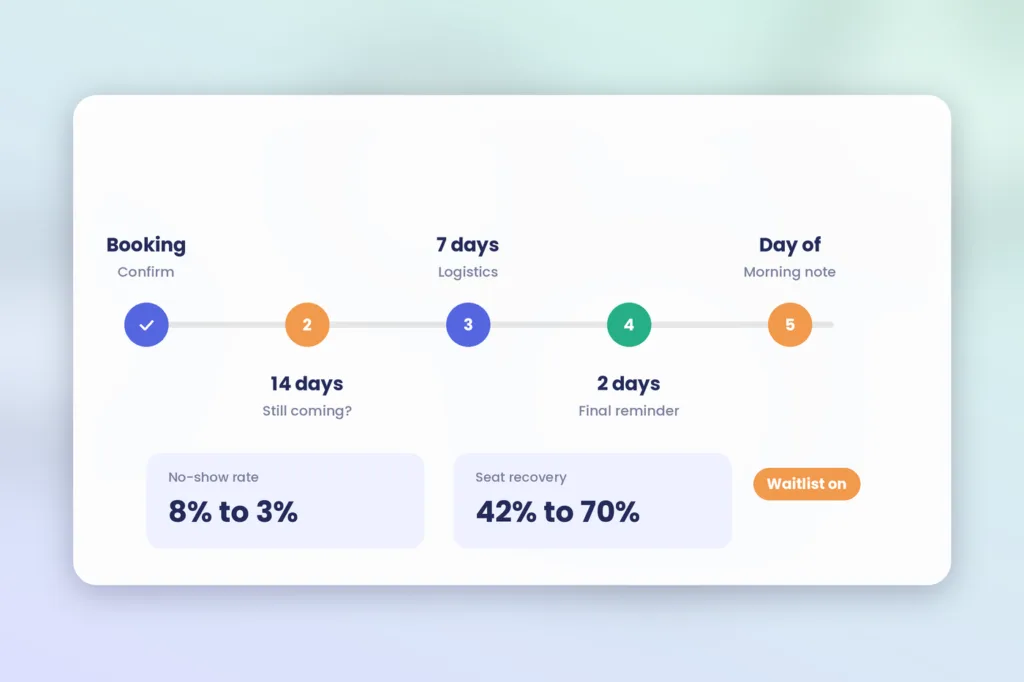
Below is a sample countdown timer you may consider. Modify the time to suit the duration of your class and target clientele since it depends on our recommended time, not a tested norm.
| When | What to send | Why it helps |
|---|---|---|
| At booking | Confirmation with date, place, policy and calendar invite | Sets the commitment |
| 14 days before | “Still coming?” check with a cancel link | Surfaces early cancellations |
| 7 days before | Logistics, pre-work and what to bring | Builds readiness |
| 2 days before | Final reminder with joining details | Fights forgetting |
| Morning of | Short note with start time and link or room | Last nudge |
| Day after a no-show | Friendly call or email with the next date | Saves the relationship |
Use only short and direct messages. Be sure to include the date, time, location/link, and single action. Also, do not send daily messages for weeks. In the BMJ Open review, one unusual study did that, and the authors called it anomalous.
In our view, the 14-day check is the most useful message in the set. This is an opportunity for them to politely decline attendance. This means that many of your future no shows will become early cancels.
How do you measure training no shows?
Nevertheless, you cannot better what you cannot measure. So track three rates each month, by course and by client.
Percentage of no-shows: no-shows ÷ confirmed seats.
Late cancellation percentage: late cancellations ÷ confirmed seats.
Recovery seat percentage: number of seats resold after late cancellations ÷ late cancellations.
Together, these rates describe training no shows from three angles: silent losses, late losses and recovery.
From the previously given hypothetical month, having 16 no-shows from 200 confirmed seats is a 8% no-show rate. Twelve late cancellations give a 6% late cancellation rate. If you refill five of those twelve, your seat recovery rate is 42%. Recovering half of the 28 empty seats would bring back about $3,500 in revenue.
For the wider picture of running instructor-led courses, see our ILT management guide.
Seat recovery is the number that most providers fail to see, but it is the number that you can control. No-show rates indicate reminders are needed. Seat recovery rates indicate your wait list is moving slowly. So each number tells you where to act.
How can software take the admin load?
The counting down on spreadsheets may be possible for just some sessions. Nonetheless, spreadsheets do not work effectively when many dates are involved since every message has to be sent manually.
In considering different tools, take into account five things:
- Automatic confirmations and reminders tied to each session date
- A cancel or reschedule link in every message
- A waitlist that offers freed seats
- Attendance records by learner and client
- No-show and late cancellation reports
SimpliTrain is our own platform for instructor-led and virtual training providers. It includes scheduling, registration, email reminders, and instructor/resource management all in one place. Learn about the instructor-led training system or schedule a demo to learn more about reminders and registration. Visit our training scheduling system page for more information about the calendar aspect.
Automation doesn’t take away from judgement. The system can handle the 14-day reminder. But it’s up to you how strict your policy is. Delegate the repetitive tasks to software and leave the discussions to humans.
What should you do next?
Select your next session and manually perform the countdown. Create your cancellation policy using just two sentences, then include that in the confirmation message for booking. Also schedule the 14 day check and two-day reminder. After the session is over, tally no-shows, late cancellations, and refilled seats.
Next, compare them with your next session. If they have improved, continue to repeat the process. Otherwise, check your cancellation reasons.
FAQs
1. Do you make people pay for no shows?
Not usually, but sometimes you should. Be clear about the policy when you book, have a sliding scale and allow substitution. Check for consumer laws and any clauses in your client contracts before you charge them.
2. How many reminders are too many?
Most service providers do fine with three or four reminders. You should send them at the time of booking, one or two weeks before, two days before and on the morning of the appointment.
3. How many no shows is acceptable in training?
There is no fixed benchmark, but figures quoted in research papers are setting. Decide your own target based on your break-even fill ratio and recovery rate. Monitor your trend per course and per customer. The trend declining is more important than reaching the quoted figure.
4. How will you prevent no shows if sessions are free or employer-sponsored?
When it comes to free or employer-sponsored classes, there is no financial cost attached. Training no shows can easily become an issue in such cases. To prevent it, you have to make it personal first. Get the approval of the learner’s supervisor for the booking. Provide team attendance report to the client sponsor. Make sure to ask for cancellation reasons and provide substitutes.
5. Is it possible to overbook a training course?
Beware, the Manchester review concluded that the influence of overbooking is unclear. There are practical risks, not enough seats, training workbooks or time allocated to the trainer. When trying this strategy, start on a small scale with training sessions that regularly attract no-shows. Also, prepare for the day when everybody shows up.
6. How can you prevent a no-show from losing you a client?
Follow up immediately, call or write a note, inquire about the circumstances and offer the next available date. Don’t be critical. There is often a problem which can easily be sorted out. If there is a persistent problem, discuss it with the client’s sponsor.