




Glossary of aviation training is an English list that contains definitions of all the terms involved in pilot, cabin and maintenance training. It ensures uniformity of terms for all people associated with training management and auditing.
This aviation training glossary defines 60 terms in nine groups, from ATO and DTO to EBT, LOFT and Part-147. Conclusion of Each Group Contains an Observation on What to Document and Why.
What is a glossary for aviation training and how can one utilize it?
A glossary of aviation training terminology provides one version of definitions for pilot, cabin, ground and maintenance training. Use it as a checklist as well as a reference source. Do three things:
- Identify your group. Begin with the part that covers your category, like checks or maintenance.
- Map each term to a record. Ask what record verifies the term.
- Verify your system. Make sure your tracking sheet has a slot for each entry, along with a due date if applicable.
This is a non-legal English-language version of these definitions. Check your authority’s current regulation for the definitive version. We provide the link to the relevant regulation when the definition is taken from there.
A glossary only makes sense if there is a correlation to a record. Terms which do not correlate to a record on your tracking sheet are a gap.
Who trains and who authorizes?
These eight terms identify who provides the training and who approves it. Definitions for the first two are given in Regulation (EU) 2018/1119.
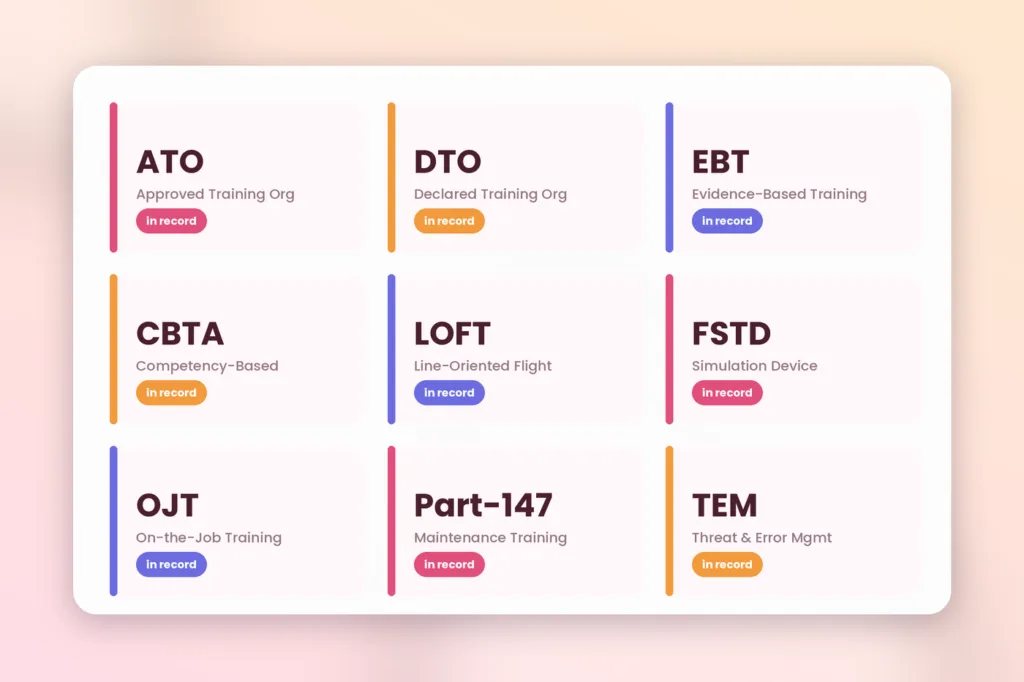
- ATO (Approved Training Organisation): This is an organisation that is authorized to train pilots under an approval from the authority.
- DTO (Declared Training Organisation): This is an organization that is authorized to train pilots under a declaration and not an approval. It also develops the DTO training program, which explains each course.
- TRTO (Type Rating Training Organisation): An organisation authorised to deliver type rating courses, normally on simulators. This is used by pilots to qualify on a certain aircraft type.
- Part 142 training centre: In the United States, an FAA certified training centre providing training, testing, and checking, normally using simulators. These are used by airlines and other operators.
- Part-147 organisation: An EASA approved maintenance training organisation. Part-147 training is linked to Part-66 licence within the EASA system.
- Part-145 organisation: An EASA approved maintenance organisation. First type rating On the Job training shall be carried out by a Part-145 establishment with proper approval.
- AOC (Air Operator’s Certificate): The certificate that permits the airline to conduct commercial air transport. The training manuals of such organisations are part of the authority approval process.
- Head of Training: The individual nominated within EU training providers for the planning and provision of training.
Your approval status determines what records you keep and who signs them. Put this at the top of your tracker so that they don’t guess.
Which rules and standards sit behind training?
Seven bodies and rule sets shape what training managers must prove. There could be acronyms that will fall into several sets of rules, therefore label all classes according to their regulatory bodies.
- ICAO: International Civil Aviation Organization. The United Nations body that oversees international rules and recommendations regarding aviation standards.
- **EASA: **European Aviation Safety Agency. (European Union) The agency develops common aviation safety regulations for European nations.
- FAA: Federal Aviation Administration. (United States). The administration creates and enforces aviation regulations in the USA.
- Part 121 and Part 135: FAA operating rules. Part 121 covers air carriers, while Part 135 covers commuter and on-demand flying, such as charter.
- Part-ORO: The EASA’s air operation organizational requirements. Part of it – ORO.FC – deals with pilot training and checking.
- Part-FCL: EASA’s flight crew licensing provisions. This includes licenses, ratings, and the training courses behind them.
- ICAO Doc 9995: The 2013 Manual of Evidence-based Training developed by ICAO that includes competency framework and behavioral indicators to evaluate it. You may find the way in which EU regulations use it in Regulation (EU) 2020/2036.
Add a “rule set” field to every course, such as Part-FCL or Part 121. Then your audit pack can filter by regulator in seconds.
What are the different forms of aviation training?
There are nine kinds of aviation training which exist. Since all kinds have their own purposes, each of them requires having its own record.
- Ab initio – Latin term meaning “from the beginning.” A training program aimed at training a student from scratch up to the professional pilot certification.
- MCC (Multi-Crew Cooperation) – training for pilots working in a multi-crew flight deck, including task sharing and communications.
- Type rating – authorization for flying a particular aircraft type like A320 or B737. Each type rating has its own training course, check and expiry period.
- Operator conversion training – a training program aimed at certifying a pilot who is new to an operator or a type with an operator.
- **Recurrent training – **Periodic training that keeps skills current. In EU evidence-based programs, it runs across a 3-year period of simulator modules.
- Upgrade training – Training for an upgrade, for example, a first officer to a captain. AQP regulations of FAA list the following types of training as qualifying: upgrade, transition, and requalification.
- Requalification – Training that brings back lapsed qualification.
- **LIFUS (Line Flying Under Supervision) – **Supervised flight for money after conversion training, with a training captain on board.
- **UPRT (Upset Prevention and Recovery Training) – **Training that teaches pilots how to prevent and recover from upsets (stalls). Simulators can be qualified for that task.
Each training has its own schedule. Recurrent restarts the clock, while requalification rebuilds it. A single “expiry date” field will blur the difference.
How do checks and evaluations work?
Checks leave the records that auditors read first. Nine terms cover most of what you will see.
- Skill test: A practical test, given by an examiner, for the issue of a licence or rating.
- Proficiency check: A check of competence to renew or revalidate. Operators run operator proficiency checks (OPC). EASA systems employ Licence Proficiency Checks (LPC) for licence revalidation as well.
- **Line check: **Assessment during normal revenue flights, therefore the test reflects practical skill level.
- **LOFT (Line-Oriented Flight Training): **Simulator training based on a complete line flight scenario and includes realistic incidents. It is a development of technical and crew skills simultaneously.
- LOE (Line Operational Evaluation): Evaluation in the simulated line environment and includes scenarios designed to evaluate technical and CRM skills at the same time.
- LOS (Line Operational Simulation): Covers LOFT, SPOT, and LOE. According to FAA, LOS is defined as training or evaluation in a simulated line environment, utilizing qualified and approved equipment. Full definition can be found in 14 CFR Part 121, Subpart Y.
- **SPOT (Special Purpose Operational Training): **Simulator training for a particular operational purpose.
- First Look: Under FAA’s AQP, an assessment during the continuing qualification cycle that helps spot trends of degraded proficiency.
- Check airman and TRE: A check airman is the FAA term for a person authorized to conduct checks for an operator. A TRE is a type rating examiner in EASA systems.
Keep three things along with each check – the outcome, the standard applied and the examiner’s approval. This will help you prove who was eligible to sign.
What do CBTA, EBT and CRM mean for assessment?
These eight terms turn the evaluation from “have they completed the task?” to “are they capable enough?” These eight terms also set a high standard when it comes to evaluation.
- CBTA (Competency-Based Training and Assessment): Training and assessment with respect to competencies, instead of just completing tasks. According to EU regulations, EBT competencies comprise everything that pilots used to know under technical and non-technical competencies in pilot training.
- EBT (Evidence-Based Training): Assessment and training with reference to operational data that builds up and evaluates capability, not individual events or actions.
- EBT module: A series of sessions in an approved simulator, which forms a part of 3-year period of assessment and training.
- Core competencies and observable behavior: Competency framework and behavioral indicators that graders use to grade core competencies. Some of the basic competencies include communication and workload management.
- Inter-rater reliability: Reliability of various instructors giving grades to the same performance. Since EBT is judgment-based, it needs calibration sessions to have consistent grading process.
- Scenario-Based Training (SBT): This type of training uses scenarios and not just individual maneuvers.
- CRM (Crew Resource Management): Communication, leadership, decision-making and situational awareness skills. FAA AQP mandates the curriculum to have both CRM and technical training and evaluation.
- TEM (Threat and Error Management): Helps in recognizing threats and management of errors.
Competency grading requires judgment. The instructor records the grade, the behavior that results in the grade, and his/her name. This helps in verifying whether the grading of the same performance by two different instructors is consistent.
Which simulator and device terms matter?
Six terms cover the devices behind most simulator sessions. A device’s level limits what training you may do on it, so check before you schedule.
- **FSTD (Flight Simulation Training Device): **For aeroplanes, either a full flight simulator, flight training device, flight and navigation procedures trainer or a basic instrument training device.
- **FFS (Full Flight Simulator): **The highest fidelity device, complete with a full cockpit mock-up along with motion and visuals.
- FTD (Flight Training Device): A cockpit systems trainer, usually a fixed base system of lower fidelity than FFS.
- **FNPT (Flight and Navigation Procedures Trainer): **An EASA device for procedures and instrument training.
- BITD (Basic Instrument Training Device): A ground-based device, which may use screen-based instruments and spring-loaded controls, for at least the procedural aspects of instrument flight.
- Qualification level: The FAA’s National Simulator Program oversees flight training devices at levels 4 to 7 and full flight simulators at levels A to D. See the FAA National Simulator Program for details.
Treat simulator slots like any other scarce resource. SimpliTrain, which is our own product, handles simulator slot allocation, instructor management and classroom capacity alongside crew schedules. See our training scheduling page** for how that works.
Which safety, cabin and ground terms do managers need?
Four terms are easy to forget in pilot-focused systems. There are cycles for cabin crew, ground crew, and maintenance, and therefore all need a place in your records.
- SMS (Safety Management System): An organized approach to managing safety risk within an organization. Staff training on it is part of most operators’ programs.
- Human factors training: Training on how people perform, and how errors happen. EASA’s Part-145 asks certifying staff to receive human factors training.
- Cabin Crew Attestation (CCA): EASA form that shows an individual’s successful completion of his or her cabin crew training and examination.
- **Dangerous Goods Training: **Training of the personnel handling, accepting, or dispatching dangerous goods. SimpliTrain’s aviation page lists it among the recurrence cycles it tracks, alongside type rating renewals, line checks and CRM refreshers.
A tracker built only around pilots will miss these cycles. List every role, then every recurring requirement for that role.
Which maintenance training terms matter for MRO teams?
Four terms cover most maintenance training paths. Together they link a person’s course history to what they may sign.
- Part-66 licence: EASA’s aircraft maintenance licence. To get one, an applicant needs type training, both theory and practical, plus on-the-job training for the first type rating. The details sit in EASA’s Part-66 FAQ.
- Type training: A course on a specific aircraft type, with theory and practical parts.
- OJT (On-the-Job Training): Required for the first type rating in a licence category. It must be done on the aircraft type for which the person seeks the endorsement.
- Authorized staff signing off on release of aircraft following maintenance. Authority to sign is based on licensing, type training and company authorization.
MRO audits frequently revolve around one key question: Was this person authorized for this type on this date? Make sure your type training and OJT sign-off are on one file. Our MRO training case study shows one team’s approach.
Which records and oversight terms keep audits calm?
Five terms sit behind almost every audit file. They turn courses into evidence.
- **Training Needs Analysis (TNA): **A process that uncovers the differences between the skills needed by a certain role and the skills of an individual. It starts every program.
- Qualification standards document (QSD): A document every FAA AQP application must include. In short, it holds the standards used to qualify people.
- Currency tracking: Currency means a person’s required training and checks are in date. Tracking involves the addition of deadlines and notifications.For example, SimpliTrain creates reminders 90, 60, and 30 days prior to the expiry date of the certification.
- Training Record and Audit Trail: Training record shows who trained whom, who trained what, when, and what were the outcomes. Audit Trail means who made the changes afterward.
- Compliance Monitoring: Verification of Compliance with Regulations. EU organizations often name a compliance monitoring manager for it.
Auditors don’t read your syllabus. They read your files. Tie your records back to your syllabus and approval, and everything falls into place. See our compliance training use case and certification management page for tips on keeping that link alive.
How can a common glossary be created for one’s own team?
Create one document where all the trainers, coordinators, and auditors can access it. Having a common glossary will eliminate any discrepancies related to terminology. Here’s how you do it:
- Pick one home. Maintain one page or document as the source of truth.
- **List your authority’s terms. **Begin with the 60 above, then delete what you do not need.
- Add your internal names. For instance, map “six-monthly check” to OPC so that all parties know it is the same thing.
- **Connect each name with its respective data point and ownership. **Every term should point to a document, a data field and a person.
- Review twice a year. Also review after any rule change.
On the other hand, try testing your tool against the above list. As explained on the aviation training management page of SimpiTrain, the tool manages to track recurrence cycles, plan simulator and instructor capacity, and generate audit reports. As per the page, reports can be filtered by crew member, role, aircraft type, base or date. We are biased, so check any system against your own terms in a demo. Our instructor management page covers the trainer side.
The best glossary is the one your system uses. If your tracker’s field names do not match your glossary, something must be wrong.
Your next step
Select 10 terms that your team uses most frequently. Relate each one to a record, a custodian, and a deadline. Then check whether your tracker holds all three. If gaps appear, see how SimpliTrain handles aviation training on our aviation training management page, or book a demo and bring your own list of terms.
FAQs
1. What is the difference between ATO and DTO?
ATO has an approval of authority to provide training. DTO is engaged in a declaration to the authority. Normally, the declaration process applies to light non-commercial training, whereas for commercial training, ATO approval is required. Please refer to your national authority for scope and limitations.
2. What is the difference between CBTA and EBT?
CBTA is the overall concept of training and assessment by competencies rather than tasks. EBT applies that approach to recurrent airline training, using operational data to decide what to train. So EBT is a specific application of competency-based thinking, defined in ICAO’s manual and in EU rules.
3. Is a Part 142 training center the same as an ATO?
No. Part 142 is a regulation of the US FAA regarding training centers, while ATO is an EU approval for pilot training organizations. The two have similar roles but differ in structure. Their approval processes, personnel duties, and record-keeping systems are not the same; hence, you cannot adopt the same processes in both.
4. How frequent is recurrent training?
It depends on the regulator, the role and the program. Under EU rules, an EBT program runs in 3-year cycles of modules in qualified simulators. Other programs use annual or other fixed intervals. Always refer to your approved training manual, and always keep a list of all due dates in one place.
5. What is the difference between a proficiency check and a line check?
A proficiency check evaluates a person’s proficiency in a simulator or aircraft. A line check evaluates a pilot’s performance in regular revenue operations. Both types of checks are required for operators, and both create their own record, signed by an authorized examiner or check airman.
6. What records are expected for aviation training?
Prove who the training was delivered by, who the trainer is, what type of training it is, when the training was carried out, the result, and the next follow-up on that. The auditors can audit individual file, which must relate to the approved syllabus and the authorized trainer. The regulator gives the detailed list.