




Compliance with DGCA training involves maintaining all the necessary records, as required by the Indian DGCA, to prove these in audit inspections and report any change in time. For most of the training centers, it begins with understanding the relevant Civil Aviation Requirement (CAR). Then, it includes maintaining all the necessary records for each student and instructor.
This guide maps the main DGCA approvals to their records, shows what audits have found, and gives you a monthly routine.
What is DGCA training compliance?
DGCA training compliance is the work of meeting the approval conditions in the CARs that cover your training. DGCA approves and oversees several kinds of training organization. Its own site lists flying training organizations (FTOs), CAR-147 maintenance training, cabin crew training programs and dangerous goods training programs, among others (DGCA A to Z index).
The legal base is also changing. Bharatiya Vayuyan Adhiniyam, 2024 came into force from 1st January 2025 replacing the Aircraft Act, 1934. Bharatiya Vayuyan Niyam, 2025 would be replacing Aircraft Rules, 1937 and in August 2026, Supreme Court compelled the government to come up with the rules. DGCA guidelines still make reference to the 1937 Rules. (AFM on the Supreme Court hearing). So rule numbers may shift, but your CARs remain your working documents.
For an FTO, the anchor is Rule 133A of the Aircraft Rules, 1937. It requires pilot licence flying experience to come from an FTO approved or recognized by DGCA (National Single Window System page on FTO approval).
Compliance begins with a list, not a policy. Make a list of all your DGCA approvals and their respective CARs
What DGCA approvals do you have for your training organization?
Every approval is under a CAR, has its own records, and has its own reporting requirements. Here is a map, based on DGCA and government sources.
| Organization type | Main rule | Records and reporting to expect |
|---|---|---|
| Flying training organization (FTO) | Rule 133A; CAR Section 7 (Series D Part I for approval, Series I Part V for audit) | Training and Procedures Manual, curricula, quality and SMS documents for approval; student and instructor files; DGCA inspection |
| Type rating training (ATO or airline program) | CAR Section 7 Series D Part IV; type rating CAR Series B Part XIX | Ground and simulator session records, test and check reports; a draft revision shows completion documents going to DGCA’s Director of Training and Licensing |
| Maintenance training (CAR-147) | CAR-147 (Basic), Issue 1, Rev 0 | Student, exam and assessment records for ten years; instructor records; independent audit; approval for up to five years |
| Remote pilot training (RPTO) | CAR Section 7 Series D Part VII; Flying Training Circular 3 of 2020 | A record for every student and trainer; returns to DGCA on student records and drone utilization |
| Dangerous goods training | CAR Section 11 Series C Part I | Program approval; recurrent training within 24 months; records for at least three years in the 2026 draft |
| Aviation English training | CAR Section 7 Series G Part V | Renewal needs the latest internal audit report and compliance with pending observations; approval for up to five years |
An FTO application, for example, includes the proposed Training and Procedures Manual, each course curriculum, and documents on the quality system and the Safety Management System, according to the government portal. Consider these documents to be part of your active records.
Two companies may have the same approval but different recordkeeping requirements. It is important to always refer to the CAR that pertains to your approval.
What do DGCA audits actually check?
DGCA audits check facilities, people and paperwork together, and many findings turn out to be record gaps. India’s regulator ran a special audit of FTOs from March 2022. By mid-June it had audited 30 FTOs and found several problems (Deccan Herald on the 2022 audit):
- Some instructors, student pilots and aircraft maintenance engineers skipped the breath analyzer test or did not submit an undertaking before duty.
- Some testing equipment did not comply with requirements or lacked calibration.
- Ground training had gaps, including overlap with flying training and a lack of instructors and arrangements.
- Student pilots were not always briefed on emergencies before solo or cross-country flights, and trainers were changed too often.
DGCA suspended one FTO’s approval, warned two accountable managers and suspended several instructors. It ran another special audit in three phases from September to November 2024, after more training aircraft incidents. It also recorded 305 enforcement measures for that year in the same sector, including those against FTOs and 17 organizations for breath analysis machine failures.
Now read those findings as records. A skipped test needs a log. Calibration needs a certificate. Overlap between flying and ground training needs a schedule. Frequent trainer changes need an allocation record.
For every finding above, ask yourself: could I produce the record today?
How should you categorize your documents?
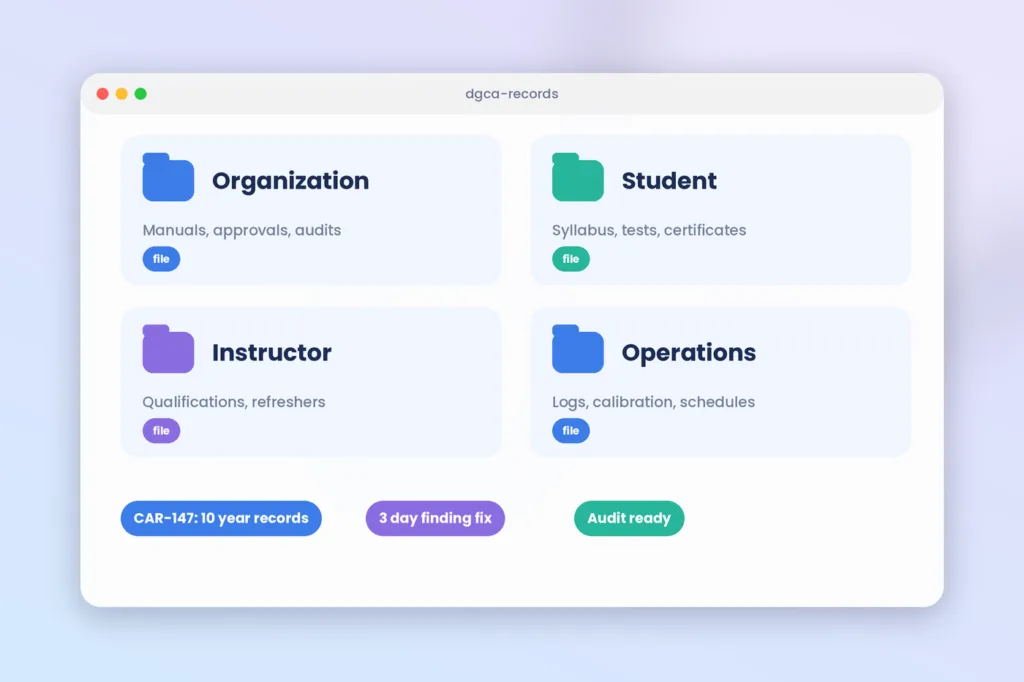
Organize records into four files and keep each one complete and searchable. This is our own suggested structure, based on what the CARs and audits point to.
| File | What it holds | Examples from DGCA sources |
|---|---|---|
| Organization file | Approvals, manuals, audit reports, change notices | Training and Procedures Manual; internal audit reports; accountable manager review |
| Student file | Enrollment, syllabus progress, assessments, certificates | CAR-147 student, exam and assessment records; RPTO records that let you reconstruct training history |
| Instructor file | Qualifications, approvals, refresher training | CAR-147 instructor training and experience records; RPTO trainer refresher every two years |
| Operations log | Schedules, flying and training logs, safety checks, equipment | Breath analyzer test logs and undertakings; calibration records; trainer allocation |
Some rules are specific:
- CAR-147: keep all student training, examination and assessment records for ten years, or for an unlimited period if you hold DGCA’s examination privilege. DGCA has access during audits. Store the test papers and records properly. Also keep records of instructors qualifications and experience (CAR-147 (Basic)).
- RPTO: The records should be such that one can trace back the training process from them. Protect them from damage or unauthorized change, archive inactive records through a DGCA-acceptable system, and let DGCA inspect at any reasonable time.
- Dangerous goods: recurrent training within 24 months, and records for at least three years, in the revised draft CAR Section 11 Series C Part I issued for comment on 13 October 2026 (TeamLease RegTech summary). The final text may differ.
A great student file is self-explanatory; if you have to mention “I recall that class,” something is missing in the file.
When should you report to DGCA, and what do you have to report?
Report on approval, on renewal, on changes, and on request from DGCA. Duties depend on the specific CARs, which is why we are giving you a checklist rather than a legal description.
- Approval and renewal. File the manuals, curriculum and quality management documents specified by your CAR. For Aviation English training, renewal needs the latest internal audit report and proof that you fixed earlier observations. Approvals run for up to five years under both that CAR and CAR-147.
- Changes. CAR-147 requires you to notify DGCA of changes to the organization. Check your own CAR for the list.
- Findings. As per CAR-147, the finding at level 1 should be rectified within 3 days after receipt of the notice in writing; otherwise, DGCA may withdraw the approval.
- Returns. RPTOs submit returns on student records and drone utilization to DGCA.
- Completion documents. A draft revision of the type rating CAR asks training organizations to send ground training records, session-wise simulator or aeroplane reports and details of remedial training on completion.
- Management review. It is clear that CAR-147 will be asking for independent audit and annual review by the accountable manager.
We recommend having an internal reporting practice on a quarterly basis, even if not required by any CARs.
Short deadlines often confuse people. Having only three days to fix things means you don’t have the luxury of searching for files, so always know where your records can be found.
What should be included in a monthly readiness program?
An easy-to-do routine will help to stay ready for inspection throughout the year. Here is how:
- Week 1 – list all expiring approvals, certificates and instructor authorizations within 90 days.
- Week 2 – review ten student files and compare each with the list from your manual.
- Week 3 – examine operations logs including test logs, calibration certificates and schedules for any gaps.
- Week 4 – review open findings, document fixes and update the management report.
- Every quarter – conduct an internal audit of one process and document the reviewer.
- Annually – conduct the accountable manager’s review and review CAR revisions.
Plus one more test – ask your colleague to find any student’s complete record in less than five minutes. If they cannot do that, fix your records before DGCA does.
Sampling beats hoping. Ten files a month shows you the pattern of gaps long before an audit does.
What role can software play?
Software will be able to store one complete record per individual, manage expiry dates and generate reports. The mentioned tool is our product, consider the information in the proper context. As described in its aviation page, SimpliTrain has compliance audit reports which can be filtered by individual, function, aircraft, base, date and even one click audit reports for EASA and FAA.
According to our aviation training management software tutorial, certificate expiry cycles can align with FAA, EASA or ICAO based national regulations. (SimpliTrain aviation training management).
State the scope clearly. Aviation page mentions EASA and FAA packs and not DGCA formats. So ask for a demo with your own DGCA cycles, and ask what exports an inspector can use. Also remember that SimpliTrain is a training management and learning platform. It does not replace your quality system, your safety management system or DGCA approvals. See our guide on aviation compliance software vs training management for the difference.
Use this checklist with any vendor:
- Does it keep a full file per student and per instructor?
- Is it capable of tracking expiry dates on approvals and authorizations?
- Can it store logs and certificates, such as breath analyzer tests and calibration?
- Can you set your own cycles and retention periods?
- Can you export a complete record for an inspector?
- Does it keep an audit trail of changes?
Learn more on our pages for certification management, instructor management and our aviation training management software guide.
Judge the system based on its worst day, not its best day. Have the vendor provide you with a complete student file and a three-day notice report based on actual data.
Your next step
Identify all DGCA approvals that you have along with the CARs for them. Choose ten random student files and validate them against the list of records in the manual. Identify the missing items and address them first. If you want to see how the system can handle these files and cycles, check out SimpliTrain’s training management and aviation training management pages or book a demo and bring your own DGCA cycles.
FAQs
1. What kind of records should be maintained by an approved FTO?
The specific records that need to be maintained will be found in your approved Training and Procedures Manual, which is your starting point. During audits, DGCA has reviewed records regarding ground and flight training schedules, instructor assignment, breathalyzer testing and maintenance log.
2. How long must a CAR-147 organization keep student records?
CAR-147 (Basic), Issue 1, requires organizations to keep all student training, examination and assessment records for ten years. If the institute holds DGCA’s privilege to conduct examinations on its behalf, the records must be kept for an unlimited period. DGCA can access them during compliance audits.
3. How often is dangerous goods training required in India?
DGCA’s CAR Section 11, Series C, Part I provides the guidelines, and the recurrent training and assessment must be completed in 24 months. A revised draft published for comments on 13 October 2026 also states that the training records have to be retained for a minimum period of three years. Verify the final draft before you modify your retention policy.
4. Do DGCA’s requirements differ if the Bharatiya Vayuyan Adhiniyam applies?
The Adhiniyam superseded the Aircraft Act, 1934 from 1 January 2025. The draft Bharatiya Vayuyan Niyam, 2025 will replace the Aircraft Rules, 1937, and in August 2026, the Supreme Court compelled the government to complete the rules. Until then, DGCA’s CARs and the CARs’ reference to the 1937 rules are your guiding documents.
5. What findings did DGCA make in the audits for flying schools?
In its 2022 audit of 30 flight training organizations, DGCA found instances of missing breathalyzer tests or exercises, non-compliant test equipment, poor ground training procedures, and haphazardly assigned trainers. One FTO had its approval suspended. In 2024, a special audit was carried out in three phases from September to November.
6. Do I need a software package for DGCA training records?
Software is not mentioned in the rules, but DGCA’s rules for remote pilot training specify that records should allow the reconstruction of each pilot’s training record and be available for inspection on request. Spreadsheets fall short here. Training management software can help if it provides complete records of each pilot and exportable ones that you can show an inspector.