




Dangerous Goods Training Compliance implies that every individual who deals with dangerous goods training is trained, assessed, and documented on time. The basic principle is quite straightforward: the majority of aviation requirements mandate recurrent training in 24 months, and you should be able to provide the proof.
This guide will help you understand how to schedule your cycles, create audit-proof documents, and prevent any gaps.
What is dangerous goods training compliance?
Compliance with dangerous goods training requires training the right people prior to employment, re-training them on schedule, and proving it. The right people include more staff than most teams expect.
The UK CAA, for example, lists these groups as the minimum for operators: staff accepting dangerous goods, staff accepting other cargo, staff who handle, store and load cargo and baggage, passenger handling staff, flight crew, other crew and load planners. Reservations, operations and commercial staff may also need training (UK CAA dangerous goods training requirements).
Some teams think they are exempt because they never carry dangerous goods. That is rarely true. The UK CAA says a commercial air transport operator’s training program needs approval whether or not it transports dangerous goods. In the US, the FAA’s final rule created programs for operators that carry hazmat and operators that do not. Failing to complete recurrent training while still doing the job can breach the law. The UK CAA says continuing to process or carry cargo without recurrent training would contravene the Air Navigation (Dangerous Goods) Regulations.
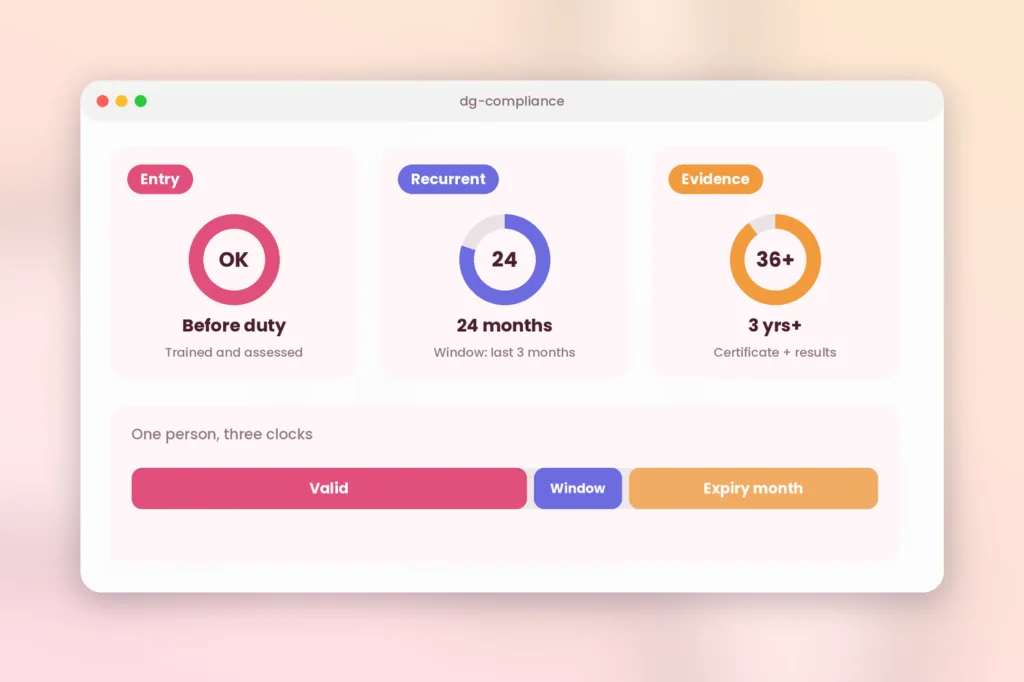
We suggest tracking three clocks for each person:
| Clock | Question it answers | Typical rule |
|---|---|---|
| Entry | Is this person trained and assessed before they work? | Before performing the function, or under supervision where a rule allows |
| Recurrent | Is the training still valid? | Within 24 months in most air rules |
| Evidence | Can you prove it? | Records kept for a set period, often three years or more |
Failures are usually because of lack of one clock only. Groups manage repeatable dates effectively, but they forget about entry training and retention time.
How did competency-based training impact the regulations?
Competency-based training and assessment (CBTA) transformed the dangerous goods programs from static training to functional training with assessment. This came into force from 1 January 2023. According to IATA, it was made mandatory from that day replacing the category-based approach in the Technical Instructions and the DGR. (IATA Knowledge Hub on CBTA). The older category tables 1.5.A and 1.5.B have been eliminated.
The UK CAA summarizes what this means for employers (UK CAA CBTA guidance):
- Training has to have awareness or familiarization, function-based training, and safety training.
- People allocated into new functions should be evaluated for competence to undertake them.
- The existing staffing structure does not determine the content of courses, although it is useful in guiding you.
- It is up to the employer to ensure that individuals are competent to undertake any particular function.
- The course could be conducted by an external trainer, but the accountability rests with the employer.
Therefore, you will require more information than the date when the certificate was awarded in your records.
Through CBTA, the auditing process shifts from “Have they taken the course?” to “Are they competent in this specific function?” Your records must answer the second question.
How do recurrent cycles work?
Recurring cycles are normally two years long with a short period when you may learn in advance without any loss of time. The requirements are not the same in each case, so please read yours.
| Rule set | Cycle | Window or grace | Source |
|---|---|---|---|
| ICAO Technical Instructions and UK CAA guidance | Within 24 months of the previous training and assessment | Training in the final three months of validity extends validity from the old expiry month | ICAO, UK CAA |
| FAA Part 121 hazmat program | Within the past 24 months | Training in the month before or after the due month counts as on time | 14 CFR 121.1005 |
| US hazmat employer rules (49 CFR 172.704) | At least once every three years | New hires or job changes: training within 90 days | PHMSA |
It is clear from the UK CAA that there must be recurrent training and assessment within 24 months for maintaining competence. Incompetent staff who have not been trained cannot perform the function. See 14 CFR 121.1005 for the US window. Other jurisdictions will have their own requirements, so verify the current requirement of your jurisdiction.
In case more than one requirement applies, we advise planning based on the shorter cycle and the narrower window. This is our suggestion, not a regulation.
Early training window is your best scheduling tool. Use it to shift training from crunch weeks and maintain the original expiry month.
How do you schedule dangerous goods training?
Arrange the dangerous goods training sessions backwards from the expiry date of each individual. Guard instructor time as zealously as learner time. Proceed as follows:
- Make the roster. List every person and function that needs training, including contractors.
- Map functions to competencies. Use a training needs analysis, so each person gets the right content.
- Anchor expiry months. Record the month, not just a date, so you can use the window.
- Open the window early. Assign recurrent training about 120 days out, open seats at 90, confirm at 60 and escalate at 30. This is our suggestion.
- Schedule instructors. ICAO’s Technical Instructions say instructors of dangerous goods training must deliver courses at least every 24 months, or attend recurrent training.
- Cover new hires. Train before they perform the function, or follow the rule that allows supervised work for a short time. FAA rules, for instance, allow it only under direct visual supervision of a trained person.
- Choose the format. Classroom, virtual and e-learning can all work, if the assessment meets your program.
For scheduling instructors, devices, and rooms at bases, please refer to our guide on aviation training scheduling.
A 24-month cycle conceals the pressure. All those hired in the same quarter will expire two years from now, so diversify by months.
Which records must you keep?
Keep a complete record of each person’s training, assessment and certificate, for the period your authority sets. The FAA’s Part 121 rule is the most specific, so it makes a good model. It requires a record of all training in the preceding three years for each person who performs or supervises dangerous goods job functions. You must keep it while the person does the job, and for 90 days after. It covers employees, independent contractors and subcontractors alike, and may be stored electronically (14 CFR 121.1007).
Each record must contain five items:
- The person’s name.
- The most recent training completion date.
- A description, copy or reference to the training materials.
- The name and address of the organization which conducted the training.
- A copy of the certificate to prove that he/she passed the test.
New hires working under the supervision exception need extra records. Those include a signed authorization, the hire or job change date, the person’s name and function, the supervisor’s name, and the date training must be complete.
Older ICAO text also set a minimum retention of 36 months from the most recent training. US hazmat employer rules use a similar three-year logic. Because rules vary, we suggest keeping at least three years and longer where your authority or customer asks.
For CBTA, add these fields. They are our recommendations:
| Field | Why it helps |
|---|---|
| Function or role | Shows the training matches the job |
| Competencies assessed | Proves assessment, not just attendance |
| Assessor name | Shows who judged competence |
| Program version | Shows which approved syllabus applied |
| Approval reference | Links the record to your authority’s approval |
The inspector can request one file and read through it from start to finish. In case any of the five must-have things is missing, then the entire document becomes flawed.
What should a monthly compliance routine be?
A brief monthly compliance routine will find problems before the inspector does. Here’s how:
- Weekly: Review all people whose window opens or closes in the next 60 days.
- Monthly: Sample ten records and examine all five required items and your CBTA items.
- Quarterly: Instructor currency and third party trainer approval checks.
- Annually: Annual program review with regard to regulatory changes, as IATA DGR is released annually and becomes effective on 1 January.
- Any finding: Fix the record, then fix the process that allowed the problem to occur.
Here’s some real enforcement to make the point. India’s DGCA issued a warning letter to IndiGo concerning lapses in dangerous goods handling norms. It requested the airline to review its training program to include additional hands-on training and operational scenarios, and conduct recurrent training of personnel handling company materials at Delhi airport.
Audits value routine, not heroic efforts. A monthly sampling audit breaks one big audit into twelve little audits.
How does software assist?
The software assists in tracking each cycle, sending notifications and recording everything in one place. This is a product that we have created ourselves; take this into consideration. According to its aviation training management page, it is used for tracking each recurrence cycle, which includes dangerous goods training, with automatic notifications sent 90, 60 and 30 days before expiry. Also, records are automatically synchronized when crew complete their training, online or offline.
Be clear about scope. SimpliTrain tracks cycles, schedules sessions and holds records. It does not replace your approved dangerous goods program or your authority’s approval. Check any system, including ours, against this list:
- Does it track entry, recurrent and record clocks separately?
- Can it hold the expiry month and a training window?
- Does it store the certificate and assessment result?
- Can it record function, competencies and assessor?
- Does it keep records for contractors and third-party trainers?
- Can you export a file for each person on demand?
See our pages on certification management, instructor management and compliance training for more.
Ask any vendor to show one person’s full dangerous goods file, from entry to latest recurrent. If it takes more than a minute, your auditors will wait too.
Your next step
Pull ten dangerous goods training files this week. Check each one against the five required items and your three clocks. Count the gaps. And then see how this system closes them up, check out SimpliTrain’s training management capabilities, or our aviation training management page, or request a demo and bring your ten files.
FAQs
1. How often is dangerous goods training required in the aviation industry?
Most airline regulations require recurrent training within 24 months from the last training session. FAA Part 121 uses the same 24-month cycle, while US ground hazmat rules use three years. Some authorities set shorter or different limits. Plan to the shortest cycle that applies to each role, and check your authority’s current rules.
2. Can staff complete recurrent training early without losing time?
Yes, within limits. According to ICAO’s guidelines, where training is completed within the last three months of validity, the period of 24 months starts from the old expiry month. According to FAA Part 121, training in the month before or after the due month is considered timely. Different regulations apply elsewhere, so check yours.
3. How long must dangerous goods training records be kept?
Keep records for at least three years in most air rules. The FAA Part 121 demands training records for the past three years when a person performs the task, as well as 90 days after. The old ICAO language has 36 months from the latest training period. Maintain contractor training records and retain the certificate of passing the test.
4. Do we need dangerous goods training if we never carry dangerous goods?
Yes, in many systems. Even when CAT operators in the UK do not carry dangerous goods, they should ensure that their dangerous goods training program gets approval. In addition, the FAA requires all operators operating under Part 121 and 135 to have a hazmat training program whether or not they transport dangerous goods. The staff has to be able to recognize undeclared dangerous goods.
5. What is competency-based training in dangerous goods?
Competency-based training is training and assessment based on individual requirements. Starting from 1 January 2023, it becomes mandatory to conduct such training and assessment in compliance with ICAO-based regulations. Employers stay responsible that staff are competent before they perform each function.
6. Who is responsible if a third party trains our staff?
You are. While regulatory authorities allow employers to use an outside trainer, the responsibility for the competencies of the staff lies with the employer. It is necessary to verify that the trainer has authorization, keep certificates and the results of assessments, and conduct your own evaluation of your procedures, as general classes might not include all the operator’s processes.