
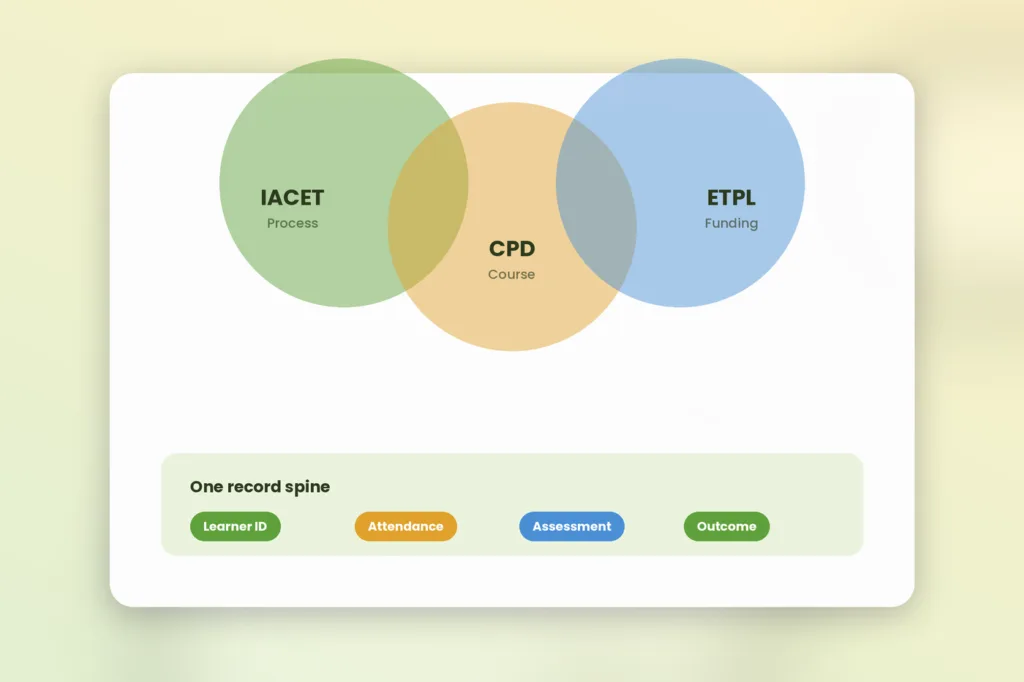





Here is how to become an accredited training provider: decide on what recognition you need first, and then make documents to show that you have the recognition. IACET, CPD and ETPL all sound similar, but they are quite different. IACET accredits your processes. CPD bodies approve your courses. An ETPL listing is a state’s permission to receive public workforce funds.
This guide tells you what they want from your records and how you can make one system to serve the interests of all three.
How do IACET, CPD, and ETPL differ for a training provider?
The IACET accrediates your organization’s process; the CPD accrediators accredit individual courses; and a listing in the ETPL means your program becomes eligible for publicly funded workforces. In other words, one is a quality mark for your whole operation, one is a quality mark for each course, and one is a funding gate. Here is a side-by-side view.
| IACET | CPD | ETPL | |
|---|---|---|---|
| Who decides | IACET, the developer of the ANSI/IACET Standard | Independent CPD accreditation bodies | Your state workforce agency and local board |
| What they judge | Your processes across the whole standard | Each course or activity | Each program’s eligibility and performance |
| What you gain | The right to issue IACET CEUs | An accreditor’s mark and CPD certificates | Eligibility for WIOA-funded learners |
| Records focus | Learner records, CEU calculation, retention | Objectives, trainer proof, attendance, feedback | Participant outcome and cost data |
Where do you begin? Examine your questioner.
- Educators want CEUs for licensing and employers: Begin with IACET accreditation.
- Professionals require CPD hours: Start with CPD accreditation of courses.
- You train jobseekers and want WIOA-funded learners: start with your state’s ETPL process.
Many providers end up with more than one. The best recommendation would be to begin with the one which your paying client is already asking for.
Choose based on the customer, not based on the badge. Accreditation requires time and documentation, and should thus be performed only when it counts.
What does IACET expect from your record keeping?
IACET expects you to run a recordkeeping system you can trust for at least seven years. This is clearly defined in the ANSI/IACET 1-2018 standard in terms of learner records. The requirements cover a process of confirming the registered learner is the one who gets the CEU, a process of calculating and crediting each CEU, a certificate/transcript, a secure system with a back-up, a seven-year retention period, and a learner record privacy policy.
The records that you keep need to allow you to do the following seven things:
- Ensure that the person registering is the same person receiving the CEUs.
- Calculate and record each CEU.
- Inform the learner if he or she has met the requirements.
- Provide a certificate of completion or transcript.
- Operate a record-keeping system with backups.
- Keep records for at least seven years, and make them accessible to the learner.
- Have a privacy and security policy for your records.
Then comes the calendar. You submit an annual report each year, and in the fifth year you must complete reaccreditation before your accreditation expires. According to IACET, “the application should be submitted at least 90 days prior to the expiration date to avoid late fees” (IACET advice for maintenance of accreditation). Also, on the same page, “IACET has scheduled a new standard for 2023 to replace 2018.” So confirm which version will assess you before you write your policies.
IACET does not grade your courses one by one. It grades your system. If you cannot pull a complete file for any learner from five years ago, no policy document will save you.
What do CPD accreditors expect from you?
The CPD accrediting bodies require evidence that each training course had well-defined aims, good plans for delivering the course and honest attendance records. The criteria of the accrediting body can be slightly different as each organization presents its own criteria. Nonetheless, the documentation is pretty much the same.
For instance, in CII CPD accreditation standards, it is stated that the list of evidence for CII CPD accreditation includes accurate attendance and results records, records of evaluation and review and feedback records (CII CPD accreditation standards).
Therefore, create a small “CPD file” for each course:
- Make SMART learning objectives.
- Save existing course materials and the date when the previous review was performed.
- Save trainer’s credentials and his/her brief experience description.
- Explain how you evaluate whether learners achieved the objectives.
- Save records of attendance at each session.
- Receive feedback and record changes based on it.
Also check who is accrediting you. A credible accreditor is independent of your business, publishes its criteria and reviews each course. If you approve your own courses, that is self-accreditation, and buyers may not accept it.
CPD accreditation is course by course, so your records must be course by course too. A shared folder called “Accreditation” will not cut it.
What is expected under ETPL, and why is this not accreditation?
An ETPL listing is not accreditation. It is a state list of programs that can receive WIOA funds, and it runs on performance data. The Iowa Application says this clearly: eligibility as an Eligible Training Provider does not constitute accreditation of the training program. (Iowa ETPL application).
The federal rules shape what you must keep. States must review provider eligibility at least every two years, may set minimum performance levels, and must remove providers that substantially fail to submit timely, accurate information (20 CFR 680.460 on eCFR). Moreover, some states ask for performance data on all participants in a training program, not only funded ones.
That changes your records in three ways:
- You need outcome data after training, such as completion and employment.
- Each student record needs to be matched up with a program, site, and source of funding.
- A person in charge needs to be designated to review all information prior to any submission.
Since regulations vary from state to state, it would be prudent to read your state’s policy on the ETPL and get in touch with your local Workforce Board.
The ETPL has stricter penalties for poor data as opposed to poor course results.
How do you create a single record keeping system that fulfills all three?
Make one record spine and report on it using three different formats. The record spine consists of data that is captured only once per each learner and session. Then each accreditation takes the slice it needs. In our view, this beats keeping three parallel files, because parallel files drift apart.
Your spine needs these ten fields:
- Unique learner ID and verified identity (mainly IACET).
- Course or program name, version and delivery mode (all three).
- Session dates, times and contact hours (IACET and CPD).
- Instructor name and credentials (CPD, and IACET’s instructional personnel rules).
- Attendance for every session (IACET and CPD).
- Assessment results and the pass criteria (all three).
- Completion status and certificate or transcript number (IACET and CPD).
- Learner feedback and your review notes (CPD).
- Post-training outcomes, where relevant (ETPL).
- Retention date and an audit trail of who changed what (IACET, and good practice for ETPL).
SimpliTrain is our own product, so weigh this mention accordingly. No software grants accreditation. A training management system gives you the records. Our platform tracks certifications and credentials, sends automated re-certification reminders, and supports compliance tracking (SimpliTrain training management features). Instructors can also mark attendance for their sessions through an instructor portal (SimpliTrain instructor management). For more, see our pages on attendance tracking and certification management.
Before you buy anything, ask three questions in a demo. How do I export a learner transcript? How long can I keep records? Can I report outcomes by program and funding source?
Insight: Accreditors audit evidence, not software. The best test of any system is whether a stranger could rebuild a learner’s full history from it in ten minutes.
How do you go from being unaccredited to accredited?
Work through six steps, in order. Each one stops you from paying for an application you are not ready to pass.
- Name the goal. Decide who needs the recognition: customers, a licensing body or a funder.
- Read the real criteria. That means the ANSI/IACET Standard, your CPD accreditor’s published criteria, or your state’s ETPL policy.
- Audit your records. Pull 20 recent learners and try to build a full file for each. Count the gaps. This “20-learner test” is our own suggestion, not an accreditor requirement.
- Fix the spine and write the policies. Cover identity checks, retention, privacy, complaints and review.
- Apply. IACET and ETPL apply at the provider or program level. CPD applies course by course.
- Set a yearly rhythm. Diary your IACET annual report, CPD review dates and ETPL data submissions.
Now, learn from your weaknesses. If 8 out of 20 of your files have no attendance, fix that issue before everything else and then retake the test. On the other hand, don’t forget what training management teaches since the same discipline of records applies to scheduling, billing, and compliance as well.
20-learner test is inexpensive and straightforward. It will reveal your readiness faster than any standard.
Your next step
Pull 20 recent learner files this week and check each one against the ten spine fields. Note every gap. Next, see how a Training Management System bridges those gaps: check out SimpliTrain’s training management solutions or request a demo and bring your 20-learner gaps list along.
FAQs
1. Is an ETPL listing the same as accreditation?
No. An ETPL listing is a state approval that lets your programs receive WIOA funds. Iowa’s application says approval is not an endorsement or accreditation of the program. Accreditation, such as IACET’s, judges your processes. An ETPL listing judges eligibility and performance data.
2. For how many years must the records of learners be retained by the IACET provider?
For at least seven years. According to the ANSI/IACET 1-2018 standard, there is a procedure for retaining records of training, which shall be made accessible to learners for at least seven years. IACET regularly updates its standard, so find out what version will evaluate you.
3. How long does IACET accreditation last?
Five years. During that time you submit an annual report each year on or before your anniversary date. In the fifth year, you apply for reaccreditation. According to IACET, one should file an application for reaccreditation at least 90 days before its expiration date.
4. Can I accredit my own courses for CPD?
No. An independent body should examine your course based on published criteria for credible CPD accreditation. Self-accreditation is approving your own courses. Make sure that the accrediting body publishes its criteria, examines each course and has no ownership relations with you.
5. What will happen if I provide inaccurate data to an ETPL?
Federal regulations mandate that your state shall remove providers who do not submit accurate information in a timely manner from the eligible provider list. Each state establishes its definition of what constitutes a substantial violation. Treat your ETPL data the same way as you treat financial data – identify who owns it, verify before submitting and retain the source file.
6. Do I need special software to be an accredited training provider?
No. The accreditors evaluate your process and evidence, not the tool used. However, data stored in spreadsheets and emails is difficult to verify. In our opinion, the training management system is useful because it stores attendance, results and certificates in one place. Just ask any vendor how its exports match your accreditor’s checklist.