




Training providers have to apply for funding from the government. This requires immaculate records of training events and participants. This is where a generic spreadsheet falls short. A dedicated Training Management System (TMS) system will reduce the burden of paperwork that a company would endure when trying to submit claims. It will track any training events and their participants. This will help you bill mixed groups when appropriate while avoiding heavy fines in case of an audit.
Why do manual spreadsheets sabotage training provider funding claims?
Using manual spreadsheets to track subsidized learners will create the problem with critical data entry that will result in delayed reimbursements and government audit clawbacks. Most commercial training providers will try to use the same generalized Excel tracker sheets for government funded courses as they are for commercial bookings. This becomes a problem when a government auditor requests timestamped attendance proof or identity verification.
Spreadsheets are ineffective for audit trails, version control, and real-time data validation. If a training coordinator misspells a trainee’s national identification number in a spreadsheet, it can lead to an entire batch of claims being denied by the funding source. Per a 2026 compliance benchmarking report by Training Industry, administrative formatting errors are the single most common reason for delayed government reimbursements to commercial training vendors.
In addition, disconnected spreadsheets create fatal gaps in the attendance records of classes and invoicing. The second a student withdraws from a subsidized class, it is upon the human operator to ensure they update the name on the roster, learning management system, and billing program. If using a centralized platform, one can automatically generate audit ready compliance reports.
How do regional funding programs demand specialized reporting workflows?
Global government funding programs all have the same goal of workforce development, but each region has their own compliance requirements. Organizations that provide training services needs to adapt their operations to the rules established by local authorities to participate.
Saudi HRDF (Hadaf): Verifying workforce localization and eligibility
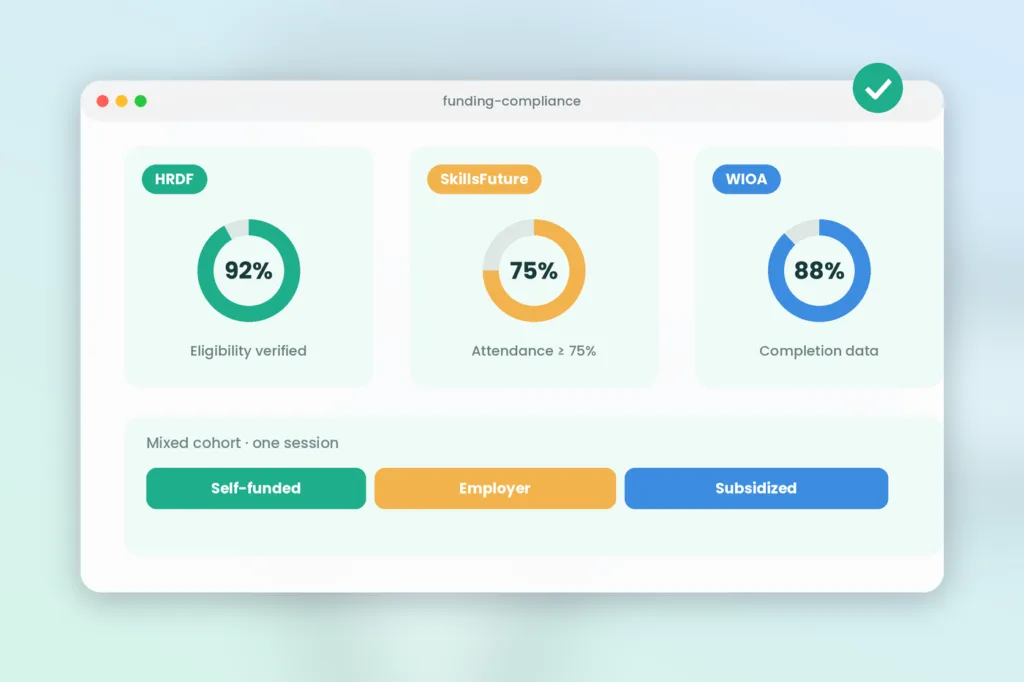
The Saudi Human Resources Development Fund (HRDF) known also as Hadaf provides a set of generous subsidies for training and development for the purpose of private sector’s workforce localization in the Kingdom. To receive the Saudi Human Resources Development Fund (HRDF), training providers should verify thoroughly the personal and professional qualifications of participants before the start of the course. The HRDF, an official Saudi Human Resources Development Fund released its new set of instructions for 2026, which includes stricter requirements for tracking the minimum hours of e-learning and certifications. This can be achieved through automated restrictions that can be built into the software.
Singapore SkillsFuture (SSG): Managing TPGateway attendance limits
Under the SkillsFuture system of Singapore, training providers are required to connect their systems to the government’s TPGateway portal. To claim absentee payroll or course fee subsidies, these providers have to demonstrate a minimum 75 percent attendance rate for each delegate. According to one of the 2025 regulatory changes, manual methods such as signing-in sheets no longer qualify, which means that Singpass or some other digital verification solutions will have to be employed. As a result, a separate TMS is needed to automate the attendance capture process.
US WIOA: Securing ETPL completion and credential metrics
As far as the WIOA standards are concerned, training providers must keep their information on the Eligible Training Provider List (ETPL) up to date. This requires all relevant agencies to report on their student completion rates and subsequent credentials earned. As of 2026, the US Department of Labor will require this information to be available to DOL representatives. Manually compiling such reports by pulling the data from dozens of Excel sheets takes weeks of effort.
How do you handle funded and self-funded learners in the same class?
A good training management software needs to be able to split billing and compliance rules for different learner types in the same session. A standard B2B instructor led training session will often include a mix of self funded individuals, corporate sponsored employees, and government subsidized delegates. Basic booking widgets force you to create separate classes for each funding type, restricting your venue capacity artificially.
By using a purpose built TMS, your operations team can put all 3 learner types in the same physical room, and simultaneously route each one through entirely different administrative workflows. The self funded learner will check out with a credit card at checkout. The corporate employee will be invoiced for a multi seat invoice to their HR department. The subsidized learner will avoid the paywall, but have to upload their government eligibility documents to receive a calendar invite.
This kind of automated segmentation is the key to scaling your operations without unnecessarily bloating your back office headcount. To understand how to appropriately structure your multi tiered commercial offerings, review our guide on how to price training courses. Natively segmenting these payment gateways will ensure that your grant claims stay pristine, without disrupting your standard commercial cash flows.
Software vs. spreadsheets: Funding compliance comparison
Leaving behind manual spreadsheets will keep you safe from compliance penalties and speed up reimbursements
Automating pre-screening to prevent grant rejections
Automating pre-screening of trainees helps prevent non-compliant enrollments from locking-in delivery expenses. Grant programs disallow reimbursements if an enrolled worker failed specific residency or employment tenure tests. Configure your booking engine to verify corporate tax identifiers and national IDs to prevent ineligible registrations at your checkout page.
Using real time alerts to Protect Subsidy Thresholds
Attendance alerts in real-time prevent devastating losses of subsidy amounts right before the course concludes. If a subsidized delegate fails to arrive for a morning session, operations managers get alerted to let instructors schedule extra hours to be certified against the grant claim.
| Evaluation Metric | Manual Spreadsheets | Dedicated Training Management System |
|---|---|---|
| Data Integrity | High risk of manual typos and version conflicts | Automated validation and tamper-proof logs |
| Attendance Tracking | Paper sign-in sheets prone to fraud | Digital verification synced to learner profiles |
| Mixed Cohort Billing | Requires duplicate rosters and manual invoicing | Automated segmentation within a single session |
| Audit Readiness | Takes weeks to manually aggregate historical data | One-click export of compliant reporting packages |
To get started on building a secure infrastructure that can withstand even the most rigorous government audits, refer to our detailed Training Management Software Buyer’s Guide 2026.
FAQs
1. What is training provider funding?
Training provider funding should be defined as government grants and subsidies that reimburse the costs of courses for individuals and corporate employers. Noteworthy examples are Saudi Arabia Human Resources Development Fund (HRDF), SkillsFuture in Singapore, and the US Workforce Innovation and Opportunity Act which require such providers to keep track of stringent attendance and course completion requirements.
2. How do training providers manage mixed cohorts?
Training providers manage mixed cohorts by using specialized software which allows different billing and compliance tracking functions across the same cohort based on a delegate’s learning funding basis. Self-funded delegates receive commercial invoices while subsidized learners are tracked against funding specific attendance requirements without requiring manual spreadsheet intervention.
3. What documentation is needed for training compliance audits?
Most grant makers require training providers to report verified time stamped attendance logs, proof of identity, record of assessments completed and signed participant declarations. For example, SkillsFuture in Singapore requires digital attendance verification using Singpass and Saudi HRDF requires strict employment verification prior to reimbursements approval.
4. Why do manual spreadsheets fail in grant compliance?
The manual data entry of spreadsheets lacks audit trails, version control, and real-time validation, which causes grant compliance issues. A wrong entry of an employee’s failure to record attendance may result in denied claims and increased delivery costs to the training provider.
5. How does software automate government grant reporting?
Training management software automates report generation for government grants by consolidating attendance, tracking learning assessment milestones, and compiling trainee profiles into exportable, compliance-ready packages. Specialized platforms natively track regional grant requirements, proactively alerting operations coordinators to any learner documentation gaps well in advance of physical training sessions.
6. What causes training to grant audit clawback?
If government agencies find out about fraud during an audit, for example, false claims, insufficient evaluations, or ineligible participants, you might have to return the funds. This is why providers should invest in an automated system that stores all compliance information in an electronic format that cannot be altered.
Stop chasing paperwork, and secure your reimbursements
Using paper-based processes to manage these important government funded grants is a liability to your revenue stream and scalability. Modernizing your compliance management ensures you get paid quicker and can pass any retrospective audits with ease. Moving these processes onto a dedicated platform makes them easier to manage and turns a previously manual process into an automated one. To get out of the admin for smaller providers, check out our post on the best training management software for small business.
Want to see how automated mixed cohort billing and attendance tracking works? See exactly what capabilities are available on the SimpliTrain Product Page or book a SimpliTrain Demo today to secure your funding workflows.