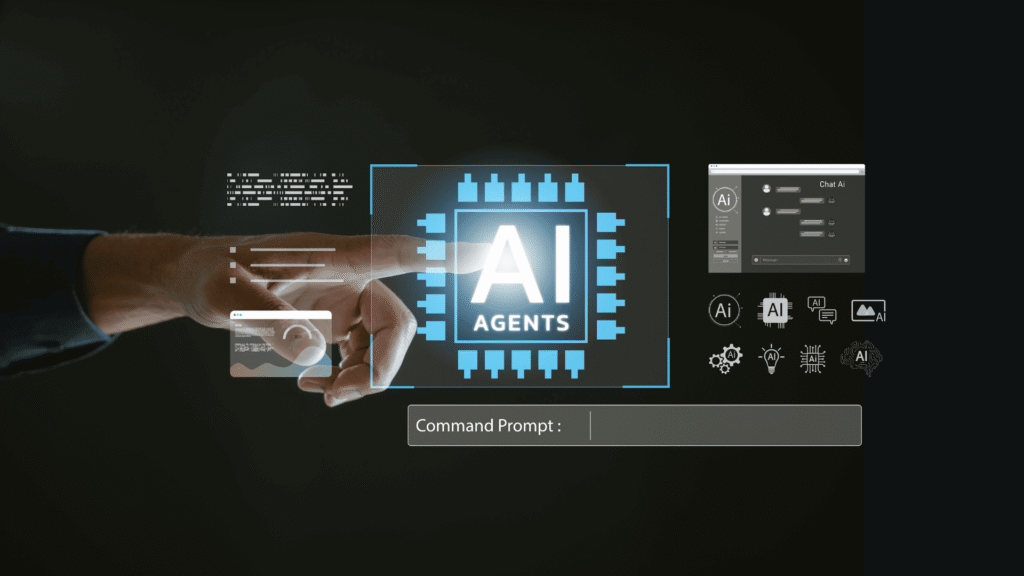






An Agentic AI is software that not only responds to a query but plans out an action sequence and performs actions within systems in order to achieve the set goals with minimal supervision from the human side, a significant step up from the chatbot applications usually associated with AI.
For the last couple of years, “AI in training” has been synonymous with just one thing – content. Produce a course curriculum, personalize a learning trajectory, summarize a compliance module. Useful, but static. The interaction with this kind of application stops with the request and the response.
An Agentic AI, however, is a very different beast. In addition to responding to prompts, an AI agent can plan out an action sequence, perform actions in real systems, and continue doing it towards its goal with minimal oversight. Applying this technology to a training company does not only mean producing better course recommendations, but also rescheduling classes, marking instructor conflicts, and reallocating training budget lines on its own, all of which has not been talked about by people who write about “agentic AI in L&D”.
We’ll tell you exactly what this means in this blog, why 2026 is the year when agentic AI in enterprise software will finally arrive, why the overwhelming majority of discussions about agentic AI in L&D today completely miss the operational aspect of training, what an agentic training coordinator can be expected to accomplish, why the very same studies forecasting widespread adoption also forecast widespread failure, and how you can avoid this fate in your training operations.
What “Agentic AI” Actually Means
A definition of an AI agent is that it can reason about a goal, make decisions about how to proceed, use tools to act on those decisions, and adapt to changing circumstances without any human supervision being necessary at each step. Agentic AI refers to the larger framework of agents planning, acting, and often coordinating with other agents within the workflow, instead of merely responding to prompts.
Perhaps the most intuitive comparison would be to observe the difference against something familiar in terms of training management operations. While a chatbot in a TMS could give an answer to the question “when is the next cohort of this course?”, an agent could recognize that it is underenrolled, check the availability of instructors to run it on another date, suggest to reschedule, notify all participants about this change, update the invoice, and only leave one decision for human approval.
In “agentic AI,” the important term is not “AI,” but “agentic.” What is really important is not creating text, but acting within a system.
Why 2026 Is the Inflection Point
The year 2026 marks the transition of the agentic AI concept from an experimental model to actual incorporation into the software that people use on a daily basis. According to projections made by Gartner, by the end of 2026, 40% of enterprise applications will include task-specific AI agents, which means an increase in the current level of 5% in one year, an eightfold rise. This is not just a prediction about some future wave but a description of software categories, including operational software such as TMS platforms, which are currently upgraded with agent capabilities.
The first signs of this trend can be seen today in the very first iterations of the training platforms we analyze in conversations with the suppliers, small task-specific automations (such as auto-flagging double-booked instructors, for example), which are somewhat shy of being classified as fully agentic but are definitely moving toward this status. The Gartner predictions about AI agents themselves are quite illustrative of this situation, too, AI agents are transitioning from assistants to task-specific agents in 2022 with a full multi-agent ecosystem expected by 2029.
An eightfold adoption jump in a single year means the “should we consider agentic AI” conversation is already behind schedule for most training providers, the practical question now is where, not whether.
Everyone’s Talking About Agentic AI for Learning Content, Almost No One’s Talking About Operations
This is the missing piece. Try searching for ‘agentic AI L&D’ right now, and you’ll find that everything returned pertains to the learning delivery aspect of the technology – creating learning content, tailoring a learning path to the learner, or suggesting next courses. This is all legitimate and valuable application of technology. It’s also only one part of the training equation.
David Blake, the CEO and co-founder of Degreed, put his finger on the mark by calling agentic AI the next wave of “learning co-worker,” expanding past the creation of learning content into taking actual actions within the workflow: enrolling teams, initiating processes, and automating the process of behavioral change. This description is entirely accurate but is almost always used in reference to the side of business that faces the learner. Nobody is asking how an agentic “learning co-worker” works from the perspective of the operational aspect of training that content-driven AI doesn’t even address.
It’s a significant oversight for any provider that offers courses using instructor-led training and/or blended programs. While content personalization does not solve the issue of an overscheduled instructor, changes made by the corporate client regarding headcount, or any budget line that’s set to overflow its limit; these are operational issues, and these are the exact kinds of tasks that an agentic AI can excel at.
What an Agentic AI Training Coordinator Could Actually Do
Applied to training operations, agentic AI’s realistic near-term job list looks less like science fiction and more like the tedious parts of a training coordinator’s week:
| Task | What an agent could do | Human still decides |
|---|---|---|
| Scheduling conflicts | Detect a double-booked instructor and propose alternate slots | Confirming the final reschedule with the client |
| Waitlist management | Auto-promote learners as seats open, send confirmations | Overriding priority for VIP or contractual seats |
| Budget monitoring | Flag a cost center trending over its training budget | Approving reallocation between budget lines |
| Compliance reporting | Assemble attendance and completion data ahead of an audit deadline | Signing off on the final report |
| Instructor resourcing | Match instructor certifications and availability to upcoming sessions | Approving a new or substitute instructor |
Each of these rows adheres to the same basic pattern found time and again by the wider literature on agentic AI systems: the machine processes the volume and the complexity, and the human makes the decision with consequences. This is not a restriction of training programs specifically; rather, this pattern occurs across every major business use of the technology at the moment because total autonomy in decision making with economic and contractual significance has not been achieved yet.
Why Gartner Also Predicts 40% of These Projects Will Fail
There may be some merit to holding a contradiction between two numbers close to your chest. While one firm predicts a 40% enterprise uptake by 2026, another predicts that more than 40% of all agentic AI projects will be canceled before the end of 2027, due to cost increases, lack of business value, and insufficient risk management. It is not difficult to see why both numbers are true simultaneously, but the latter is the most important warning sign for anyone implementing an agentic AI solution into their training operations.
The problem behind the cancellation of most agentic AI projects is not about the AI itself, it lies in the fact that current projects are mostly experimental projects with no real operational needs. This problem is obvious for any training organization in a form of an agent which auto-cancels a session without taking into account the minimum number of hours contracted or allocating budget without anyone noticing until the next quarterly report comes out. Again, there is nothing about the technology that makes these problems happen, it is all about poor scoping of the project.
Both Gartner numbers are true at the same time, fast adoption and a high failure rate aren’t contradictory. They’re describing the same immature market from two different angles.
A Practical Framework for Bringing Agentic AI Into Training Operations
If you’re a training provider wondering where agentic AI actually fits into your business, start with a targeted approach that makes sense:
- Find a single workflow that is highly frictional and defined by rules. Conflicts in scheduling and waiting list management work well here, lots of volume, lots of rules, little ambiguity.
- Pinpoint which tasks must be done by a human versus what can be done by an agent. Be explicit. It’s safe for an agent to suggest a reschedule, but not to confirm one with a paying client.
- Pilot a narrow set of tasks, measure it, then build from there by tracking how much time you save, how few mistakes were made, and how many times the agent escalated properly before adding more tasks.
- Require observability. You need to know what was done and why, particularly when it involves invoicing or compliance documents, and this is non-negotiable in any training business with even light regulation or audits.
- Scale incrementally. The most successful players aren’t those moving the fastest, they’re the ones scaling scope only after proving themselves with the narrow version.
Where SimpliTrain Fits
SimpliTrain was founded on the principle that the operations component of the training industry carries equal weight as the content component, which is why the application of agentic AI in this industry is seen as operational in nature and not solely in regard to content. Scheduling, resourcing, billing, and compliance may seem mundane in the grand scheme of things, yet they represent the highest volume of rule-governed tasks in the operations process of instructor-led and blended training courses, making them ideal for this sort of technological development with humans in the loop.
It goes without saying that there is no need to exaggerate the current capabilities of this technology because the very same research that indicates its rapid adoption has shown a high percentage of project failures due to overly optimistic timelines on projects without proper boundaries. We aim to develop this very thing, agentic capabilities in the operations layer.
See what’s coming in SimpliTrain AI
FAQ
1. What makes agentic AI different from a normal chatbot in a TMS?
The chatbot responds to a question posed and ceases. The agentic AI can sequence multiple actions, employ various tools for modifying the system, re-schedule sessions, update invoices, and work to complete its objectives with a minimum of human involvement, stopping only at decision points that require a human decision-making process.
2. Is the application of agentic AI to training operation already in progress or still at the theoretical stage?
Task-specific early examples of the technology already start to appear, automated conflict detection, waitlist promotions, and other narrow automations. Complete agency, however, within such areas as scheduling, resource allocation, and budget planning, although still at the earlier stage of development, will quickly follow the Gartner adoption curve for the enterprise-wide application of the technology.
3. Are AI agents going to take the place of training coordinators?
Very unlikely. The likely scenario will be agents performing routine volume tasks governed by rules, conflict detection, waitlist management, reports compiling, while coordinators dealing with exceptions and with clients.
4. Why do so many agentic AI projects fail?
According to Gartner, most failures occur because of rising costs, lack of clarity on business value, or poor risk management, but not because of any failure of the underlying technology. Initiatives that begin with a wide-ranging effort fueled by hype rather than an operationally defined challenge will most probably be cancelled.
5. What must a training provider do before implementing agentic AI within its operations?
Begin with a single operationally-defined problem such as scheduling conflicts or waiting lists management. Figure out what kind of decisions the agent is able to take by itself and what kinds of decisions require human approval, measure the results of implementation and scale up gradually after proving effectiveness.