






White label training management software enables training organizations to transform robust third party software into one that is entirely their own. Everything from branding logos, domains, learning portal and even invoicing and communication channels can be branded to reflect their identity. At the backend, the software does all the hard work like scheduling, administration and compliance, allowing training organizations to focus solely on providing quality training.
If you’re running a training business, chances are you’ve been on the hunt for white label training software. But let’s be honest, most of the info out there focuses on label learning management systems. The catch? These systems only show part of the picture for your learners and clients. The other piece of the puzzle is a training management system.
It is definitely worth considering the issue of the matter due to the huge sums at stake – the value of the LMS market globally amounted to $28.6 billion in 2025, reaching $34.1 billion in 2026, with the compound annual growth rate equaling 20.2% up to 2033 (Learning Management System Market Report by Grand View Research, 2026). Training management solutions are following the same trend – and branding becomes the point at which they differ from each other.
In this guide, we’ll dive into what a white label training management system is, how it differs from a label learning management system, and what to keep in mind when you’re checking out different vendors. While a white-label learning management system gives a fresh look to the classroom, a white-label training management system revamps the entire business behind it.
A white-label LMS rebrands the classroom; a white-label TMS rebrands the business behind it. Most providers only solve for the first one.
What Is a White-Label Training Management System?
White label training management system is a tool, which a vendor can customize in full to represent his brand. You have an opportunity to change the logo, the domain, colors, emails, portals for the learners and the administrators, invoices, URLs, etc. This solution handles all operational functions related to learning management, including scheduling of courses, management of instructors and materials, enrollments, payments, billing, and compliance tracking. In case you decide to white label a training management system, every single workflow will be branded for you, not just the catalog of courses which is visible to the learners.
White labeling a training management system means that every single workflow will be branded for you from end to end, unlike the course catalog which would be white labeled only in case you have something on the top of someone else’s operations engine.
In case the white labeling of your system is limited only to a course catalog, the operations engine underneath it still bears the name of your vendor.
White-Label TMS vs. White-Label LMS: Why the Difference Matters
A label learning management system transforms the entire learning experience, while a white label training management system focuses on rebranding the delivery side of things. Think of a white label learning management system as encompassing the course catalog, video player, quiz engine, certificate template, and discussion forum.
On the other hand, a white label training management system takes care of everything that happens before a learner even clicks play. This includes scheduling classes, assigning and compensating instructors, and managing how a corporate client books a cohort.
This is where the gap really shows itself in real-world situations. Any provider that’s running instructor-led or virtual instructor-led programs on a large scale, like a certification institute, an accredited training partner network, or a corporate academy managing multiple live cohorts each month, is dealing with operations that an LMS simply wasn’t designed to handle. If your white-label solution only changes the branding on the front-end learner catalog, but every scheduling email, calendar invite, instructor portal, and invoice still carries your vendor’s name, then that white-label investment isn’t doing much to protect your brand where it truly matters.
If you look up “white-label LMS” today, you’ll come across a wealth of in-depth content from well-established companies, all focused on enhancing the learner experience. However, if you search for “white-label training management system” or “white label TMS,” you’ll notice a significant gap in available information. That’s because many vendors in the operations layer haven’t integrated white-labeling into their main offerings, and they certainly haven’t taken the time to write about it.
An LMS rebrand covers the classroom. A TMS rebrand covers the business running it, scheduling, invoicing, compliance, and that’s where most vendors leave a gap.
Why Training Providers Running Instructor-Led Training and Virtual Instructor-Led Training at Scale Need the Operations Layer White-Labelled Too
If you’re a reseller, franchise, or certified training partner, brand consistency isn’t a nice-to-have, it’s often contractually required by the certification body or master licensor you operate under. Look at what actually touches a learner or corporate buyer during a typical ILT engagement:
- The booking confirmation email sent the moment a seat is reserved
- The calendar invite that lands in the learner’s inbox next to every other meeting
- The pre-course reminder, often the last touchpoint before the session
- The virtual classroom link (for vILT), the actual room the learner joins
- The attendance and completion record used for compliance and audit purposes
- The certificate or credential the learner keeps and shares publicly
- The invoice sent to whoever is footing the bill, often a corporate L&D budget holder
- The instructor portal where trainers log in to manage their own schedule
If you don’t have white-labeled TMS, then quite a few of them will feature someone else’s name, someone else’s domain, “powered by” tag. In a case when the choice is between renewing a multi-six-figure training deal for your corporate client or picking your program over a competitor’s certification candidate, these small cracks will make a huge difference. They also create operational problems: support tickets go to a wrong inbox, learners cannot recognize the sender’s domain and label all of the emails as spam; procurement teams begin to wonder who this “other vendor” is.
These are exactly the problems that white-labeled LMS platforms completely ignore, and this is exactly the place where LMS providers offering ILT and vILT experience their biggest pains.
Eight different touchpoints, from the booking email to the invoice, define whether your training program appears like one branded or two. Seven out of eight of them are located in your TMS rather than in LMS.
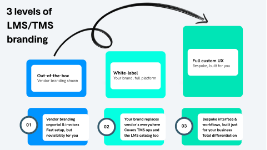
What to Look for in a White-Label TMS (2026 Checklist)
Not all “white-label” claims hold up once you look past the marketing page. Google’s own guidance on creating helpful, people-first content applies just as well here in reverse: the same scrutiny you’d want a reader to apply to a vendor’s claims is what you should apply during evaluation. When you’re checking a white label training platform against your actual needs, look for these specifics:
- Full domain and portal branding – your own domain, not a subdomain of the vendor’s; your logo and colors across every learner, admin, and instructor portal; no vendor branding in footers or “Powered by” tags.
- Branded transactional communications – confirmation emails, reminders, calendar invites, and notifications sent from your domain, not the vendor’s mail server.
- White-labeled invoicing and payments – invoices, receipts, and payment pages that show your company name and tax details, not a third party’s.
- Custom certificates and credentials – templates that are fully yours, design and wording included, since these get shared publicly on LinkedIn and resumes.
- Multi-tenant, partner-ready architecture – if you resell or franchise training, the platform needs to let you white-label separately per partner or business unit, not just once at the top level.
- API and integration flexibility – the ability to plug the white-labeled TMS into your CRM, HR, or finance stack without breaking the brand experience for end users.
- Native LMS inclusion, not a bolted-on add-on – if you also deliver e-learning content, check whether it runs on the same contract and data model as the TMS, or whether you’re stitching together two vendors and two brand experiences.
That last item is where most providers get stuck. It’s rare to find both layers genuinely white-labeled under one roof.
Seven checklist items separate a real white-label TMS from a rebrand in name only, and the last one, native LMS inclusion, is where most vendors quietly fall short.
The Real Cost of Getting This Wrong
If you’re a provider that only white-labels your LMS, you will find out about it the hard way, typically in a situation where a procurement person from the corporate customer asks why the booking emails are coming from some other company, or in an audit when it comes out that the attendance was logged on some platform you’ve never even heard of. And at that point, the solution is no longer a matter of simply changing some settings. It’s a vendor migration: re-training instructors, re-mapping integrations, and re-explaining the switch to every learner mid-program.
It’s a solvable problem. But it’s far cheaper to solve during vendor selection than after a few hundred cohorts have already run on an unbranded backend.
The gap between a white-labeled LMS and an unbranded TMS usually surfaces during a client audit, by then, fixing it means a full vendor migration, not a settings change.
SimpliTrain: White-Label TMS and LMS, One Contract
Most platforms force a choice: white-label your learning experience with an LMS vendor, and separately negotiate, or simply accept the absence of, white-labeling for your operations backend with a different TMS vendor. That split creates two vendor relationships, two support queues, and two brand experiences to keep consistent.
SimpliTrain was built to close that gap. It’s a training operating system offering native white-labeling across both the TMS and the LMS from a single contract, scheduling, instructor management, enrollment, invoicing, compliance tracking, and the learner-facing catalog all carry your brand end to end, without stitching together separate vendors or compromising on which layer gets rebranded and which doesn’t.
When you’re a training provider offering ILT and vILT on a grand scale, it means that all points of contact, starting from the first booking email and ending with the final certificate, must be yours through and through.
Want to know what white-labeling your entire operations and learning process can look like for your business? Book a demo with SimpliTrain and we’ll walk through your specific ILT/vILT workflows.
FAQs
How does the white-labeling of TMS differ from that of an LMS?
White-labeling the LMS allows for rebranding of the front-end of e-learning: the course catalogue, video player, and the certificates. However, white-labeling a TMS implies rebranding the entire training operations layer, including scheduling, instructor management, enrollment process, invoicing, and compliance tracking. If you offer instructor-led or virtual instructor-led trainings, then the white-labeling of the TMS layer becomes necessary because all the learner and client touchpoints are located there.
Is it possible to white-label the LMS and leave the TMS layer unchanged?
It is possible, although not preferable, because you cannot ensure full consistency of your brand. Your learners and corporate clients will be still exposed to emails, calendar invites, invoices and instructor portals that belong to the platform of your vendor. Moreover, for your resellers, franchises or certification partners, the lack of the white-labeling may lead to the breach of brand consistency terms specified by a master licensor.
Can I get white-label TMS and LMS from a single vendor?
Yes, although this is relatively rare. Vendors tend to focus on either layer exclusively, meaning that providers have to integrate two separate platforms under two separate brands. However, we do natively white-label both the TMS and LMS under one contract, which means that scheduling, invoicing, compliance and learning experience will all come under one brand.
What should go on my evaluation checklist for a white-label TMS?
Begin with the things that your clients will see when working with the system: transactional emails, invoices, certificates and instructor portal – not the dashboard that you’ll use when demonstrating the product. If the vendor can rebrand the admin interface but leaves their branding on transactional emails and invoices, then they’ve missed the point.
Why is this more important for certification bodies and training resellers?
Because brand consistency is not something that comes out of a desire but out of necessity. Certification bodies and master licensors usually expect their partners to provide white-label experience of all aspects of the work including the unbranded TMS layer, invoices, calendar invites, instructor portals even though the catalogue of courses may be fully branded.