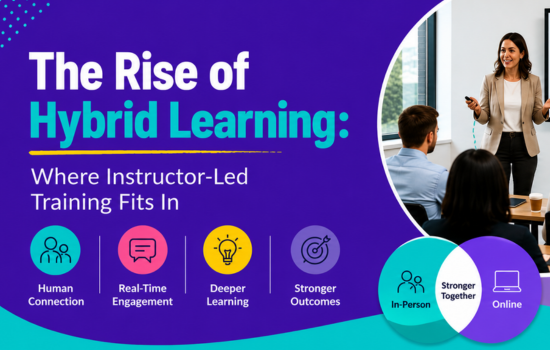





The Rise of Hybrid Learning: Where Instructor-Led Training Fits In
Organizations today are balancing remote work, distributed teams, skill shortages, and changing learner expectations. As a result, companies are moving away from fully classroom-based training and purely self-paced learning toward hybrid learning ecosystems that combine flexibility with human interaction.
But amid AI-powered platforms, on-demand content, and automation, one thing remains surprisingly important: Instructor-Led Training (ILT).
This blog explores why hybrid learning is growing rapidly, where Instructor-Led Training fits into this transformation, and why modern organizations are blending digital learning with live facilitation to improve engagement, retention, and business outcomes.
Hybrid Learning Is Becoming the Default Training Model
The corporate learning landscape has changed dramatically over the past few years.
Organizations are no longer asking whether learning should be online or offline.
Instead, they are asking:
- How do we make learning flexible?
- How do we improve engagement?
- How do we scale training globally?
- How do we keep human interaction alive?
That is exactly why hybrid learning is rising.
Hybrid learning combines:
- Instructor-Led Training (ILT)
- Virtual Instructor-Led Training (VILT)
- Self-paced digital modules
- Collaborative learning
- Mobile learning
- Real-time discussions
Recent corporate learning trend reports show that hybrid and blended learning models are becoming the preferred training approach for global enterprises because they balance scalability with learner engagement.
Hybrid learning succeeds because it combines the flexibility of digital learning with the accountability and engagement of live instruction.
Why Organizations Are Moving Toward Hybrid Learning
Several major workplace shifts are accelerating hybrid learning adoption in 2026.
1. Distributed Workforces
Remote and hybrid work models have permanently changed how organizations operate.
Employees now work across:
- Different cities
- Multiple time zones
- Hybrid offices
- Remote environments
Traditional classroom-only learning can no longer support this level of workforce distribution effectively. Hybrid learning allows organizations to deliver training consistently without sacrificing accessibility.
According to corporate training trend reports, modern organizations are redesigning learning around “learning in the flow of work” rather than isolated classroom experiences.
The rise of remote work has made hybrid learning less of a trend and more of a business necessity.
2. Learners Want Flexibility, But Not Isolation
One major misconception about modern learners is that they prefer completely self-paced learning.
In reality, learners want flexibility without losing collaboration.
Many organizations discovered that purely self-paced learning often creates:
- Low engagement
- Weak completion rates
- Poor accountability
- Limited knowledge application
Corporate learning communities and industry practitioners increasingly report that learners still value instructor interaction, peer discussion, and live workshops for deeper learning experiences. This is where Instructor-Led Training continues to play a critical role.
Employees may enjoy learning anytime, but they still learn best when human interaction is involved.
Where Instructor-Led Training Fits into Hybrid Learning
Instructor-Led Training is no longer limited to traditional classrooms. In 2026, ILT has evolved into a more flexible and technology-driven experience.
Modern ILT now includes:
- Virtual instructor-led workshops
- Live collaborative sessions
- Interactive hybrid classrooms
- Cohort-based learning
- Real-time simulations
- Peer learning experiences
Instead of replacing ILT, hybrid learning is redefining how it is delivered.
Industry reports show that Virtual Instructor-Led Training (VILT) is becoming one of the most important pillars of corporate learning because it combines scalability with engagement.
For example, many organizations now use:
- Self-paced modules for foundational knowledge
- ILT sessions for practice and collaboration
- Hybrid workshops for application and feedback
This layered approach improves both learner engagement and knowledge retention.
In hybrid learning ecosystems, Instructor-Led Training becomes the human layer that transforms information into practical understanding.
Why Instructor-Led Training Still Matters in 2026
Despite the growth of AI-powered learning and automation, ILT remains highly valuable for specific learning outcomes.
1. Better Engagement
Live sessions encourage participation, discussion, and real-time feedback.
Learners remain more attentive when instructors actively facilitate conversations and activities.
2. Stronger Skill Application
Skills such as:
- Leadership
- Communication
- Problem-solving
- Sales
- Team collaboration
require interaction and coaching, not just content consumption. This is why many organizations are increasing investments in facilitator-led learning experiences again.
3. Higher Accountability
Structured instructor-led sessions improve:
- Attendance
- Participation
- Completion rates
- Learner consistency
This becomes especially important in compliance, onboarding, and leadership development programs.
Content alone rarely changes behavior. Guided learning experiences do.
Technology Is Powering the Hybrid Learning Revolution
Hybrid learning depends heavily on operational coordination and learning technology.
Organizations now require systems capable of managing:
- Instructor scheduling
- Virtual classrooms
- Learner tracking
- Assessments
- Certifications
- Analytics
- Attendance
- Cohort management
This is why modern learning ecosystems increasingly combine LMS platforms with Training Management Systems (TMS).
The future of hybrid learning depends not just on content quality, but on operational excellence and seamless learner experiences.
The Future of Hybrid Learning
The next generation of hybrid learning will become even more personalized and intelligent.
Emerging trends include:
- AI-powered learning personalization
- Skills-based learning paths
- Learning analytics
- AR/VR simulations
- Microlearning integration
- Real-time learner insights
- Adaptive learning systems
However, even as technology advances, experts consistently emphasize that human-led facilitation remains essential for meaningful learning outcomes.
The future is not about replacing instructors. It is about empowering instructors with better technology, better analytics, and better operational systems.
The most successful learning ecosystems in 2026 are not fully digital, they are intelligently human.
Conclusion
Hybrid learning is no longer the future of corporate training.
It is the present.
Organizations are adopting hybrid learning because it offers the flexibility of digital learning while preserving the engagement and collaboration of Instructor-Led Training.
In this evolving ecosystem, ILT is not disappearing.
It is becoming more strategic.
Companies now rely on Instructor-Led Training for:
- Collaboration
- Coaching
- Behavioral learning
- Leadership development
- Skill application
- Learner engagement
At the same time, self-paced learning and automation continue to improve scalability and accessibility.
The organizations that succeed in 2026 will not choose between technology and human instruction.
They will combine both to create connected, operationally efficient, learner-centered hybrid learning ecosystems.