




It is impossible to host hundreds of commercial courses simultaneously without some sort of internal automation. New horizons training centers offer over 900 technology courses at a time by deploying a Training Management System (TMS) that synchronizes their website with the CRM. A corporate client buying a seat automatically updates the room availability, adds the details of the trainer and tracks the revenue. No manual updates of any information required.
The real cost of managing enterprise IT training delivery
Hosting hundreds of instructor led training sessions per month exposes the weaknesses in your back office processes. You can’t effectively manage enterprise IT training with a disconnected spreadsheet approach. Every time a coordinator manually copies a booking from your website into your sales database you are bleeding profit margin.
A 2026 operations benchmark report from Training Industry found that commercial training providers waste roughly 15 hours a week on unbillable data entry. This occurs when the front end checkout process doesn’t synchronize with back-end fulfillment tools. If a trainer calls in sick then managers have to manually update the website, notify delegates and fix the billing status in their CRM.
Enterprise leaders eliminate this friction by developing a fully integrated software stack. A 2025 technology study from the Association for Talent Development (ATD) found that integrated training businesses enjoy 40% faster cash flow velocity. This is achieved by removing human intervention from the registration, scheduling and billing pipeline.
What is Tri-directional synchronization in training software?
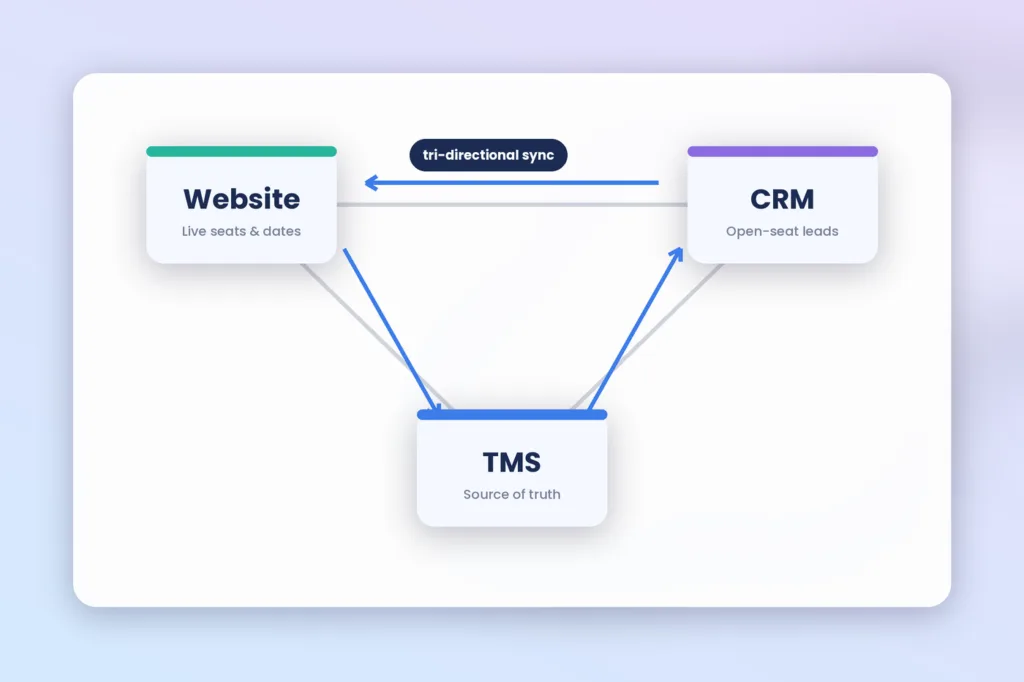
Tri-directional synchronization is a system capability that establishes a secure connection between the public-facing website, Training Management System (TMS), and Customer Relationship Management (CRM).
With such synchronization, TMS and CRM receive real-time data exchange with the website. This feature eliminates the need for separate maintenance of TMS, CRM, and public-facing website. For example, TMS stores all the information about the training courses catalog, which is regularly updated on the website.
At the same time, TMS syncs with CRM and automates the flow of leads and revenue data to CRM. Tri-directional synchronization can also prevent scheduling errors. In case of cancellation in TMS, the website will be immediately updated, and the CRM system will notify an account executive to contact the buyer.
How the website frontend drives dynamic checkout
As your public website is a digital storefront for your course catalogue, it has to reflect precisely what is on offer in the classroom. A connected site is in constant contact with the TMS database to provide real seat numbers, upcoming dates and venue information.
When a learner tries to buy a certification course, your website has to check for seat availability before running their card. If you use standard e-commerce plugins but lack this live check, you will inevitably oversell a physical classroom leading to immediate fire code compliance issues and awkward refund conversations.
Corporate buyers need an entirely separate checkout pathway on your frontend. A company HR director might want to buy twenty seats on one purchase order, an integrated website would capture this bulk request and route the invoice straight through the TMS. If you are having trouble structuring these corporate tiers, we have a guide to help you with how to price training courses.
Managing resource and instructor allocation in the TMS
Generic scheduling applications only allocate a timeslot, whereas a dedicated TMS (Training Management System) takes care of the involved physical logistics as well. It simultaneously books the physical room, the required hardware, as well as the human instructor upon a session’s start.
Such resource governance is then critical for maintaining profitable operations. Whenever a new session is created, the system checks whether the assigned trainer does indeed hold the required credentials. It also evaluates their travel time between geographical destinations, which enforces mandatory rest time.
A good TMS also manages the wait list in such a way to protect the delivery margins. Whenever a corporate delegate cancels their registration 48h before the start of a session, the system is able to automatically promote the first waiting learner. According to a 2026 analysis by Accessplanit, such an automated process can help recover up to 15% of otherwise lost session revenues.
Why CRM integration secures recurring corporate B2B billing
Connecting the CRM to the delivery platform makes the sales team more productive. The integrated system enables account executives to always know the open seat capacity within a particular course.
The integration can help the company increase revenue by providing value to corporate accounts that want to buy seats for their employees. For example, if five engineers from the same organization sign up for separate courses, the CRM will notify the assigned sales representative, who can then offer a private cohort course for the enterprise’s employees.
The integration will also make invoicing faster. According to the 2026 data intelligence report by Salesforce, companies that use automated billing and invoice software reduce their accounts receivable cycle by approximately 22 days on average. When a course is completed, the TMS notifies the CRM of a closed-won opportunity and sends the invoice.
Why custom WordPress plugins are failing complex B2B logistics
While many providers attempt to address the needs through custom WordPress plugins, such solutions are failing to keep up with the demands of commercial training logistics. Generic e-commerce plugins are treating courses as a t-shirt, ignoring instructor availability, room sizes and complex cancellation rules.
Training operations are changing constantly and unpredictably. A single client request can require moving the venue, trainer and a discount rate at the same time. Custom-developed calendar plugins are unable to keep up with such operational realities without disrupting data pipeline integrity.
Meanwhile, the technical debt created by custom API bridges is crippling many providers. Every WordPress core update creates the possibility that a custom security patch or API call will fail. Native migration to a purpose-built platform eliminates this risk entirely.
Comparing integration methodologies: Custom APIs vs. Native TMS
Your approach to architectural integration will determine your long-term costs and software reliability. Compare your options using these three common frameworks before moving forward.
If you’re in the market to replace a precarious custom solution, refer to our Training Management Software Buyer’s Guide 2026 to identify the API specifications you should request from vendors.
| Integration Method | Best Used For | Operational Risk | Maintenance Cost |
|---|---|---|---|
| Custom CMS Plugins | Very small, local B2C providers | High risk of double-booking | High developer fees |
| Middleware (Zapier) | Simple data transfers | Data latency causes errors | Moderate monthly fees |
| Native TMS Platform | Enterprise B2B ILT providers | Very low risk | Built into license fee |
The three step checklist for automating your training tech stack
Integrating your systems without disrupting your live client classes requires a clear strategy. This simple three step framework will help you get your operations in order without sacrificing active revenue:
- Combining the master catalog: Make your TMS the ultimate source for describing courses, pricing tiers and session dates, in order to eliminate all hard-coded course information from your website CMS.
- Automation of the checkout data flow between your website checkout gateway and TMS to process isolated credit card payments and corporate purchase orders.
- Mapping of learner data to the CRM: Setting the transfer of data from the TMS to your CRM and ensuring that individual learner records are placed under corporate parent accounts.
FAQs
1. How does New Horizons maintain its course catalog?
New Horizons’ use of enterprise training management system (TMS) is the backbone of the enterprise. It is a central database that automatically uploads the schedule, the availability of seats and instructor information to its website to provide students with updated and relevant training information.
2. How do you link a training website with a CRM?
To link a training website to a CRM, an automated API or TMS bridge needs to be installed. Both options give you the chance to transfer the information about the purchased course, contact data, and company to your CRM in real time and remove the necessity to enter any data manually.
3. What is tri-directional sync in training software?
Tri-directional sync is the synchronization between the public facing website, the backend training management system and the CRM. So any change in the course date in the TMS will automatically update the website and the CRM so that the sales team can see the latest information.
4. Why do custom WordPress booking plugins fail at B2B logistics?
Custom WordPress plugins tend to fail at advanced corporate invoicing processes or ones with high variability of courses. A true TMS knows the nuances of B2B instructor-led training: It can account for classroom capacities, teacher conflicts and even enforce a sliding-scale cancellation policy that a generic e-commerce plugin would have no hope of implementing.
5. How does a connected CRM drive corporate training sales?
Linked to a CRM, your sales reps have visibility into available seats across your catalog of courses at all times. This lets your account executives sell out remaining seats to corporate clients, negotiate volume discounting more strategically and recognize patterns that drive recurring B2B training revenue.
Scale your training operations like an enterprise leader
The key to running a profitable commercial training business is to remove friction from the relationship between your buyers, your scheduling team, and your sales reps. To do that, you’ll want your course catalogue, website, and CRM to be able to communicate seamlessly with one another in order to unlock the full potential of your business.
If your coordination team still enters registration data from a web form into a sales database manually, it’s time to invest in a better system. See our article about the best training management software for small business to learn more about foundational tools. Want to see the full end-to-end solution in action?
Check out the features on the SimpliTrain Product Page or schedule a SimpliTrain Demo today.