





What Is a Headless TMS? (Quick Definition)
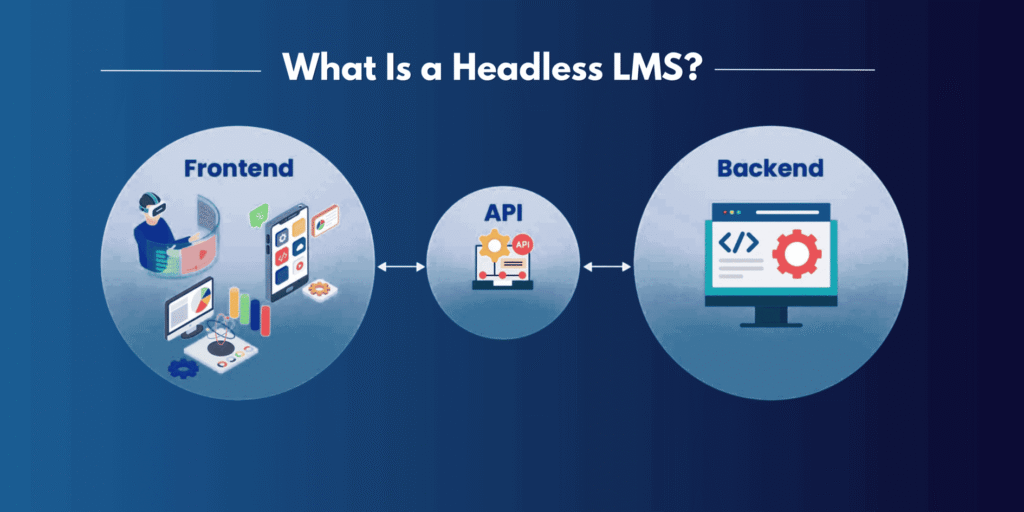
A headless TMS (Training Management System) is a training operations backend, covering scheduling, instructor and venue management, enrollment, payments, and compliance reporting, that’s accessible entirely through APIs, with no fixed user interface attached. You design and build the frontend yourself; the TMS vendor runs the operational engine behind it.
Where a traditional TMS hands you a pre-built admin dashboard and learner-facing booking flow, a headless TMS hands you the same operational capabilities as raw, structured API endpoints. What you display, how it looks, and where it lives (your product, your portal, your internal tool) is entirely up to you.
“Headless doesn’t mean ‘no interface.’ It means the interface isn’t ours to dictate, it’s yours to build.” – SimpliTrain
How a Headless TMS Works
A headless TMS is structured in two layers that talk to each other exclusively through APIs, the same pattern as a headless LMS, just applied to operations instead of content.
The backend (the engine):
- Instructor-led session scheduling and batch capacity management
- Instructor, trainer, and venue assignment
- Enrollment and waitlist workflows
- Payments, invoicing, and refunds
- Multi-tenant and multi-client account structures
- Compliance, audit, and reporting logic
The frontend (the “head”):
- A custom booking and scheduling interface inside your own app
- An internal ops dashboard your team already uses, extended with training data
- A partner or franchise portal with its own design system
- A learner-facing enrollment flow embedded in your product
The connective layer: REST or GraphQL APIs, often paired with webhooks, so that events like “session fully booked” or “invoice paid” can trigger real-time actions in whatever system you’ve built.
This is the same decoupled-architecture principle covered in our Headless LMS explainer, but instead of decoupling course content, a headless TMS decouples the machinery that runs training as an operation.
“If a headless LMS is the engine for content, a headless Training Management System is the engine for logistics, and most training programs need both running at the same time.”
Headless TMS vs. Headless LMS: Two Different Engines
It’s easy to conflate these, so it’s worth being precise. They solve different problems and, ideally, work together.
Most real training programs, especially instructor-led, cohort-based, or compliance-driven ones, need both engines running under one custom frontend. A headless LMS without a headless TMS can show a learner their course, but not book them into next month’s live session, assign an instructor, or generate the invoice for it.
| Headless LMS | Headless TMS | |
|---|---|---|
| What it decouples | Content delivery | Training operations |
| Core data | Courses, lessons, quizzes, completions, certificates | Schedules, instructors, venues, payments, enrollments, compliance |
| Typical API calls | “Get course progress,” “mark module complete,” “issue certificate” | “Book a session,” “assign instructor,” “generate invoice,” “pull compliance report” |
| Who needs it most | Teams building a custom learning experience | Teams running instructor-led or blended training as a business function |
| Alone, it solves | How content is displayed and consumed | How training is scheduled, staffed, and billed |
“A content API tells a learner what to learn. An operations API tells the business how training actually gets delivered. You need both, or you’ve only automated half the job.”
Headless TMS vs. White-Label TMS: Don’t Confuse These
This is the distinction most vendors blur, and it’s worth stating plainly:
White-label TMS means you use SimpliTrain’s existing interface, the admin console, the learner portal, the booking flow, with your logo, colors, and domain applied on top. You’re not building anything. You’re rebranding something that already exists and works out of the box. This is covered in depth in our White-Label Training Management System pillar.
Headless Training Management System means there is no interface to rebrand. You’re not skinning our UI, you’re building your own UI, from scratch, using our API as the backend. Nothing about the frontend is inherited from SimpliTrain. The only thing that’s ours is what runs underneath it.
| White-Label TMS | Headless TMS | |
|---|---|---|
| Frontend origin | SimpliTrain’s UI, rebranded | Built entirely by you |
| Design freedom | Limited to available theming | Unlimited |
| Engineering effort | Minimal, mostly configuration | Significant, full frontend build |
| Time to launch | Fast | Slower, but fully custom |
| Best for | Reselling training under your brand quickly | Embedding training operations natively into your own product or experience |
Put simply: white-label is “use ours, rebranded.” Headless is “build your own.” Both run on the same SimpliTrain backend, the difference is entirely in who owns the frontend.
“White-label gets you our head with your paint job. Headless gets you no head at all, just the body, ready for whatever you want to build on top.”
Why This Category Doesn’t Really Exist Yet
Search “headless Training management system” today and you’ll find almost nothing. The handful of adjacent mentions, most notably from Administrate, treat the Training management system, as a supporting backend to a headless LMS, not as a headless product category in its own right. Nobody has defined “headless Training management system” as a thing you can evaluate, compare, or buy on its own terms.
That’s a gap, not an accident. Most Training Management System platforms were built as monolithic, UI-first products: you get the scheduling engine because you’re using the admin dashboard, not the other way around. Very few Training Management System vendors expose their operational core as a standalone, well-documented API product.
SimpliTrain is defining the category on its own terms:
“We get you the backend, the TMS/LMS engine and admin features. You build your own frontend, the head.”
That single sentence is the entire model. Everything else in this article is detail on top of it.
What You Actually Get With a Headless TMS
When you adopt SimpliTrain’s headless TMS, you’re not getting a stripped-down product, you’re getting the full operational engine, exposed as API:
- Scheduling API create, update, and manage instructor-led sessions, cohorts, and batch capacity
- Instructor & venue API assign trainers, manage availability, coordinate physical or virtual venues
- Enrollment API handle registrations, waitlists, approvals, and cancellations
- Payments API trigger invoicing, process payments, issue refunds
- Compliance & reporting API pull audit trails, attendance records, and regulatory reports on demand
- Admin console a management layer your operations team can still use directly, even while your customer- or learner-facing frontend is entirely custom
Combined with the Headless LMS content layer, this gives you what we call a full training operating system, a backend that runs both the content and the operations of training, leaving the entire frontend experience in your hands. We go deeper on that combined model in our Training Operating System post.
“The backend runs the business logic. The frontend runs the brand experience. Headless just means we stay firmly out of your way on the second part.”
Real-World Use Cases
A headless Training management system makes the most sense for organizations that already have (or need) full control over their frontend experience:
- Training companies and academies building a proprietary booking and cohort experience they can’t get from an off-the-shelf portal
- Enterprises embedding instructor-led training scheduling directly into an internal HR or LMS tool they’ve already built
- SaaS platforms that offer certification or onboarding programs and want training operations to feel like a native part of their product, not a bolted-on third-party tool
- Franchise and multi-location businesses that need one operations engine powering many differently branded, differently designed local frontends
- EdTech and workforce-development platforms where the booking and scheduling experience is itself a core differentiator, not something to outsource visually
If your team doesn’t have frontend engineering resources, or you just need a fast, working portal, a white-label Training Management System is almost always the more practical starting point.
“Headless isn’t for everyone, it’s for teams who already know exactly what they want their frontend to look like, and just need someone else to run what’s underneath it.”
How to Evaluate a Headless TMS
If you’re vetting vendors claiming API-first or headless training operations, check for these specifically:
- Full API coverage of operations not just scheduling, but instructors, payments, enrollment, and compliance reporting too.
- Real, current API documentation ask to see it directly, not a roadmap slide.
- Webhooks for real-time events session booked, payment received, certificate issued, should all be able to trigger your systems instantly.
- Multi-tenant support at the API level critical if you’re serving multiple brands, clients, or franchise locations from one backend.
- An admin console that doesn’t require the API your internal ops team should still be able to manage things directly when they don’t need a custom view.
- Clear separation from white-label confirm whether the vendor is actually exposing a true API-first backend, or just calling their white-label theming options “headless.”
Final Thoughts
“Headless Training management system” isn’t a category that exists in the market yet, search for it and you’ll find almost nothing written specifically about it. That’s exactly why it’s worth defining clearly, in plain language, rather than borrowing loosely from headless LMS or headless CMS conventions.
The model is simple: we get you the backend, the TMS/LMS engine and admin features. You build your own frontend, the head. Not rebranded. Not themed. Actually yours, running on an operational engine you don’t have to build or maintain.
If your team is ready to design a fully custom training experience and just needs the operational backend to run underneath it, the fastest way to see what’s possible is to look at the API itself.
FAQs
01 – Is a headless Training Management System the same as a headless LMS?
No. A headless LMS decouples content delivery (courses, quizzes, certificates). A headless TMS decouples training operations (scheduling, instructors, payments, compliance). Many organizations need both, ideally from a backend that exposes them together.
02 – What’s the difference between headless and white-label?
White-label means using the vendor’s existing interface with your branding applied. Headless means there’s no vendor interface at all, you build your own frontend entirely, using the vendor’s API as the backend.
03 – Do I need developers to use a headless TMS?
Yes. Because there’s no default frontend, you (or a development partner) need to build the interface that consumes the API. This is the core trade off versus a white-label or traditional TMS.
04 – Can I combine a headless Training Management System with a headless LMS?
Yes, this is exactly what SimpliTrain’s combined architecture is built for. One custom frontend, backed by both a Content API (LMS) and an Operations API (TMS), covering the full training operating system.