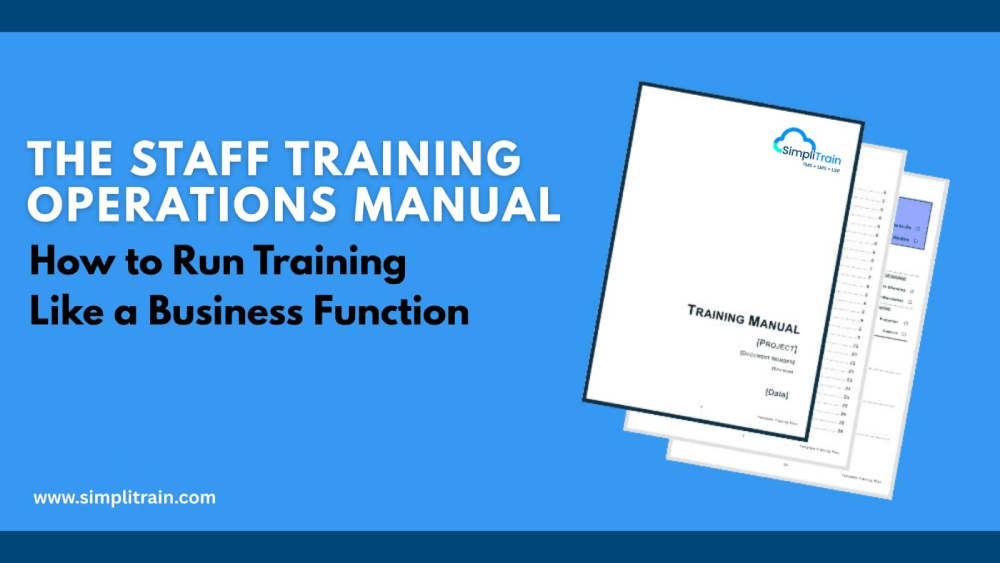





The staff training operations manual
How to Run Training Like a Business Function
2026 Training Operations Playbook | L&D Leadership Guide
$102.8B
Annual corporate training spend in 2025 (Training)
75%
Of organizations rank business alignment as a top L&D priority (Brandon Hall Group)
70%
Of training is still delivered through instructor-led modalities (ILT/vILT) (Brandon Hall Group)
40%
Potential reduction in training administration through integrated training management systems
01. STATE OF TRAINING OPERATIONS
Organizations have never invested more in workforce development.
Corporate training spending surpassed $102 billion in 2025, yet many L&D teams still struggle to connect training activity with measurable business impact. The problem is not a lack of learning content.
The problem is operational execution. Training requests arrive from every department. Courses are delivered. Attendance is tracked. Certificates are issued. Yet many organizations still cannot answer critical business questions:
- What is our cost per learner?
- Which staff training programs drive performance?
- How many coordinator hours are spent on administration?
- Which programs should be expanded or retired?
Training is often managed as a collection of events rather than a business function.
The New Reality
High-performing organizations no longer manage training as a support activity.
They manage it like:
- Finance manages budgets
- Sales manages pipelines
- Operations manages efficiency
02. THE TRAINING OPERATIONS CHALLENGE
Why Staff Training Programs Break at Scale
As organizations grow, training complexity increases exponentially.
The Five Operational Breakpoints
1. Scheduling Chaos
Training scheduling often relies on spreadsheets, email threads, and calendar coordination.
The result:
- Double bookings
- Missed sessions
- Resource conflicts
- Administrative overload
2. Fragmented Systems
Many organizations operate across:
- LMS
- HRIS
- Virtual classrooms
- Assessment tools
- Reporting systems
Disconnected technology creates disconnected data.
3. Resource Visibility Gaps
Few organizations maintain a centralized view of:
- Trainers
- SMEs
- Vendors
- Training locations
- Learning resources
This results in underutilized resources and unnecessary costs.
4. Poor Measurement
Many teams measure:
- Attendance
- Completion rates
- Satisfaction scores
Very few measure business impact.
5. Administrative Overload
Training managers spend significant time coordinating logistics rather than improving learning outcomes. Time remains one of the biggest constraints facing learning organizations today.
03. INDUSTRY SPOTLIGHT
Where Training Operations Matter Most
Healthcare
Training must support certifications, compliance, clinical competencies, and recertification requirements.
Manufacturing
Safety training, operational certifications, and shift-based scheduling require precise coordination.
Financial Services
Regulatory training demands audit-ready reporting and completion tracking.
Technology
Rapid upskilling requires scalable learning operations and measurable outcomes.
Commercial Training Providers
Managing multiple clients, instructors, schedules, and revenue streams requires operational discipline.
04. THE 6-PILLAR TRAINING OPERATIONS FRAMEWORK
Pillar 1: Strategic Alignment
Every training initiative should map to a measurable business outcome.
Examples:
- Reduced onboarding time
- Increased productivity
- Improved compliance
- Faster time-to-competency
If training cannot be linked to business impact, it should be re-evaluated.
Pillar 2: Training Scheduling & Capacity Planning
Training scheduling should be automated wherever possible.
Best practices include:
- Centralized calendars
- Automated reminders
- Conflict detection
- Waitlist management
- Multi-location visibility
Pillar 3: Resource Management
Create a single source of truth for:
- Internal trainers
- External facilitators
- SMEs
- Venues
- Virtual resources
Resource utilization should be monitored continuously.
Pillar 4: Training Software Management
Training software management is the operational backbone of modern L&D.
Key capabilities include:
- Scheduling automation
- Enrollment management
- Reporting
- Trainer allocation
- Cost tracking
- Compliance monitoring
Organizations increasingly invest in human capital technology to improve operational effectiveness.
Pillar 5: Learner Experience
The learner journey should be frictionless.
Best practices:
- Self-service enrollment
- Mobile access
- Automated communication
- Personalized learning paths
Pillar 6: Measurement & Optimization
Training should be managed using operational KPIs, not assumptions. Every completed program should generate actionable insights.
05. THE KPI FRAMEWORK
The KPIs Every Training Leader Should Track
| KPI | Basic | Mature | High Performing |
|---|---|---|---|
| Training Completion Rate | <70% | 70-85% | >90% |
| No-Show Rate | >20% | 10-15% | <7% |
| Coordinator Hours per Session | >8 hrs | 4-7 hrs | <3 hrs |
| Cost per Learner | Unknown | Quarterly Tracking | Real-Time |
| Trainer Utilization | <60% | 65-75% | >80% |
| Training ROI | Not Measured | Partial | Consistently Measured |
Adapted from industry benchmarks and training operations best practices.
06. THE BUSINESS CASE FOR TRAINING OPERATIONS
Conversation 1: The Cost of Inaction
What does a 15% no-show rate cost your organization annually? How much productivity is lost through missed training?
Conversation 2: The Administration Tax
How many hours does your team spend:
- Scheduling
- Chasing attendance
- Updating records
- Generating reports
These are activities that should be automated.
Conversation 3: The Performance Impact
Training should improve:
- Productivity
- Compliance
- Revenue
- Customer outcomes
- Employee retention
The objective is not more training. The objective is better business performance.
07. THE 90-DAY TRAINING OPERATIONS ROADMAP
Days 1–30: Audit
- Review all staff training programs
- Identify operational bottlenecks
- Baseline KPIs
- Map existing systems
Days 31–60: Build
- Standardize training scheduling
- Centralize trainer management
- Automate communications
- Implement reporting dashboards
Days 61–90: Optimize
- Measure operational KPIs
- Review learner feedback
- Eliminate manual processes
- Establish continuous improvement cycles
08. TRAINING OPERATIONS HEALTH CHECK
Strategic Alignment
- Training linked to business KPIs
- Annual training needs analysis completed
Training Scheduling
- Centralized scheduling process
- Automated reminders enabled
- Conflict detection active
Training Software Management
- Training platform in place
- Reporting automated
- Learner records centralized
Measurement
- Cost-per-learner tracked
- Completion rates monitored
- ROI measured
FINAL THOUGHT
Organizations that treat training as a business function consistently outperform those that treat it as an administrative activity.
The future of L&D belongs to teams that can manage:
- Staff training programs
- Training scheduling
- Training software management
- Resource utilization
- Learning performance
with the same operational discipline applied to any other business function.
About SimpliTrain
SimpliTrain is an end-to-end training operations platform designed for organizations that need to manage staff training programs at scale.
With SimpliTrain You Can:
- Automate training scheduling
- Manage instructors and resources
- Track KPIs in real time
- Centralize training operations
- Improve compliance and reporting
- Measure training impact
Book a Demo → SimpliTrain.com