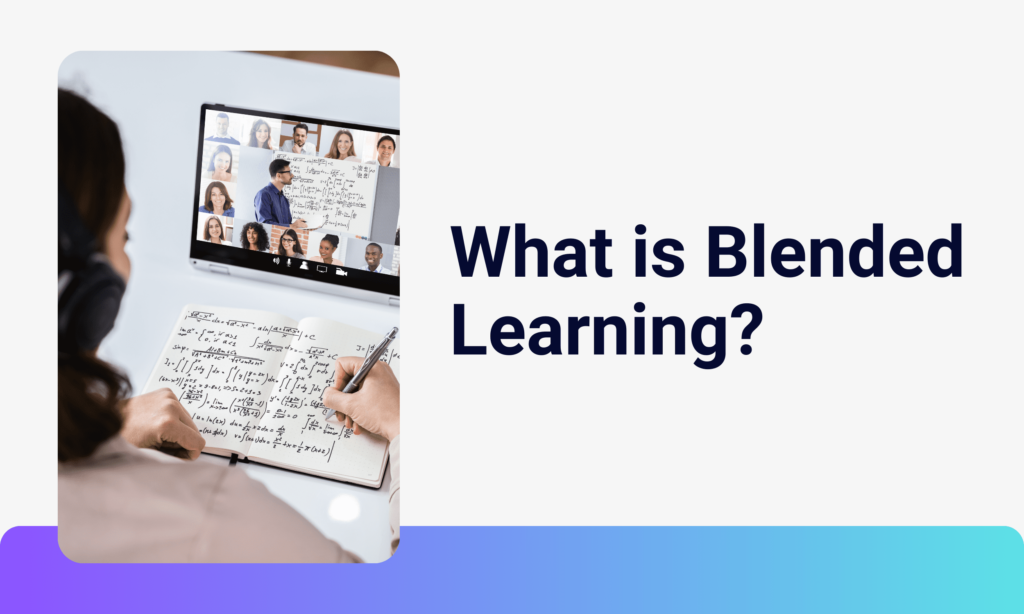





“Blended learning” is a term almost every training program already uses in some form, mixing a live session with self-paced content, without necessarily calling it that. The label is generic enough that it has become close to meaningless on its own. What actually matters is which specific mix, and why, which is the part most explanations of the term skip entirely.
What is blended learning?
Blended learning is any training approach that deliberately combines live, instructor-led instruction with self-paced digital content, rather than relying on one format alone. The “blend” describes the mix, not a single fixed formula, which is why two programs both calling themselves blended learning can look completely different in practice.
Does blended learning actually work better?
The most-cited evidence here is older than most articles citing it acknowledge, and it comes with a caveat that rarely makes it into the summary.
Means, Toyama, Murphy and Baki, in a 2013 meta-analysis commissioned by the U.S. Department of Education and published in Teachers College Record, analyzed 50 effects across 45 studies comparing online, blended and face-to-face instruction. For the 23 contrasts specifically comparing blended learning against face-to-face-only instruction, they found a statistically significant weighted effect size of g = +0.35 (p < .0001) favoring blended learning.
The caveat matters as much as the number. The authors noted directly that studies using blended learning also tended to involve more total learning time, more instructional resources, and more built-in opportunities for interaction than the face-to-face comparison groups, which leaves open the possibility that those extra factors, not the blend itself, produced the advantage. In practice, that means the honest takeaway is not “blending automatically improves outcomes.” It is “programs that add more time, better resources and more interaction tend to work better, and blending is often how that extra investment gets delivered.”
What actually makes up a blended program
The live component
Direct interaction, whether in person or virtual, that allows for real-time feedback, discussion and hands-on practice. This is where questions get resolved and skills get demonstrated, not just described.
The self-paced component
Digital content, video, reading, interactive modules or assessment, that learners work through independently. Its value is flexibility and reach: content built once can serve any number of people on their own schedule.
Learner control
Genuine blended programs give learners some real control over pace, and sometimes path, through the self-paced portion specifically. A program that simply schedules half its hours online and half in person, with no actual learner choice, is technically blended but is not capturing the flexibility that makes the model worth the extra design effort.
The platform underneath
Without a system that connects the two halves, scheduling the live sessions, tracking who completed the self-paced material before showing up, and reporting on both together, a blended program tends to split into two disconnected tracking problems. This is the part most explanations of blended learning skip, and it is usually where implementations actually break down.
Common blended learning models
- Flipped classroom. Self-paced content comes first, live time is reserved for applied practice. Covered in full in our flipped classroom guide, including what the research says about how large the effect actually is.
- Rotation model. Learners rotate between stations or formats, some online, some live, on a fixed schedule within a single session or program.
- Flex model. Most content is delivered online, with live instruction available as targeted support rather than as the default delivery method.
- Enriched virtual model. The majority of the program runs online, with periodic scheduled live sessions for support, assessment or deeper application.
None of these is inherently better than the others. The right one depends on how much of the content genuinely benefits from real-time interaction versus how much is reference material learners can absorb independently.
Blended learning as a workplace training platform
In a corporate setting, the label matters less than a specific operational question: can one system schedule the live sessions, deliver and track the self-paced content, and report on completion across both, or does running a blended program mean stitching together a course platform and a separate scheduling tool.
That question is exactly what a training management system built for blended learning answers. It matters more as programs scale, because the coordination overhead of running live sessions and self-paced tracks on separate systems grows with every additional cohort, while a combined system keeps that overhead flat.
One training organization’s approach to exactly this problem, standardizing a blended delivery model across live and self-paced tracks, is covered in our blended learning case study. For a deeper look at building the operational side of a blended program specifically, our guide on future-proofing training with a training management system goes further into implementation than this overview does.
Where blended programs run into trouble
- Access isn’t equal. Reliable technology and internet access for the self-paced portion cannot be assumed for every learner, particularly frontline and field roles.
- Facilitators aren’t trained for the shift. Running a blended session well is a different skill from running a fully live one, and that gap is rarely addressed explicitly.
- Self-paced completion isn’t tracked before the live session. Without visibility into who actually finished the pre-work, live sessions default back into re-explaining material that was supposed to already be covered.
- The blend drifts without a reason behind it. Ratios of online to live time should be a deliberate design choice tied to what each format does best, not an arbitrary split.
Where this approach falls short
The strongest evidence for blended learning’s advantage comes with a real confound attached: programs studied as “blended” also tended to include more total time and more resources than their face-to-face comparison, so part of the measured benefit may belong to the extra investment rather than the format itself. That does not make blended learning a bad choice. It means the honest pitch is “a well-designed mix of live and self-paced instruction, with real learner control and a system that tracks both,” not “blending anything automatically improves results.”
Frequently asked questions
What is the definition of blended learning?
Is blended learning the same as hybrid learning?
What are the main features of a blended learning program?
Does blended learning improve outcomes compared to face-to-face training alone?
What is the difference between blended learning and a flipped classroom?
Where to start
Before choosing a blended model, identify which parts of your current training genuinely need real-time interaction and which parts are reference material learners could absorb independently. That distinction, not the label, should drive the design.
Book a demo to see how SimpliTrain schedules live sessions and tracks self-paced completion on one system, so a blended program does not depend on two tools staying in sync manually.