





Competency based training examples all follow one rule. Nobody gets signed off for turning up. Instead, they get signed off for showing they can do the task. This guide covers five actual training programs including forklift certification, airline pilot simulation training, and medical residency program. You will get an idea about what they assess and who verifies them. You can then replicate the process.
Picture two forklift operators. One scores 100% on a classroom quiz but clips a rack on his first real reverse. The other scores 80% and parks the load perfectly. Which one do you want on your client’s warehouse floor? So competency-based training exists to answer that question honestly. If the idea is new to you, start with our guide to the competency-based training model. Then come back here for the real-world proof.
What do competency based training examples have in common?
Competency-based training programs have a very simple formula. First, the program sets standards for “good.” Second, the program gathers evidence of the ability to achieve it, and someone competent makes the decision. Third, if the learner is not yet able, the program gives another chance.
Four questions reveal that pattern in any program:
- What does the individual need to be able to do? The answer is a task, not a topic.
- How can proficiency be demonstrated? Often by performance, not just a test.
- Who signs off? A named assessor, not the system.
- What happens if they are not ready yet? A feedback and re-assessment path.
Therefore, we will be using the four questions in comparing the examples provided below.
In these cases, the standards are set and the time is variable. Consequently, the price and schedule of training are variable because some learners may complete earlier while others require a second training.
Which real programs show competency-based training in action?
Below are the five programs that were derived from the realms of safety, regulation, higher education, aviation and medicine. The size may vary, but the reasoning remains constant. We have also highlighted when the evidence is dated.
1. Forklift operator training under OSHA
In the US, forklift operators are a textbook case of competency based training examples in the workplace. OSHA’s guidelines for powered industrial trucks require that the training process consists of three components: classroom instructions, practical training, and workplace performance assessment. In other words, a classroom certification is not sufficient.
Evaluation does not stop after day one. OSHA requires it during initial training, at least once every three years and after refresher training. Events also trigger refresher training. These examples include reckless driving, accidents, and near-accidents, and switching to a new type of truck. The last step requires that the certificate contain the name of the operator, dates of training and assessment, and the person who conducted them.
Use this for free: divide the day into theoretical learning and practical observation. Give out the certificate only when there is practical approval. Also, make an entry of the three-year reassessment.
2. NSW Food Safety Supervisor certificate (Australia)
New South Wales requires many food businesses to have a trained Food Safety Supervisor. The NSW Food Authority’s guideline for training organisations sets the rules. Learners must be assessed as competent in set units of competency: two for hospitality or one for retail. An approved registered training organisation then issues the statement of attainment and certificate. The certificate lasts five years.
In this example, there are two interesting points. One of them is that the recognition of prior learning can be used by renewing students, but it’s not possible for newcomers. Another point is that the regulation looked at compliance and foodborne disease information from 2010 to 2015 and spotted issues with egg processing, allergy prevention, and cleanliness. For that reason, those topics were included in training.
Use this for free: provide quicker way to renewal for learners who have experience and improve your materials based on incidents.
3. Western Governors University (higher education)
Western Governors University is one of the best-known examples in higher education. Education Next’s inside look at the university explains the model. Students must prove they have mastered the skills and knowledge in each subject area. First, pre-assessments show when they are ready. Then objective assessments check mastery.
These tests contain both simple questions and performance-based tasks like presentations and case studies. The article also brings up an important point that even good results in other areas cannot compensate for a poor result. The publication was written in 2017; therefore, the statistics provided is outdated.
Steal this: let people test out of content they already know. Also use at least one performance task, not only multiple choice.
4. Evidence-based training for airline pilots
Aviation is an example of a domain that proves how competency-based design works where errors may cost people their lives. The International Air Transport Association defines evidence-based training as a methodology for developing and assessing crucial pilot competencies. This methodology is built upon data that has been obtained in operations and training procedures. IATA initiated this process since 2007, while the International Civil Aviation Organization approved it in 2013 via Doc 9995.
However, it becomes interesting when one considers the data itself. Pilots do not need to repeat a set number of manoeuvres, they select what they are going to train based on evidence that has been acquired during operations.
Stole that? Practice using realistic scenarios and get the assessment consistent among your assessors.
5. Competence by Design for Canadian doctors
Canada moved its specialist medical training to a competency-based model called Competence by Design. A 2024 paper in Perspectives on Medical Education describes a time-variable approach. Educators created new standards and entrustable professional activities with 67 specialties and subspecialties. The change reached 17 universities and more than 1,000 training programs.
An entrustable professional activity is a real task that a supervisor decides whether to trust a trainee with. So the big idea is to judge the whole task, not a list of small skills.
Steal this: list five to eight real tasks your learners must do on the job. Then assess those tasks, not 50 learning objectives.
Insight: Look at the scale of these examples. They range from a one-day forklift course to a national medical system. That tells you competency-based training is a design choice, not a size. So you can apply the same four questions to a half-day workshop.
How do these competency based training examples compare?
The table below puts the five programs side by side. It sums up our reading of the sources above, and the “time” column uses plain-language labels, not official terms.
| Program | Competency standard | Proof of competence | Who signs off | Time |
|---|---|---|---|---|
| OSHA forklift training | Safe operation of the truck type in use | Practical training plus a workplace performance evaluation | Trainer or evaluator with the right experience, then employer certification | Re-evaluate at least every 3 years |
| NSW Food Safety Supervisor | Set units of competency | Assessment by an approved training organisation | The training organisation issues the certificate | Certificate lasts 5 years |
| Western Governors University | Defined competencies in each subject | Pre-assessments, then objective and performance assessments | The university’s assessment system | Learners set their own pace |
| IATA evidence-based training | Key pilot competencies | Assessment of competencies during training | Instructors using a grading system | Recurrent training cycle |
| Royal College Competence by Design | Entrustable professional activities | Observed work on real tasks | Supervisors and training programs | Time-variable |
Insight: Every row has a named signer. Nobody in these programs relies on a quiz score alone. So when you design a course, decide who the signer is before you write the content. That one choice shapes your staffing, your pricing and your risk.
How do competency based training examples look in a training provider’s course?
The five real programs are large. However, you can scale the same ideas down. Here are three small, illustrative designs for a typical provider. They are our own examples, not case studies, so adapt them to your subject and local rules.
| Course | Competency (observable) | Evidence | Sign-off |
|---|---|---|---|
| Customer service skills | Calm an upset customer and agree a next step | Role-play scored on a five-point checklist | Assessor after two observed role-plays |
| Spreadsheet skills for finance teams | Build a monthly report from raw data | Timed task on a supplied file | Assessor checks the result against an answer key |
| Manual handling | Lift and carry a standard box with safe technique | Observed on site with a checklist | Trainer signs the checklist |
Note that all competencies begin with verbs that can be observed. “Understand customer service,” for instance, does not pass this test, while “Calm an upset customer and reach agreement on next steps” does.
Formulating the competency is by far the most difficult task, but it is well worth the trouble. For example, if two assessors interpret the same sentence differently, then it should be rewritten.
How do you design your own competency-based course?
A university budget is not required. You should use these seven steps for any class:
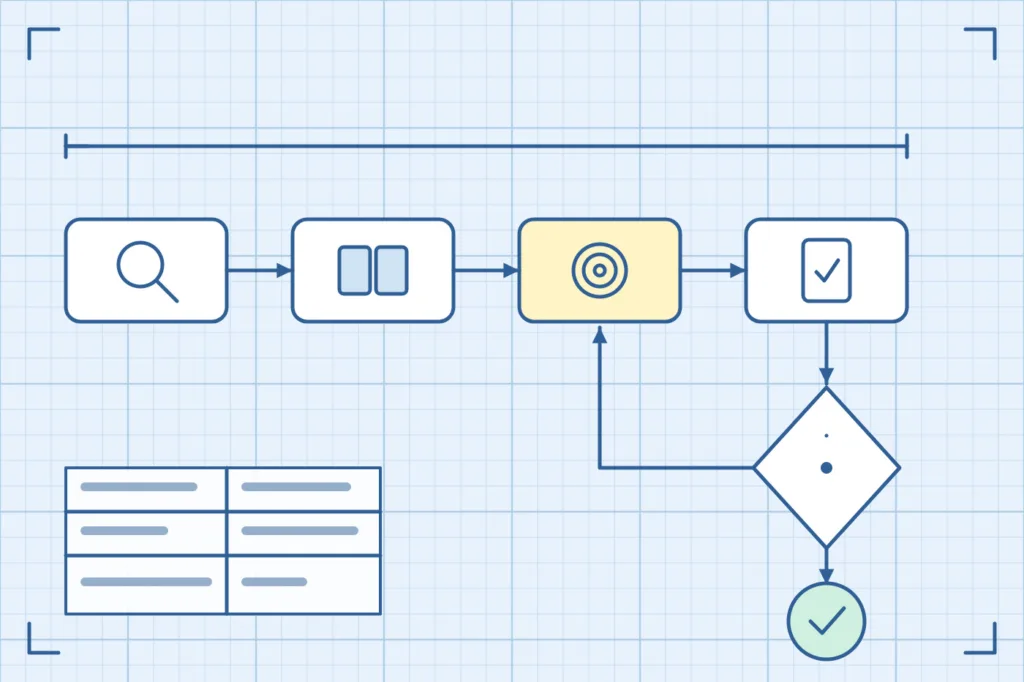
- Write the competency as an observable task. Use a verb, a condition and a standard.
- List the performance criteria. Keep it to five or six, so assessors can use them live.
- Pre-assess. A short check lets experienced learners skip content they already know.
- Teaching through practice incorporated into lessons. The learner needs to practice the task prior to assessment.
- Assess by observation. Use a checklist and a named assessor.
- Outline the “not yet” path. Provide feedback, practice time, and reassess on another day.
- Record and renew. Keep the evidence and diary the refresh date.
The competency-based loop. A learner who is not yet competent returns to practice, not to the start of the course.
Step six, however, is where logistics come into play. Learners marked as “not yet” require scheduling of another session with an assessor, as well as a location. Without any process in place, such learners get lost somewhere down the pipeline. Using scheduling softwarecan help you schedule them within a matter of days.
Where does competency-based training go wrong?
The model is strong, but it is easy to get wrong. In our view, four traps cause most failures.
- Ticking from memory. The assessor fills in the checklist later, instead of watching live.
- Assessor drift. Certificates have different meanings due to differences in the pass marks assigned by two different assessors.
- Teaching for assessment. Trainees just practice the tasks being assessed instead of the whole task.
- No way back. Learners who fail once have no clear route to a retry.
Each trap can be cheaply remedied. Review live, run a brief calibration exercise quarterly, create one additional unplanned scenario, and document your re-assessment process. The WGU case demonstrates the idea, since no poor score can be hidden by high scores.
Competency training will be credible only to the extent that its weakest assessor is credible. You will be judged based on the poorest certificate you issue, not the best. That is why you should train your assessors first.
What should you do next?
Choose one of your existing courses. Write down three to five competencies for the course with action verbs that can be easily observed followed by an assessment and a follow-up assessment date for those not ready.
If your courses are classroom based, you have more administrative burdens to add – assessor logs, re-assessments, and registrations. SimpliTrain is our own platform for training providers. It handles that logistics layer, including scheduling sessions and assessors, instructor and resource management, registrations and reminders. See how it works for training providers, or look at our instructor-led training system.
FAQs
1. Is competency-based training the same as skills-based training?
Skill-based training develops a particular skill while competency-based training considers the overall situation. Competency-based training establishes performance criteria in terms of knowledge, skills and behaviors of a person and then assesses the learner against them. In other words, the skill is usually a component of the competency.
2. What is “not yet competent”?
The learner has not produced all the required evidence yet. It is a status rather than failure. The learner receives feedback, more practice and further assessment. Many vocational systems use the terms “competent” and “not yet competent” instead of percentages since there is a standard which is valid for all.
3. How long does competency-based training last?
It varies from person to person. Those who have any experience before may pass the pre-assessment and finish soon. While others will require more time for practice and further assessment. It is better not to give an exact time period.
4. Can you conduct competency-based training in a classroom?
Yes. In most classroom training programs, a practical station or observed task is added at the end. Maintain low assessor ratio so that each learner is observed. Use checklist and sign off the day if possible. Include a brief re-assessment period for those who are not ready.
5. What documents should you retain?
Retain the documents that prove each sign-off. OSHA’s forklift training requirements provide a good example: the certificate contains the name of the operator, the date of training and evaluation, and the person who conducted them.
6. Is competency-based training more costly to implement?
Yes, since the assessors have to observe each learner. However, the pre-assessment allows learners to skip material that they already know.