




Key Takeaways
- Experiential learning focuses on learning by doing rather than passive consumption.
- Knowledge retention can reach 75–90% with experiential learning methods. (isEazy)
- Immersive technologies like VR and AR are transforming corporate training.
- Simulations allow employees to practice real-world challenges safely.
- AI-driven learning platforms are enabling adaptive and personalized experiences.
- Experiential learning is becoming essential for future-ready workforce development.
- The Future of Experiential Learning: Beyond Video Courses
Introduction
For years, video-based courses have dominated corporate training. Organizations relied on recorded lectures, webinars, and static modules to deliver knowledge at scale. While video learning improved accessibility, it often failed to create deep skill development or long-term knowledge retention.
Today, organizations are moving toward experiential learning, a training model that prioritizes learning through practice, simulations, and real-world problem-solving. Instead of passively watching content, learners actively participate in experiences that mirror workplace challenges.
This shift reflects a broader transformation in how people learn in the modern workplace. With the rise of immersive technologies, AI-driven simulations, and collaborative learning platforms, experiential learning is quickly becoming the cornerstone of next-generation workforce development.
Experiential learning emphasizes “learning by doing,” allowing employees to practice skills in realistic environments rather than just studying theory.
Passive learning delivers information, but experience builds capability. The future of training lies in participation, not observation.
Why Traditional Video Courses Are No Longer Enough
Video-based learning platforms make training scalable, but they often struggle to drive real behavioral change. Watching a course about negotiation, leadership, or safety procedures rarely prepares employees for the complexity of real-world situations.
Modern workplaces demand skills like critical thinking, decision-making under pressure, and collaboration. These competencies are difficult to develop through passive content alone.
Experiential learning bridges this gap by placing learners in interactive scenarios where they must make decisions, solve problems, and reflect on outcomes.
Examples include:
- Business simulations
- Scenario-based training
- Role-playing exercises
- Interactive labs and projects
These methods allow employees to practice applying knowledge in environments that replicate real workplace challenges.
Watching a concept teaches theory. Applying it in practice builds real workplace confidence.
The Rise of Immersive Learning Technologies
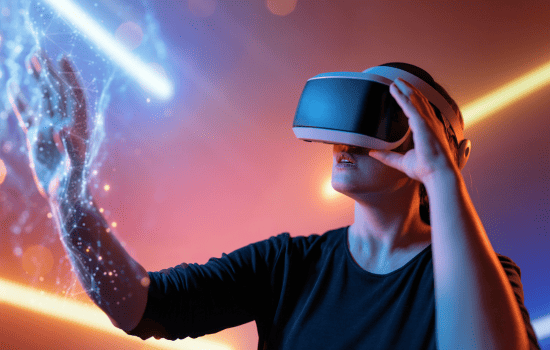
One of the biggest drivers of experiential learning is the emergence of immersive technologies such as virtual reality (VR), augmented reality (AR), and mixed reality (MR). These tools enable organizations to recreate realistic environments where employees can practice tasks safely and repeatedly.
For example:
- Manufacturing teams train on equipment using VR simulations.
- Sales professionals practice negotiation scenarios with virtual customers.
- Healthcare professionals rehearse procedures in immersive environments.
Immersive technologies enable learners to experiment, make mistakes, and improve without risking real-world consequences.
Additionally, research highlights how VR and AR environments provide interactive and immersive learning experiences that transform traditional training models.
Immersive learning transforms training from observation into experience. Learners step inside the lesson rather than watching from the outside.
Simulations and Scenario-Based Learning
Beyond immersive technology, simulations are becoming a powerful experiential learning strategy. Simulations replicate complex business situations and require learners to make decisions that influence outcomes.
For instance, leadership simulations might challenge managers to:
- Handle employee conflicts
- Manage budget constraints
- Respond to organizational change
Similarly, customer service simulations allow employees to practice difficult conversations with virtual customers.
These environments create a safe space for experimentation, allowing learners to test strategies without risking real-world consequences.
Simulation-based training also enhances self-awareness because participants can analyze their decisions and learn from mistakes.
Simulations turn learning into experimentation. Mistakes become lessons instead of costly failures.
The Role of AI in Experiential Learning
Artificial intelligence is accelerating the evolution of experiential learning. AI-powered learning systems can now create dynamic training environments that adapt to individual learners.
AI can:
- Personalize simulation difficulty levels
- Provide real-time coaching feedback
- Generate scenario-based learning modules
- Analyze learner behavior and performance
Some advanced platforms even combine AI with digital twins and immersive environments to create personalized training experiences tailored to each learner’s progress.
This adaptive approach ensures learners remain challenged while receiving the support they need to improve.
Instead of static training programs, organizations can deliver continuously evolving learning experiences driven by real-time data.
AI makes experiential learning intelligent and adaptive. Training evolves alongside the learner’s progress.
Experiential Learning and Workforce Development
Experiential learning is not only improving individual training outcomes, it is reshaping how organizations approach workforce development.
Companies that prioritize experiential learning cultures often see improvements in innovation, collaboration, and productivity.
Employees develop:
- Stronger decision-making skills
- Greater confidence in applying knowledge
- Improved teamwork and communication
- Higher engagement with learning programs
Organizations also benefit from faster skill development cycles and improved training ROI.
Additionally, 87% of organizations now use experiential learning in some form, reflecting its growing importance in modern L&D strategies.
Experiential learning develops not just skills but workplace readiness. It prepares employees for the complexity of real business challenges.
The Future: From Learning Platforms to Experience Platforms
The next evolution of corporate learning will move beyond traditional Learning Management Systems toward Learning Experience Platforms (LXPs) and immersive training ecosystems.
Future learning environments will likely include:
- AI-powered scenario simulations
- VR-based training environments
- Collaborative virtual classrooms
- Real-time performance analytics
- Digital twin simulations for technical training
These technologies will transform training from linear courses into interactive learning journeys.
Instead of completing modules, learners will engage in experiences that continuously evolve based on their goals, roles, and performance.
Training platforms will evolve into experience ecosystems. Learning will become continuous, immersive, and deeply personalized.
Conclusion
The future of corporate learning is moving beyond static video courses toward dynamic, experienced-driven training models. As organizations face rapid technological change and evolving skill demands, experiential learning provides a powerful solution for building practical capabilities.
By combining immersive technologies, simulations, and AI-driven learning systems, companies can create training environments that mirror real-world challenges and accelerate skill development.
In the coming years, the most effective learning strategies will not be defined by how much information employees consume, but by how effectively they practice, experiment, and apply what they learn.
Experiential learning is no longer a supplement to corporate training. It is quickly becoming the foundation of the future workforce.