





A Practical Guide to AI-Powered Training for L&D Teams
Executive Summary
AI-powered training has moved from experimentation to execution for learning and development (L&D) teams. In 2025, organizations across industries tested artificial intelligence in corporate training—from personalized learning paths and skill-gap analysis to predictive analytics and learner engagement tools. The results were mixed, not because AI lacked potential, but because many implementations lacked clarity, readiness, and human-centered design.
This practical guide is written for L&D leaders who want to move beyond AI hype and understand how to apply AI-powered training effectively. It draws on real-world lessons from 2025.
More importantly, it outlines how organizations can apply these insights in 2026 to build ethical, effective, and human-centered learning ecosystems.
Key takeaway: AI does not improve learning by default—it delivers value only when applied intentionally, supported by quality data, and guided by human expertise.
AI in Corporate Training: A Reality Check in 2025
For many organizations, 2025 served as a reality check for AI adoption in workplace learning. While AI-powered LMSs, LXPs, and analytics tools promised transformation, results varied widely depending on strategy and execution.
Common observations across L&D teams included:
- Broad AI deployments without clear learning goals failed to deliver measurable ROI
- Learners responded positively to relevant, contextual personalization—but disengaged when automation felt excessive
- AI delivered the most impact when it supported instructors, coaches, and managers rather than attempting to replace them
These insights reshaped how organizations approached AI in training, setting the foundation for more focused and responsible adoption in 2026.
Targeted AI Use Cases Delivered Measurable Impact
One of the most important lessons from 2025 was clear: AI works best when applied to specific, high-impact learning problems. Organizations that defined targeted use cases saw measurable improvements across key training outcomes.
High-performing AI use cases included:
- Personalized onboarding: AI-driven learning paths reduced time-to-productivity and improved new-hire engagement
- Skill-gap analysis: Predictive analytics identified individual and organizational skill gaps, enabling targeted upskilling
- Learner engagement: Intelligent content recommendations increased completion rates for role-relevant courses
In contrast, generic or overly ambitious AI implementations often underperformed, reinforcing the importance of focus and intent.
Generic or overly broad AI implementations, by contrast, often overpromised and underdelivered, reinforcing the importance of focus.
Why Data Quality Mattered More Than AI Complexity
Another critical takeaway from 2025 was that data readiness outweighed algorithm sophistication. Even advanced AI models struggled when underlying data was incomplete, unstructured, or misaligned with learning objectives.
Organizations that succeeded invested in:
- Clean, up-to-date learner profiles
- Well-structured and tagged learning content
- Clearly defined competency frameworks and learning goals
In practice, strong data foundations consistently delivered better outcomes than complex AI features deployed without preparation.
Key Lessons L&D Leaders Learned in 2025
Reflecting on AI adoption across corporate training environments, several consistent lessons emerged:
- Personalization only works when content is relevant – irrelevant recommendations quickly erode learner trust
- AI analytics empower better leadership decisions – visibility into skill development supports smarter workforce planning
- Learners value guidance over automation – human interaction remains central to engagement and motivation
- AI complements instructors, it does not replace them – subject-matter expertise and coaching drive real learning outcomes
These lessons reinforce a critical truth: AI is a powerful tool, but it cannot replace thoughtful learning design.
How L&D Teams Can Apply AI Lessons in 2026
As organizations move into 2026, successful AI-powered training strategies will prioritize intentionality, ethics, and alignment with business outcomes.
Key strategic actions include:
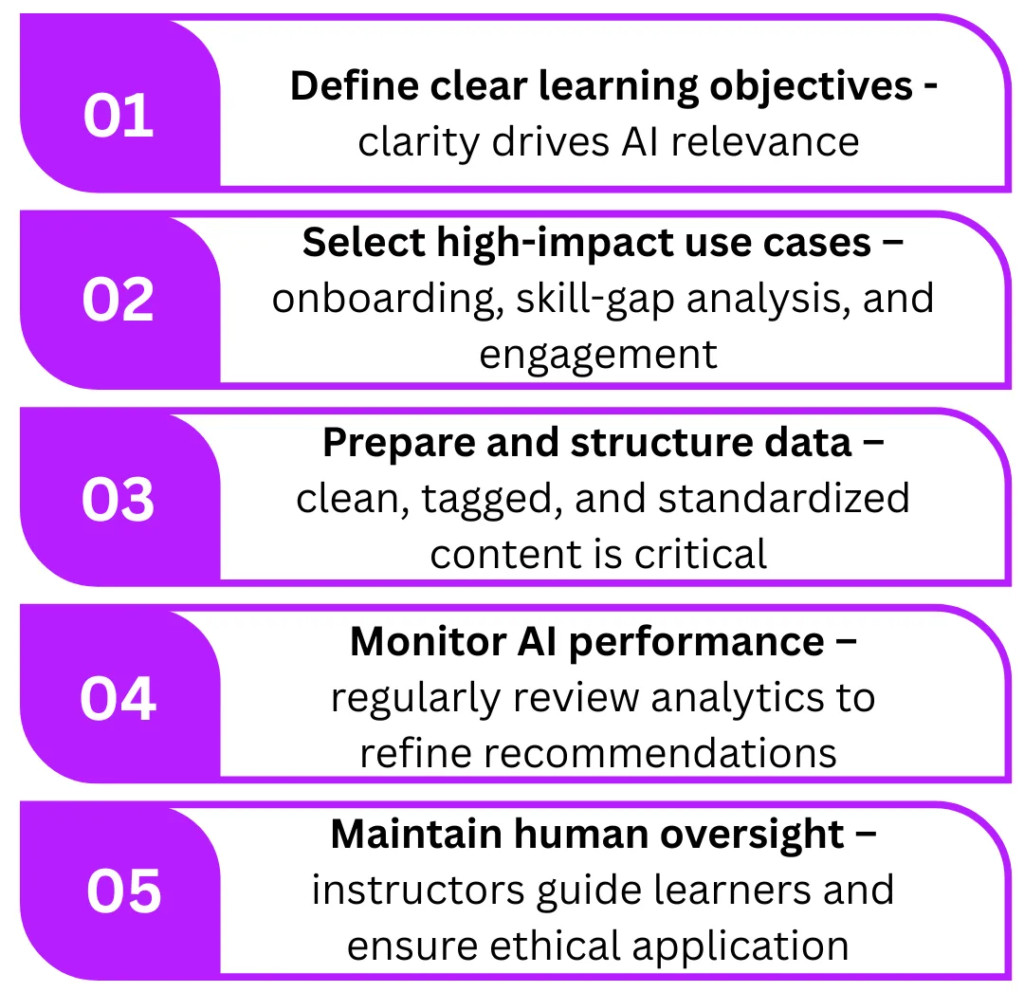
- Defining clear learning objectives before enabling AI-driven features
- Using personalization and predictive analytics to address specific skill gaps
- Investing in data hygiene, governance, and content tagging
- Combining AI insights with human judgment to maintain relevance and trust
Ethical considerations must remain central—transparency, data privacy, and fairness should guide every AI implementation.
Practical Recommendations for Organizations
To translate lessons from 2025 into results in 2026, organizations should:
- Start with 2 – 3 high-impact AI use cases aligned to business goals
- Audit learner and content data before scaling AI initiatives
- Train instructors and managers to interpret and act on AI insights
- Establish ethical AI guidelines for learning and talent decisions
- Measure success using business-aligned KPIs, not vanity metrics
When implemented thoughtfully, AI becomes a strategic enabler rather than a risky experiment.
To apply 2025 learnings in 2026, organizations should:
Intentional AI Is the Future of Workplace Learning
The lessons from 2025 are clear: AI delivers value in corporate training only when applied with purpose, supported by quality data, and guided by human expertise. Organizations that adopted AI strategically saw measurable improvements in engagement, skill development and decision-making.
As L&D teams look ahead to 2026, the path forward is intentional, ethical, and human-centred AI adoption. Those who balance technology with thoughtful learning design will build smarter, more resilient learning ecosystems.
AI in 2026 will not replace people—it will empower learners, instructors, and organizations to achieve more together.