






Executive Summary
AI-powered training emerged as a priority for learning and development teams seeking to scale skills and personalize learning in 2025. Organizations adopted artificial intelligence to personalize learning, automate recommendations, and gain deeper insight into learner performance. While some initiatives delivered measurable improvements in engagement and skill development, many others fell short of expectations.
The key lesson from AI-powered training in 2025 is clear: AI does not improve learning outcomes on its own. Organizations that succeeded treated AI as a support system for learners and instructors, while those that failed relied too heavily on automation and underestimated the importance of change management, trust, and learning design.
This article breaks down the most effective and ineffective AI training approaches and explains how businesses can turn these lessons into scalable, human-centered training strategies for 2026.
Introduction: AI-Powered Training Meets Reality
As AI adoption accelerated across corporate learning and development in 2025, expectations were high. AI-powered training platforms promised faster upskilling, personalized learning paths, and predictive analytics to close skill gaps.
However, 2025 became a reality check for many organizations. While AI-enabled learning delivered value in some cases, others experienced low adoption, disengaged learners, and concerns around transparency and ethics.
AI proved to be a powerful tool but not a shortcut to effective learning.
When Automation Helps and When It Hurts in AI-Powered Training
One of the most important lessons from AI-powered training in 2025 was the impact of automation on learner engagement. AI performs well when it analyzes data and provides guidance, but over-automation often reduced motivation and trust.
What Worked in AI-Powered Training
- AI-guided content recommendations based on learner behavior
- Adaptive pacing suggestions that respected individual learning speed
- Smart reminders and nudges that supported consistency without pressure
What Failed in 2025
- Fully automated learning journeys with no learner choice
- Excessive notifications that overwhelmed learners
- Removing instructors entirely from the learning experience
Learners responded positively when AI supported decision-making rather than controlling it. The most effective AI-powered training programs focused on guidance, not enforcement.
The Role of Change Management in AI Adoption
Many organizations struggled with AI-powered training because they treated AI adoption as a technology rollout rather than a change management initiative.
Successful AI training programs in 2025 shared several characteristics:
- Clear communication about why AI was introduced
- Structured onboarding for learners and instructors
- Training on how to interpret AI recommendations and insights
- Continuous feedback loops to improve adoption
Instructor enablement played a critical role. When instructors understood how AI worked and trusted its recommendations, they were more likely to reinforce adoption and learner confidence.
Core Lessons from AI-Powered Training in 2025
1. AI Works Best as a Learning Support System
AI delivers the most value when it enhances learning decisions instead of replacing human judgment. Human oversight remains essential for context, motivation, and ethical decision-making.
2. Transparency Builds Learner Trust
Learners are more likely to engage with AI-powered training when they understand:
- Why specific content is recommended
- How learner data is collected and used
- What AI can and cannot do
Transparency reduces resistance and increases confidence in AI-driven learning systems.
3. Instructor Enablement Is Critical
AI does not replace instructors; it amplifies their impact. Instructors remain essential for:
- Contextual guidance and coaching
- Learner motivation and accountability
- Ethical oversight of AI-driven decisions
4. Simpler AI Features Often Deliver Better Results
In 2025, basic AI capabilities such as progress insights, skill-gap indicators, and smart recommendations often outperformed complex automation.
Common Mistakes Organizations Must Avoid in 2026
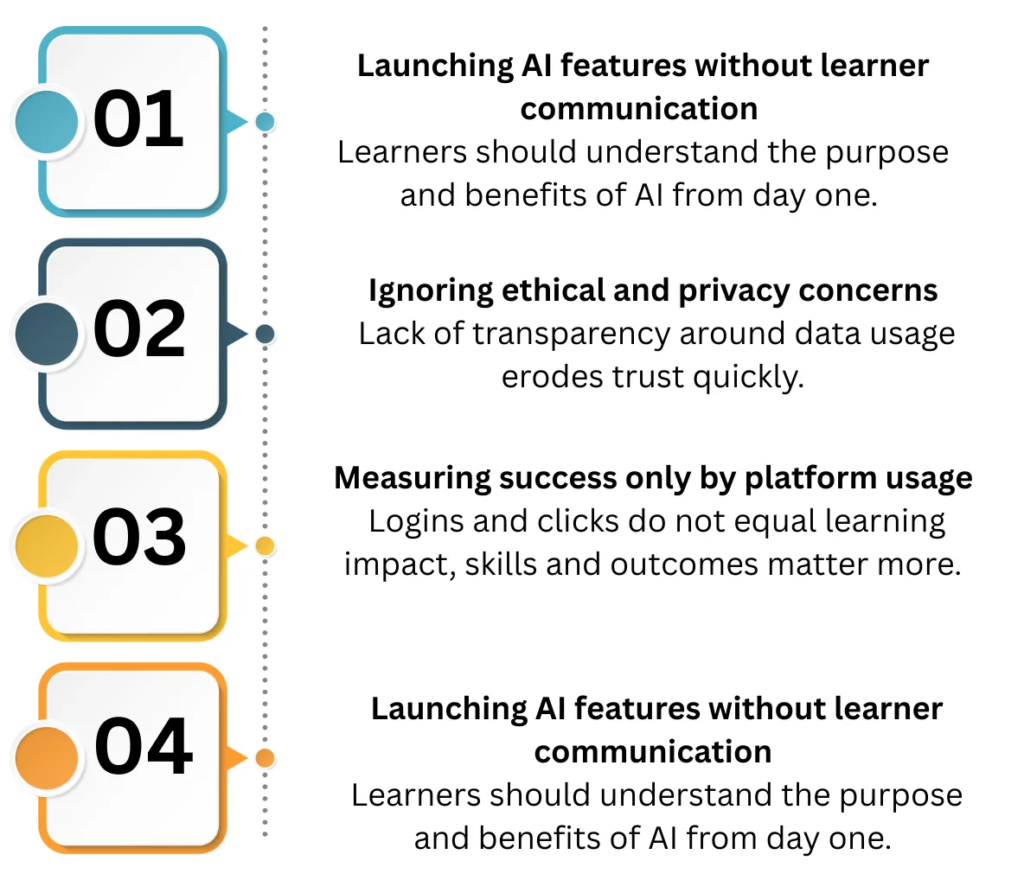
The failures of AI-powered training in 2025 offer clear warnings for the future. Organizations should avoid the following mistakes:
- Over-automating learning experiences without learner autonomy
- Treating AI as a replacement for instructors, rather than a support tool
- Ignoring data quality, leading to inaccurate or biased recommendations
- Lack of governance and ethical oversight for AI systems
- Insufficient change management, resulting in low adoption
- Deploying AI without transparency, eroding learner trust
The fastest way to fail with AI-powered training is to deploy it without empathy, ethics, and human oversight.
How to Build AI-Powered Training Programs That Work in 2026
Organizations that apply the lessons from 2025 should focus on balanced AI integration:
- Design AI to support learning goals, not drive them
- Preserve learner choice and autonomy
- Use AI insights to inform instructors, not replace them
- Start with high-impact, low-complexity use cases
Strong learning design remains the foundation of effective training. AI enhances learning outcomes only when content is relevant, well-structured, and aligned with real business skill needs.
Preparing for 2026: Organizational Readiness for AI in L&D
Success with AI-powered training in 2026 will depend on organizational readiness, including:
- L&D teams with a clear understanding of AI capabilities and limitations
- Defined governance and ethical guidelines for AI use
- Clean, well-structured learning data
- Alignment between learning, HR, and business strategy
Organizations that treat AI as a strategic enabler—not just a feature—will achieve sustainable results.
Conclusion: Technology Plus Design Drives Learning Impact
The lessons learned from AI-powered training in 2025 make one thing clear: AI alone does not create better learning experiences. Meaningful impact comes from the thoughtful combination of technology, human expertise, ethical practices, and strong learning design.
As organizations move into 2026, those that apply AI intentionally—focusing on support, transparency, and readiness—will build AI-powered training programs that are effective, trusted, and future-ready.
AI-powered training will succeed not because it is intelligent, but because it is human-centered.