





Training companies expanding internationally usually plan for the parts that are visible: translating content, hiring in new markets, finding local instructors or franchise partners. What catches most of them off guard is the part that isn’t visible until it becomes a problem, regulatory fragmentation. Market research shows Asia-Pacific is the fastest-growing region for compliance training, projected at roughly 8.2% annual growth through 2033, driven partly by rising foreign direct investment and tightening regulatory requirements across markets like India, China, and Japan. Growth and regulatory complexity are rising together, not one at the expense of the other, and a training company scaling into new regions has to solve for both at once.
What Global Expansion Actually Requires
Content, engagement, and interactivity matter, but they’re not what determines whether global expansion succeeds or creates a legal headache. A localization specialist puts it plainly: training materials that are fully compliant in one country can create real legal exposure in another, since data protection, labor law, and workplace safety requirements differ by region. A training program built around US data handling assumptions, for example, may not hold up against GDPR requirements once it’s delivered to learners in the EU, and that gap doesn’t show up until an audit or a complaint forces the issue.
Europe alone accounts for roughly a quarter of the global e-learning compliance training market, with GDPR compliance and comprehensive labor protections cited as major drivers of adoption, which underscores how much of the “global expansion” problem is really a regulatory-consistency problem wearing a training hat.
Supporting Learners Across the Globe
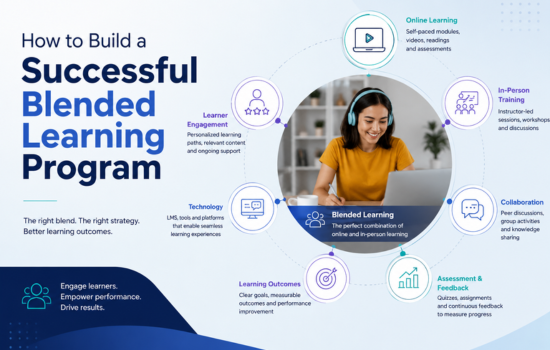
Once the regulatory foundation is right, the learner experience layer is what determines whether training actually lands. Personalized learning paths let learners in different regions and roles progress at their own pace rather than following a single generic sequence, with analytics giving instructors visibility into where individual learners are struggling. Supporting a range of content formats, video, quizzes, interactive simulations, matters more across a global learner base than a single-market one, since preferences for self-paced versus instructor-led delivery vary meaningfully by region and culture.
Empowering Franchisee Partners Without Losing Control
Franchising is a common way training companies scale internationally without directly hiring in every new market, but it introduces a real tension: how do you maintain consistent quality and brand standards while giving local partners the flexibility to operate within their own regulatory environment?
Centralized franchisee management addresses this directly by keeping onboarding, training, performance monitoring, and material updates in one system that every franchisee draws from, rather than each location maintaining its own local copy that gradually drifts out of sync with the original. Performance analytics layered on top let a parent company identify which franchisees are excelling and which need support, using the metrics that actually reflect performance rather than surface-level activity counts.
A Real Example: Expanding Into a Regulated New Market
A SimpliTrain case study illustrates exactly this tension in practice. A global training franchise expanding into a new country faced stricter local regulations than its existing markets, while needing to preserve its established brand identity, training methods, and quality standards. The solution centered on curriculum customization that let local requirements be layered onto the core program without rebuilding it from scratch, compliance tracking specific to the new market’s regulations, and centralized management that kept the parent company’s oversight intact throughout the expansion. That’s the actual shape of a successful global expansion: local flexibility built on top of centralized control, not a choice between the two.
Simplifying Training Center Management
Beyond franchisee relationships, physically running training centers across multiple countries adds its own layer of operational complexity, scheduling, staffing, resource allocation, and facility management all multiply with each new location. A center management system that integrates these into one platform means center managers spend less time on logistics and more time on training quality, and it means a company running centers in five countries can see all five from a single administrative view rather than piecing together separate local reports.
This also extends to how staff collaborate across centers. Shared information and coordinated planning between locations, even ones separated by both distance and time zone, tend to produce more consistent outcomes than centers operating as fully independent units that happen to share a brand name.
Global Expansion Challenges and How a Unified Platform Addresses Them
| Challenge | How It’s Addressed |
|---|---|
| Regulatory fragmentation across countries | Region-specific compliance tracking layered onto a centrally managed core curriculum |
| Franchisee quality and brand consistency | Centralized franchisee management with performance analytics per location |
| Multi-country training center operations | A single administrative view across scheduling, staffing, and facilities |
| Language and cultural relevance | Multi-language and localization support built into content delivery |
| Brand consistency with local flexibility | Customizable curriculum and interface that preserves core standards while adapting to local needs |
What This Looks Like With SimpliTrain
SimpliTrain brings franchisee management, center management, learner engagement, and compliance tracking into one platform rather than requiring a training company to stitch together separate tools for each. Curriculum customization lets local requirements sit on top of a consistent core program, multi-language and localization support extends reach without fragmenting administration, and performance analytics give leadership visibility across every market from a single view. That combination is what lets a training company treat global expansion as a scaling problem to solve rather than a series of one-off local exceptions to manage.
SimpliTrain combines franchisee management, center management, and compliance tracking in one platform, so training companies can expand into new, regulated markets without losing centralized control over quality and brand consistency. Book a demo to see how it supports your specific expansion plans.